periodical issue
Freedom First
By Rabindranath Tagore, Arvind Deshpande, K. F. Rustomji
Published by J. R. Patel for the Indian Committee for Cultural Freedom, 3rd Floor, Army & Navy Building, 148, Mahatma Gandhi Road, Mumbai 400 001; printed by him at Kaiser-E-Hind Private Ltd., 300, Perin Nariman Street, Mumbai 400 001 · Mumbai · 2000
52 pages
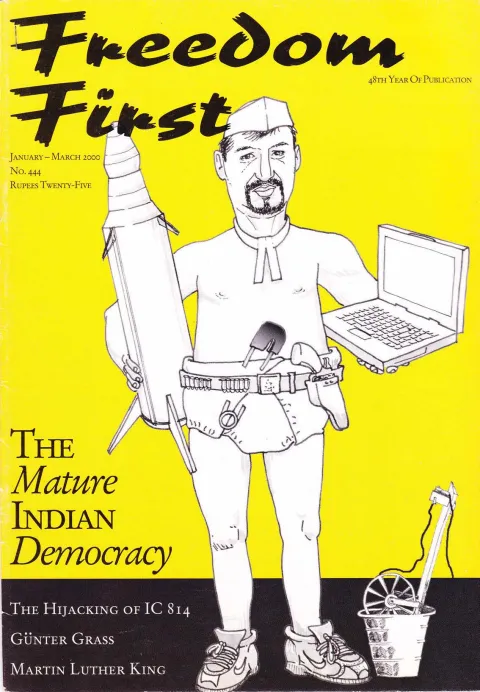
Freedom First
Summary
Freedom First No. 444 (January-March 2000), the 48th year of publication, is edited by S. V. Raju for the Indian Committee for Cultural Freedom. Its cover feature is a multi-contributor symposium, ‘The Mature Indian Democracy,’ assembled from a Freedom First-sponsored half-day discussion held on December 18, 1999, plus written reader contributions, on whether fifty years after independence India qualifies as a mature democracy — or a democracy at all. In the rendered pages, roughly two dozen contributors (academics, retired civil servants and police officers, journalists, and readers) weigh in with sharply divided views: some stress gains in life expectancy, literacy, and the peaceful transfer of power through a fractured multi-party Lok Sabha; most catalogue continuing failures — caste-based and money-driven elections, subverted institutions, police ‘encounter’ killings, corruption immune from prosecution, resurgent sectarianism and casteism, and a widening gap between constitutional promise and lived reality for the poor. The issue’s regular front-matter features (‘With Many Voices,’ a page of press quotations, and ‘Of Cabbages and Kings,’ the editor’s column) address related contemporary controversies: the mobbing of filmmaker Deepa Mehta’s ‘Water’ shoot in Varanasi by Hindu-nationalist groups, VIP traffic disruptions in Bangalore, and the ethics of taxi and public-sector strikes. The rendered pages also carry a translated Rabindranath Tagore poem (‘False Religion’) and open a second symposium on the 1999 Lok Sabha elections (‘Of Elections and Electioneering’), with pieces on electoral arithmetic, caste-based candidate selection, and the NDA-versus-Congress contest between Vajpayee and Sonia Gandhi.
Key points
-
The cover symposium “THE Mature Indian Democracy”, retitled from “maturing” after contributors disputed whether India even qualifies as a democracy, assembles roughly two dozen contributors: J. B. D’Souza argues fifty years of franchise have changed little for India’s rural poor, using the recurring figure of a tribal woman named Somiya, and catalogues institutional decay including police encounter killings and impunity for criminal-politicians.
-
Arvind Deshpande and Nagindas Sanghvi argue Indian society itself remains fundamentally undemocratic beneath its political institutions, citing persistent caste and rising communal xenophobia, while V. K. Sinha and K. F. Rustomji take a more optimistic view, citing halved infant mortality and doubled life expectancy.
-
N. Namasivayam and Mohamed Jaffar invoke Ambedkar’s 1949 warning that mere political democracy is meaningless without social and economic democracy, and tabulate defaulting ex-prime ministers’ unpaid Air Force dues.
-
A companion symposium, “Of Elections and Electioneering”, analyses the 1999 Lok Sabha elections, covering caste- and money-driven candidate selection in Maharashtra and the NDA’s Kargil-driven mandate against the “videshi” (foreign-origin) controversy around Sonia Gandhi.
-
The “Of Cabbages and Kings” column, titled “Mobocracy on the Rise”, criticises the Hindu-fundamentalist mob that drove filmmaker Deepa Mehta from Varanasi during the shoot of “Water” despite official clearance, and the NDA coalition’s muted response.
-
A translated Rabindranath Tagore poem, “False Religion”, also appears in the rendered pages.
Essays
Many Voices
A page of quotations from the Indian and international press and public figures (film actress Madhuri Dixit, Masood Azhar, Laloo Prasad Yadav, C. R. Irani, Prem Shankar Jha, Tavleen Singh, V. P. Singh, N. S. Venkatraman, Swagato Ganguly, James Gardner, Saeed Mirza, and Ashok Chowgule, among others), spanning topics from the Kashmir hijacking and Deepa Mehta’s ‘Water’ controversy to Indian bureaucratic culture and the treatment of Nobel literature laureates.
- Compiles topical quotations from late-1999/early-2000 Indian and international media on politics, religion, and culture.
- Includes Masood Azhar’s post-release remarks on the IC 814 hijack and jihad in Kashmir.
- Includes commentary on Deepa Mehta’s ‘Water’ shoot and communal reactions to it from Ashok Chowgule of the Viswa Hindu Parishad.
- Includes former PM V. P. Singh on the need to balance redressing past injustice without inflicting new ones.
Of Cabbages & Kings
S. V. Raju’s editorial column ‘Of Cabbages and Kings’ opens with ‘Mobocracy on the Rise,’ criticising the Hindu-fundamentalist mob that drove Deepa Mehta and her crew out of Varanasi during the shoot of ‘Water,’ and the BJP-led coalition’s tacit tolerance of VHP and Bajrang Dal disruption despite formal official ‘clearance’ for the film. It proceeds to ‘VIP Nuisance,’ documenting how routine VIP movements shut down Bangalore traffic for hours, and ‘When Strikes are Not Justified,’ arguing that a three-day Mumbai taxi and auto-rickshaw strike against a pollution-control court order, and a public-sector strike against privatisation, were not legitimate exercises of the right to strike. A closing note acknowledges an earlier oversight in crediting ‘Liberal Times’ and the Friedrich Naumann Foundation for an article on unstable governments.
- Criticises the driving-out of filmmaker Deepa Mehta from Varanasi by Hindu-fundamentalist groups despite official film clearance.
- Notes the muted reaction from NDA coalition partners to the assault on freedom of expression.
- Describes VIP-related traffic disruption in Bangalore as an entrenched, officially ‘regularised’ abuse.
- Argues the Mumbai taxi/auto-rickshaw strike against a pollution-compliance order, and a public-sector anti-privatisation strike, were illegitimate uses of the strike weapon.
- Corrects an earlier omission: acknowledges ‘Liberal Times’ (Friedrich Naumann Foundation, Delhi) as source of an October-December 1999 Freedom First article by Gerhart Raichle.
THE Mature INDIAN Democracy
The cover symposium ‘THE Mature Indian Democracy’ (retitled from ‘The Maturing of Indian Democracy’ after contributors disputed whether India was even a democracy) opens with an editor’s framing note referencing K. M. Munshi’s ‘Pilgrimage to Freedom’ memoirs, then presents a summary of the December 18, 1999 discussion led by Dr. B. N. Colabawalla, followed by roughly twenty individually bylined short pieces. Contributors sharply disagree: J. B. D’Souza (‘Do We Qualify to be called a Democracy?’) uses the image of a poor Katkari tribal woman, Somiya, encountered fifty years apart, to argue universal franchise has delivered little to India’s poor, and that institutional decay — police ‘encounter’ killings, politicised courts and civil service, impunity for the powerful (citing Phoolan Devi, Laloo Prasad Yadav, Narasimha Rao, Bal Thackeray, Jayalalitha) — has left India’s democratic claims hollow. Arvind Deshpande (‘Mature Democracy - An Overstatement’) and Nagindas Sanghvi (‘Planting Democracy on an Undemocratic Soil’) argue Indian society itself remains fundamentally undemocratic and unequal, citing rising xenophobia and the persistence of caste. V. K. Sinha (‘A Question of Perspective’) and K. F. Rustomji (‘It is Not all that Bad’) take the more optimistic view, citing halved infant mortality, doubled life expectancy, and India’s comparative stability against Myanmar, Sri Lanka, Pakistan, and Afghanistan. Yogesh Kamdar warns of a ‘Return to Tribalism’ via regional and caste sectarianism; N. Namasivayam and Mohamed Jaffar quote B. R. Ambedkar’s 1949 Constituent Assembly warning that political democracy is meaningless without social and economic democracy, and tabulate defaulting ex-prime ministers’ unpaid Air Force dues (Chandrashekhar, Narasimha Rao, Rajiv Gandhi, Deve Gowda). R. Srinivasan, Parvathi Vasudevan, and others discuss panchayat raj and education. A second sub-symposium, ‘Of Elections and Electioneering,’ covers the 1999 Lok Sabha elections: Nagindas Sanghvi and Usha Thakkar describe the entrenchment of multi-party, front-based politics; Sanjay Panse and S. S. Bankeshwar describe caste- and money-driven candidate selection and paid-for press coverage in Maharashtra, and the 1999 defeat of the Deve Gowda-led Janata Dal and the poor showing of BJP-baiting predictions; J. S. Apte and P. R. Dubhashi analyze the NDA’s Kargil-driven mandate and the ‘videshi’ (foreign-origin) controversy around Sonia Gandhi.
- Reframes the cover question from ‘maturing’ to ‘mature,’ reflecting contributor disagreement over whether India even qualifies as a democracy.
- J. B. D’Souza argues fifty years of franchise have not materially changed the lives of India’s rural poor, using the recurring figure of ‘Somiya.’
- Multiple contributors cite institutional decay: politicised judiciary and civil service, police encounter killings, and impunity for prominent criminal-politicians.
- Arvind Deshpande and Nagindas Sanghvi argue Indian society remains fundamentally undemocratic beneath its political institutions, citing caste and rising communal xenophobia.
- Optimistic voices (V. K. Sinha, K. F. Rustomji) point to gains in life expectancy, literacy, and comparative regional stability.
- N. Namasivayam and Mohamed Jaffar invoke Ambedkar’s 1949 warning against ‘mere political democracy’ and document ex-PMs’ unpaid dues to the exchequer.
- A companion piece analyzes the 1999 Lok Sabha elections, covering fractured coalition politics, caste-driven candidate selection, and the Vajpayee-versus-Sonia Gandhi ‘videshi’ debate.
Generated by the v1.5 extraction pipeline. Awaiting editorial review.
Metadata and summary are AI-extracted from the source PDF and reviewed for editorial accuracy. The original work is available via the Read PDF tab above (where present); paragraph-level citation inside the PDF is deferred to a future engagement.