periodical issue
Freedom First
A Liberal Quarterly
By Frédéric Bastiat, S. V. Raju
Published by J. R. Patel for the Indian Committee for Cultural Freedom and printed by him at Kaiser-E-Hind Private Ltd., 300, Perin Nariman Street, Mumbai 400 001. Publishers: Indian Committee for Cultural Freedom, 3rd Floor, Army & Navy Building, 148, Mahatma Gandhi Road, Mumbai 400 001. · Mumbai · 2001
56 pages
Freedom First
Summary
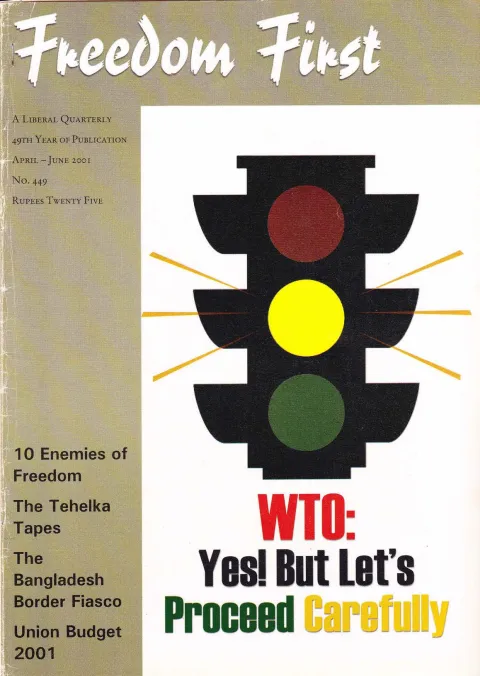
Freedom First No. 449 (April–June 2001), the 49th-year quarterly issue of the Bombay-based liberal magazine founded by Minoo Masani, leads with a cover feature, ‘WTO – Yes! But Let’s Proceed Carefully,’ making the case that India should stay in the WTO while negotiating its terms more carefully, with contributions on tariff liberalisation, agricultural exposure, and a call for expanded bilateral US-India trade relations from a Heritage Foundation analyst. In the rendered pages, the issue also runs obituary tributes to two figures central to Freedom First’s own history — columnist Behram ‘Busybee’ Contractor and former publisher B. K. Desai — an analysis of the Tehelka defence-bribery sting defending due process against a rush to judgment, and short pieces including a ‘With Many Voices’ page of quotations, the editor’s ‘Between Ourselves’ note, the ‘Of Cabbages and Kings’ miscellany column, and a piece on using India’s surplus foodgrain stocks productively during drought.
Key points
-
The cover feature “WTO - Yes! But Let’s Proceed Carefully” opens with A. Mohamed Jaffar’s primer explaining the WTO’s origins from GATT and stressing that its agreements do not require dismantling India’s Public Distribution System or food subsidies.
-
L. S. N. Prasad examines how globalisation and falling global commodity prices have exposed Indian agriculture’s structural weaknesses, citing Kerala farmer suicides linked to collapsing produce prices, and calls for freeing agriculture from state control and unifying India’s fragmented internal market.
-
Dana R. Dillon, a Heritage Foundation policy analyst, argues the Bush administration should build on WTO commitments with a comprehensive US-India bilateral trade agreement, citing India’s high average tariffs and restrictive foreign equity caps.
-
Ashok V. Karnik’s “The Tehelka Tapes - An Analysis” defends due process against a political and media rush to judgment following the defence-bribery sting, questioning the tapes’ editing and the ethics of publicising secretly recorded, unverified boasting as proven fact.
-
Obituary tributes mark the deaths of columnist Behram “Busybee” Contractor and B. K. Desai, Secretary of the Democratic Research Service and Freedom First’s publisher from 1959 to 1963, who later helped found the Shiv Sena before drifting away.
-
S. S. Bankeshwar’s “Using Surplus Food Stocks Profitably” laments the government’s silence on a Delhi School of Economics letter about India’s rotting foodgrain surplus, arguing the stocks should fund drought-relief income-generation schemes.
Essays
Between Ourselves
By The editor
The editor’s ‘Between Ourselves’ note, in the rendered pages, frames the WTO cover feature as a response to loose, uninformed anti-WTO sentiment shared even by ‘a majority of our lawmakers,’ and announces that the magazine will begin carrying the SRDD (Society for the Right to Die with Dignity) Newsletter as a regular section.
- Editor argues that opposition to the WTO in India comes largely from vested interests (trade unions, protected businessmen, patronage-dependent bureaucrats) unsettled by liberalisation
- States the issue’s WTO feature exists to educate readers on what the WTO actually involves
- Announces the SRDD Newsletter will now be folded into Freedom First for the foreseeable future
- Previews the next issue’s cover theme as a look at whether Indian voters still care, prompted by recent state assembly election results
- Sets a contribution deadline of Monday, July 23 for reader submissions
With Many Voices,
‘With Many Voices,’ in the rendered pages, is a page of topical quotations culled from the Indian and international press in early-to-mid April 2001, spanning Sam Pitroda on implementation failures, Sonia Gandhi on ‘an alliance of corrupt forces,’ Bill Clinton speaking at a UP village, Taliban leader Mullah Muhammad Omar on idol-breaking, and commentary from Tavleen Singh, Suraiya, and others.
- Compiles press quotations from mid-April 2001 across politics, religion, and culture
- Includes Sonia Gandhi criticising the ruling alliance as corrupt (The Sunday Times of India, April 22)
- Includes Bill Clinton’s remarks on Indian education delivered at a UP village (MID-DAY, April 9)
- Includes Taliban leader Mulah Muhammad Omar’s remark on idol-breakers vs. idol-sellers (The Week, March 18)
- Includes Tavleen Singh on the place of street-fighting tactics in the Lok Sabha (India Today, April 16)
Of Cabbages and Kings,
‘Of Cabbages and Kings,’ in the rendered pages, is the magazine’s recurring miscellany column covering a Tibetan protest against a visiting Chinese Communist Party delegation at Bombay’s Prince of Wales Museum, taxpayer-funded police security for gangsters and film stars, and the work of the Community Help Line, a Mumbai voluntary organisation founded by Mohandas Nathani to address educated unemployment.
- Reports Tibetan protestors detained by Colaba Police during a visit by CPC delegate Comrade Li Changchun to the Prince of Wales Museum on May 14
- Notes an earlier incident where Chinese consular pressure got a Tibetan women’s exhibition at SNDT closed early
- Criticises taxpayer-funded police security extended to associates of criminal gangs alongside film personalities like Salman Khan and Amitabh Bachchan
- Profiles the Community Help Line, whose founder Mohandas Nathani devotes daily hours to counselling educated unemployed youth away from drift into petty crime
s back matter as seen in the rendered pages: one for columnist Behram
By Two tribute obituaries open the issue
Two tribute obituaries open the issue’s back matter as seen in the rendered pages: one for columnist Behram ‘Busybee’ Contractor (October 11, 1930–April 9, 2001) by Manuwant Choudhary, recalling his ‘Round & About’ column and fictional characters like Bolshoi the Boxer; and one for B. K. Desai, Secretary of the Democratic Research Service and Freedom First’s publisher from 1959 to 1963, by S. V. Raju, describing Desai’s role educating the public on international communism and his later work with the World Marathi Parishad.
- Behram Contractor tribute recounts his three decades writing ‘Round & About’ across The Evening News of India, MID-DAY, and Afternoon
- Notes Contractor’s ethic that ‘corruption in journalism…is about knowing something and not writing about it,’ invoked regarding the Tehelka tapes
- B. K. Desai tribute credits Minoo Masani and Sardar Vallabhbhai Patel with founding the Democratic Research Service that Desai served as Secretary
- Describes Desai’s early writing under the pseudonym S. Sarangapani and his study of Chinese communism, including a paper titled ‘India, China and Tibet’
- Notes Desai’s later involvement founding the Shiv Sena alongside Balasaheb Thackeray before drifting away, and his subsequent work with the World Marathi Parishad
Understanding the WTO
By A. Mohammed Jaffar
Under the cover banner ‘WTO – Yes! But Let’s Proceed Carefully,’ A. Mohamed Jaffar’s ‘Understanding the WTO,’ in the rendered pages, is a primer explaining the WTO’s origins from the Uruguay Round and GATT, its institutional differences from GATT, and the tariff-reduction commitments India undertook — while stressing the agreement does not require changes to India’s Public Distribution System or food subsidies.
- WTO established January 1, 1995 as successor to GATT following the Uruguay Round, with 76 founding members including India
- Distinguishes WTO from GATT: WTO is a permanent institution with its own secretariat and full/permanent commitments, versus GATT’s provisional, goods-only rules
- India’s tariff-binding commitments rose from about 5% of tariff lines to roughly 68% under the UR agreement
- Cites industrial-country tariff cuts of about 30% versus India’s average tariff-weighted reduction of 40% (from 6.2% to 8.7% dutiable share reported in the piece)
- States explicitly that the WTO agreement does not require dismantling India’s PDS or food subsidy programmes
WTO Norms and Indian Agriculture
By L. S. N. Prasad
L. S. N. Prasad’s ‘WTO Norms and Indian Agriculture,’ in the rendered pages, examines how globalisation and falling global commodity prices have exposed the structural weaknesses of Indian farming — fragmented, indebted, poorly stored — even as it argues that freeing agriculture from state control and unifying India’s internal market are the more urgent reforms.
- Argues Indian agriculture had a comparative-advantage window in niche exports (organic produce, medicinal plants, hybrid seeds) that has eroded in the last 2-3 years amid a global commodity glut
- Contrasts India’s fragmented land tenure, poor storage/irrigation infrastructure, and indebtedness with the sector’s natural endowments of sunlight and water
- Includes a sidebar news item reporting farmer suicides in Kerala linked to collapsing produce prices, citing losses of Rs. 6,650 crores across 2000-2001 per a Kerala Agricultural Prices Board study
- Calls for ‘ousting the State from agriculture’ and privatising the sector, criticising state control over land leasing, input supply (fertilizer, pesticides), and produce disposal
- Advocates unifying India’s internal market by removing state-level barriers (district bans, state bans, zoning, levies), comparing India’s fragmentation unfavourably to European market integration
WTO and Indian Agriculture - Farmers Declaration
No summary was extracted for this article. Listed for completeness.
Using Surplus Food Stocks Profitably
By S. S. Bankeshwar
S. S. Bankeshwar’s ‘Using Surplus Food Stocks Profitably,’ in the rendered pages, is a numbered-point commentary lamenting the government’s silence on a Delhi School of Economics letter to the Prime Minister about India’s rotting foodgrain surplus, arguing the stocks should instead fund food-for-work and income-generation schemes for drought relief without adding to the budget deficit.
- Notes an April 2, 2001 DSE letter to PM Atal Bihari Vajpayee went unanswered and largely unreported except by Mainstream
- States wheat procurement alone is likely to exceed 15 million tonnes in the coming year, with roughly half at risk of rotting for lack of storage
- Argues using surplus stocks for income-generation programmes would not add to the budget deficit since the stocks are already purchased
- Criticises the Antyodaya programme for making no significant dent in surplus stocks or drought relief
- Calls for bold intervention at the highest level to avert ‘widespread deprivation and misery… amidst plenty’
Time for Expanded Trade Relations with India
By Dana R. Dillon
Dana R. Dillon’s ‘Time for Expanded Trade Relations with India,’ written by a Heritage Foundation Asian Studies Center policy analyst, argues in the rendered pages that the Bush administration should build on WTO commitments with a comprehensive bilateral trade agreement, citing India’s high tariff barriers, foreign equity caps in insurance and IT services, and the missed opportunity of the Clinton administration’s approach.
- Cites the Heritage Foundation/Wall Street Journal 2001 Index of Economic Efreedom ranking India in the bottom quintile of 161 countries, ‘mostly unfree’
- Notes average Indian tariffs near 30%, the highest in the noncommunist world per the piece
- Argues foreign equity caps of 26% in insurance discourage American investment in India’s ‘virtually vacant market’
- Highlights India’s IT sector, citing Lucent Technologies figures of about 280,000 Indians employed in IT and India’s ambitions to reach $50 billion in IT exports by 2008
- Concludes the Clinton administration failed to capitalise on India’s openness by insisting on labor/environmental standards, and urges the Bush administration to pursue a bilateral agreement instead
- Includes a reprinted WIPO arbitration panel decision (Tata Sons Ltd. v. D & V Enterprises) on the ‘bodacious-tatas.com’ domain dispute
The Tehelka Tapes - An Analysis
By Ashok V. Karnik
Ashok V. Karnik’s ‘The Tehelka Tapes – An Analysis,’ in the rendered pages, defends due process against what the author sees as an opportunistic political and media rush to judgment following the tehelka.com defence-bribery sting, arguing the scandal reflects the venality of a few officers and middlemen rather than any deep systemic rot, while also raising questions about the sting’s editing methods and journalistic ethics.
- Argues the Tehelka exposé shook the country more for the ‘blatant venality of a few senior officers’ than for revealing genuinely new facts
- Criticises the opposition (particularly Congress) for using the tapes to try to dislodge the government rather than debate its implications dispassionately
- Raises doubts about the tapes’ editing, asking what omitted portions might contain and whether deleted footage included officers who refused to cooperate
- Questions the ethics of publicising secretly recorded, unverified boasting as proven fact, comparing it to the earlier Kapil Dev/Manoj Prabhakar tehelka.com tapes where Kapil Dev was later exonerated
- Criticises middlemen R. K. Jain and R. K. Gupta specifically, noting Jain had already confessed to lying to inflate his commission claims
- Concludes that if mere allegations start bringing down governments, ‘democratic practices are still foreign to us’
Generated by the v1.5 extraction pipeline. Awaiting editorial review.
The Bangladesh Border Fiasco - Not Just A Skirmish
By Nitin G. Raut
No summary was extracted for this article. Listed for completeness.
The Bangladesh Border Fiasco - A Blundering Response
By Eustace D’Souza
No summary was extracted for this article. Listed for completeness.
10 Enemies of Freedom
No summary was extracted for this article. Listed for completeness.
Metadata and summary are AI-extracted from the source PDF and reviewed for editorial accuracy. The original work is available via the Read PDF tab above (where present); paragraph-level citation inside the PDF is deferred to a future engagement.