periodical issue
Freedom First
A Liberal Quarterly
By S. V. Raju
Published by J. R. Patel for the Indian Committee for Cultural Freedom and printed by him at Kaiser-E-Hind Private Ltd., 300, Perin Nariman Street, Mumbai 400 001 · Mumbai · 2001
56 pages
Freedom First
Summary
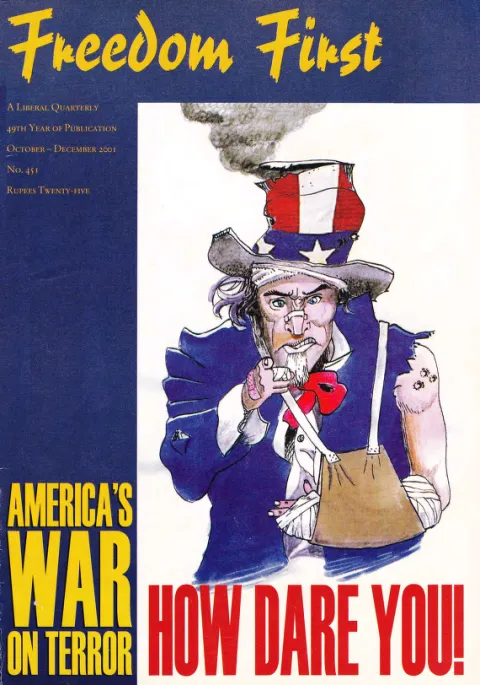
This is issue No. 451 of Freedom First (October–December 2001), the Bombay-based liberal quarterly founded by Minoo Masani, edited in this issue by S. V. Raju with R. Srinivasan as Associate Editor. The issue was originally planned as a cover feature on Bollywood but was scrapped after the September 11, 2001 attacks in New York and Washington, and the editors dedicated the issue instead to a special feature titled “How Dare You! America’s War Against Terrorism.” In the rendered pages, the volume opens with a reprinted World Forum on Democracy statement condemning terrorism (to which Freedom First is a signatory), the regular “With Many Voices” page of quoted press excerpts, the editor’s “Of Cabbages and Kings” column (on POTO, the Prevention of Terrorism Ordinance, and an obituary for Prof. G. N. Sarma), and then the bulk of the “How Dare You!” symposium: S. V. Raju’s lead essay on America’s war against terrorism and its implications for India-Pakistan-Kashmir; Minoo Adenwalla’s “We Shall Not Sleep” on the U.S. response and the identity of al-Qaeda and the Taliban; Amit Dholakia’s “Global Terrorism: Causes and Correctives” on the roots and remedies of terrorism; Dr. Prasenjit Maitri’s “The WTC Tragedy and After,” arguing that U.S. foreign policy bears some responsibility for breeding anti-American terrorism; and S. S. Bankeshwar’s “The USA’s Double Standards,” contrasting Washington’s response to 9/11 with its treatment of terrorism in Kashmir. The rendered pages end partway into Tamim Ansary’s “Why the Afghans Suffer the Taliban?” The volume’s argumentative center in the rendered pages is a debate over the legitimacy and consistency of America’s post-9/11 War on Terror, especially as it bears on Pakistan, the Taliban, and Kashmir.
Key points
-
A planned Bollywood cover feature was scrapped after September 11, 2001, and replaced with “How Dare You! America’s War Against Terrorism”, opening with a reprinted World Forum on Democracy statement condemning terrorism to which Freedom First is a signatory.
-
S. V. Raju’s lead essay argues Indians should not invest the United States with moral superiority after 9/11 given its history of self-interested policy including arming both the Taliban and Pakistan, framing the real confrontation as with fundamentalist Islam rather than Islam itself, and urging India and Pakistan to use the moment to discuss Kashmir.
-
Minoo Adenwalla’s “We Shall Not Sleep”, written within days of the attacks, surveys al-Qaeda’s prior record from the 1993 WTC bombing to the USS Cole attack and predicts a war of covert strikes and economic attrition rather than conventional battle.
-
Dr. Prasenjit Maitri’s “The WTC Tragedy and After” argues US foreign policy bears some responsibility for breeding anti-American terrorism, citing Cold War-era coups in Chile and Central America and calling Osama bin Laden “a Frankenstein created by America itself”.
-
S. S. Bankeshwar’s “The USA’s Double Standards” accuses Washington of treating terrorism against itself as a global crime while dismissing Kashmiri terrorism, which he says has killed over 80,000 people, as a matter for mere “restraint and patience”.
-
The “Of Cabbages and Kings” column addresses the Prevention of Terrorism Ordinance (POTO) and carries an obituary for Professor G. N. Sarma.
Essays
America’s War Against Terrorism
By S. V. Raju
S. V. Raju’s lead essay opens the “How Dare You!” feature by arguing that Indians should resist investing Americans with a moral halo after 9/11: the U.S. has historically acted from self-interest (citing Vietnam, Tiananmen Square, and arming both the Taliban and Pakistan), and its past indifference to Indian pleas against Pakistan-sponsored terrorism was itself dictated by Cold War-era strategic interest. Raju frames 9/11 as marking the end of one kind of global era and the start of another, and argues the crucial confrontation is not with Islam per se but with fundamentalist forces within Islam represented by bin Laden, Mullah Omar, and allied terrorist outfits based in Pakistan. He closes by urging India and Pakistan to seize the post-9/11 moment to discuss Kashmir “in an atmosphere of relative peace.”
- Argues against investing the United States with moral superiority after 9/11; American foreign policy has always been driven by national self-interest.
- Notes the irony that Stinger missiles given by the US to the Taliban (to fight the Soviets) are American-made, as is much of the current threat.
- Frames the post-9/11 confrontation as being with fundamentalist Islam, not Islam per se.
- Calls this a moment of both threat and opportunity for India and Pakistan to address Kashmir.
- Criticizes Indian leaders’ ‘sulking’ reaction to the US not immediately branding Pakistan a terrorist state.
”We Shall Not Sleep” - Terror in the U.S.A.
By Minoo Adenwalla
Minoo Adenwalla’s “We Shall Not Sleep” — written within days of the September 11 tragedy — describes the mood of shock, grief, and unity in the United States, drawing a comparison to the WWI poem “In Flanders Fields.” He surveys who the declared enemy is (al-Qaeda, the Taliban, and allied groups operating out of Pakistan and elsewhere), the diplomatic and intelligence response (NATO’s Article V invocation, U.S. plans to release evidence against bin Laden), and the likely shape of the coming war — a war of covert strikes, economic attrition, and intelligence-sharing rather than conventional battle. He reviews al-Qaeda’s record (the 1993 WTC bombing, the 1998 embassy bombings, the USS Cole attack) and closes urging a united international effort to root out terrorism before “much worse” follows, noting the creation of the new Office of Homeland Security under Governor Tom Ridge.
- Describes the American public mood after 9/11 as more unified and aroused than at any point the author recalls, including during Vietnam or the Kennedy assassination.
- Details President Bush’s ultimatum to the Taliban to hand over al-Qaeda leaders and close training camps.
- Surveys al-Qaeda’s prior record: the 1993 WTC bombing, 1995 Ethiopia assassination attempt on Mubarak, 1996 Dhahran attack, 1998 embassy bombings in Kenya/Tanzania, and the 2000 USS Cole attack.
- Predicts the war will be one of covert, quick strikes and economic attrition rather than conventional warfare, quoting Bush’s description of it as unlike the Gulf War or Kosovo.
- Reports the creation of a new Homeland Security office under Governor Tom Ridge to coordinate over 40 agencies.
Global Terrorism : Causes and Correctives
By Amit Dholakia
Dr. Prasenjit Maitri’s “The WTC Tragedy and After” argues that terrorism is a psychological and social phenomenon present in all societies, not reducible to a single cause, and that state terrorism (citing US-backed coups and assassinations in Chile, Panama, and Central America during the Cold War) has often bred private terrorism as blowback. He argues the US cannot escape some liability for breeding the terrorism now directed at it, given its unconditional support for Israel, its backing of authoritarian Middle Eastern regimes to secure oil, and its heavy military presence near Muslim holy sites — explicitly calling bin Laden “a Frankenstein created by America itself.” The essay closes on short-term policy prescriptions: risk-minimizing US foreign policy, more targeted counter-terrorism measures, and caution against isolationism.
- Terrorism is described as arising from interconnected political, ideological, religious, social, and psychological causes rather than a single root cause.
- State terrorism (US involvement in coups/assassinations in Chile, Panama, Central America) is presented as a precursor that legitimizes private terrorism.
- Argues the US bears some responsibility for terrorism given its support of Middle Eastern autocracies for oil and unconditional backing of Israeli policy toward Palestine.
- Describes Osama bin Laden as ‘a Frankenstein created by America itself.’
- Warns that the logic of deterrence collapses in the face of suicide terrorism, prompting a need to reconceive national security.
The USA’s Double Standards
By S. S. Bankeshwar
S. S. Bankeshwar’s “The USA’s Double Standards” accuses President Bush of applying an inconsistent standard to terrorism: treating Islamic terrorism against the US as a global crime deserving a worldwide coalition, while dismissing Islamic terrorism against India in Kashmir (which the author says has killed over 80,000 people in two decades) as a matter calling only for ‘restraint and patience.’ He calls Pakistan an unreliable ally that sponsored the Taliban and Kashmiri terrorism yet now stands to receive US financial and military aid, IMF loans, and sanctions relief — predicting this history of US support for Pakistan and the Taliban (as previously for Iraq) will eventually backfire again, with Pakistan turning hostile toward the US and India becoming a ‘frontline state.’
- Argues Bush treats terrorism against the US as a crime against humanity while treating terrorism in Kashmir as a matter for ‘restraint and patience’ only.
- Cites a claimed death toll of over 80,000 in Kashmir from Islamic terrorism over two decades, versus roughly 6,000 in the 9/11 attacks.
- Portrays Pakistan as an unreliable ally that previously backed the Taliban and now receives renewed US financial/military support.
- Predicts Pakistan will eventually turn against the US, drawing a parallel to Iraq (a former US ally) and the Taliban itself.
- Concludes that ‘history will repeat itself’ because the US does not learn from its own past support of proxies that later turned hostile.
Generated by the v1.5 extraction pipeline. Awaiting editorial review.
Metadata and summary are AI-extracted from the source PDF and reviewed for editorial accuracy. The original work is available via the Read PDF tab above (where present); paragraph-level citation inside the PDF is deferred to a future engagement.