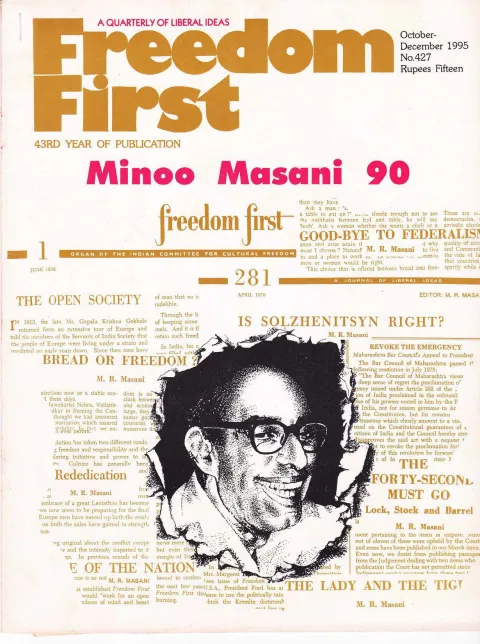
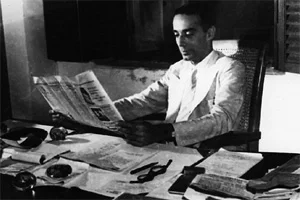
periodical issue
Freedom First
A Liberal Quarterly
Edited by S. V. Raju
Indian Committee for Cultural Freedom, 3rd Floor, Army & Navy Building, 148, Mahatma Gandhi Road, Mumbai 400 001. Published by J. R. Patel for the Indian Committee for Cultural Freedom and printed by him at Kaiser-E-Hind Private Ltd., 300, Perin Nariman Street, Mumbai 400 001. · Mumbai · 2004
48 pages
Freedom First
Summary
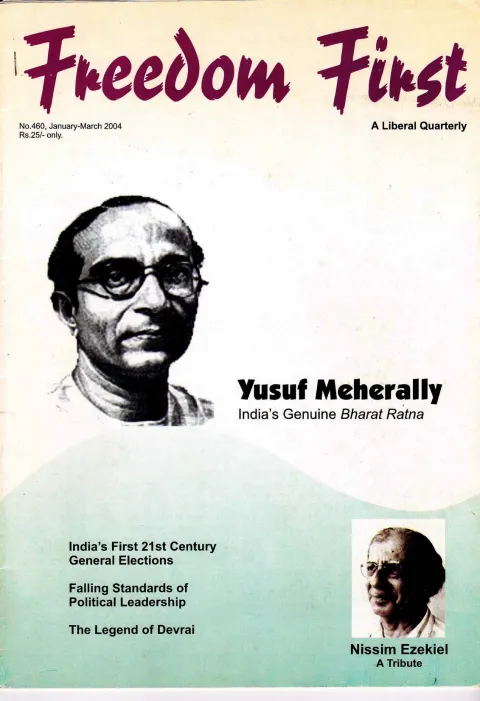
This is issue No.460 (January-March 2004) of Freedom First, the Bombay-based liberal quarterly founded by Minoo Masani, edited by S. V. Raju in its 52nd year of publication. The issue’s cover feature marks the birth centenary of freedom fighter Yusuf Meherally, a Congress Socialist Party co-founder and one-time Bombay Mayor, with two tribute essays. The editorial (“Between Ourselves”) notes the issue was delayed and its pages cut to 44 due to advertising shortfalls, and previews a post-election discussion planned for May 2004. The rest of the issue is a miscellany typical of the magazine’s format: an editorial reflection on a failed workshop to build a new liberal political party (“Of Cabbages and Kings”), a curtain-raiser analysis of the 2004 general election by A. D. Moddie, an open letter needling Sharad Joshi for allying with the NDA, an interview-based piece by former PM Chandrashekhar on declining political standards, and the opening pages of a short story, “Pad (Carrion)”, depicting the pre-Ambedkar life of the Mahar community. In the rendered pages, contributors span veteran commentators (Moddie, Bhargava), activists (Kisan Mehta), journalists (Manuwant Choudhary, R. Rajagopalan), and fiction (Amitabh).
Key points
-
Freedom First No. 460 (Jan-Mar 2004) marks the birth centenary of freedom fighter Yusuf Meherally with two tribute essays, while the editorial notes the issue was delayed and cut to 44 pages for lack of advertising.
-
S. V. Raju’s “Of Cabbages & Kings” recounts a Delhi workshop to draft “A Liberal Strategy for India: 2004 and Beyond” that collapsed into factional manoeuvring, closing by invoking Masani’s and Rajagopalachari’s insistence that a liberal party pursue principle rather than chase power.
-
Kisan Mehta’s reminiscence recalls Yusuf Meherally’s tenderness toward fellow prisoners at Yeravada jail, their secret correspondence under aliases, and Meherally’s late-life work organising a freedom-struggle exhibition from his sickbed.
-
G. S. Bhargava’s tribute narrates Meherally’s life from his 1928 leadership of the “Simon Go Back” protests through his break with his guardian M. A. Jinnah, his Congress Socialist Party co-founding, and his death in 1950 at 47 from a lathi injury sustained years earlier.
-
A. D. Moddie’s “India’s First 21st Century General Elections” surveys the eve of the 2004 poll, describing a “600 million schizophrenic” electorate and assessing a maturing BJP/NDA, a dynastically-trapped Congress, and a Left overtaken by history.
-
Manuwant Choudhary’s open letter reproaches Sharad Joshi for allying the Shetkari Sanghatana with the NDA, invoking Minoo Masani’s vision of a “Swatantra Bharat Party” as a betrayed liberal dream.
-
Former Prime Minister Chandrashekhar, interviewed by R. Rajagopalan, criticises opportunistic shifts among India’s political leadership and calls for cross-party unity on shared national-interest questions such as agriculture.
-
Amitabh’s short story “Pad (Carrion),” introduced as a depiction of pre-Ambedkar Mahar community life, opens with a shanty town’s frantic, unresolved scramble to butcher a dead cow found at dawn.
Essays
Of Cabbages & Kings
S. V. Raju’s editorial column recounts a three-day Delhi workshop convened to devise “A Liberal Strategy for India: 2004 and Beyond,” which collapsed into factional maneuvering. Framed as an anecdote (with participants anonymized as ‘The Convenor,’ ‘The Leader,’ and ‘The Demolition Man’), it describes how a proposal to strengthen the existing liberal party was hijacked by a party leader’s personal ambitions, reducing high-minded discussion of liberal principles to horse-trading over candidates and funds. The piece closes by invoking Minoo Masani’s and Rajagopalachari’s insistence that a liberal party must pursue principle rather than chase power, and vows that Freedom First will keep working toward a genuine liberal alternative.
- A workshop meant to draft ‘A Liberal Strategy for India: 2004 and Beyond’ devolved into factional politics
- Three options were tabled: a nationwide liberal movement, a new liberal party, or strengthening the existing liberal party
- A political party leader (‘The Demolition Man’) derailed the workshop to serve his own agenda once the majority backed strengthening the existing party
- The piece reprints a 1973 Weekly Mail report in which Minoo Masani criticized the Orissa Swatantra Party for allying with Biju Patnaik in a toppling operation, as an illustration of the ‘spirit of Swatantra’
- C. Rajagopalachari is cited for the maxim that power should chase the party’s policies rather than the party chasing power
- The author concludes the workshop was a lost opportunity and reaffirms Freedom First’s commitment to a liberal alternative
Some Personal Reminiscences (Tributes to a genuine ‘Bharat Ratna’ on his Birth Centenary: Yusuf Meherally)
By Kisan Mehta
Kisan Mehta’s reminiscence recalls his encounters with Yusuf Meherally, beginning in 1953 when both were imprisoned at Yeravada Central Prison during a satyagraha in support of a Gandhi-led fast, and continuing until Meherally’s death in 1950 (the piece’s own internal chronology moves between the 1930s Yeravada meeting and later years). Mehta describes Meherally’s tenderness toward fellow inmates, an elaborate covert-correspondence scheme the two maintained under aliases (‘Kisan’ and ‘Kasam’) to evade prison censorship, and a sidebar anecdote titled “The True Satyagrahi” describing an improvised overnight prisoner handover between Yeravada and Arthur Road jail guards. It closes with Mehta locating a visibly declining Meherally at Dadar station being transferred for medical treatment, describing his physical collapse and his effort to hide the severity of his illness from his family, and Meherally’s late-life work organizing a freedom-struggle exhibition from his sickbed.
- Mehta first met Meherally in the Yeravada prison hospital compound in 1953 (recounted alongside a strike/imprisonment episode)
- Meherally, though an ‘A’ class detenu, spent his days tending to sick ‘C’ class inmates with soap, tooth powder, and books
- The two corresponded secretly using the pseudonyms ‘Kisan’ and ‘Kasam’ after a warder intercepted an earlier letter
- A sidebar recounts a improvised, extra-legal overnight handover of Meherally between Yeravada and Bombay’s Arthur Road Prison guards
- Meherally organized an Indian National Exhibition on the freedom struggle, then from his sickbed arranged an alternative exhibition after Congress leaders tried to suppress images of Jayaprakash Narayan and Achyut Patwardhan
- The essay closes describing Meherally’s declining health and his effort to conceal the severity of his illness from his own family
Freedom Fighter Par Excellence (Tributes to a genuine ‘Bharat Ratna’ on his Birth Centenary: Yusuf Meherally)
By G. S. Bhargava
G. S. Bhargava’s tribute narrates Yusuf Meherally’s biography from his 1903 birth into a prosperous, pro-British Bombay business family through his emergence as a nationalist leader. It covers his early exposure to Mazzini, Garibaldi, and the Chinese and Russian revolutions; his disillusionment with the abrupt end of Gandhi’s Non-Cooperation Movement after Chauri Chaura; his leadership of the Bombay Provincial Youth League and its 1928 boycott of the Simon Commission (including the famous ‘Simon Go Back’ slogan and a lathi-charge during a harbour demonstration); his defiant break with his guardian M. A. Jinnah, who had arranged his legal apprenticeship; repeated arrests through the 1930 Civil Disobedience Movement and 1932 and 1940 detentions; his tenure as Bombay’s reform-minded Mayor during WWII; and his declining health after a police lathi injury, ending in his 1950 death at 47. Sidebars include a 1949 anecdote about Meherally’s views on British ‘fair play’ and a closing sidebar summarizing his short but eventful life and posthumous reputation as a biographer (author of the two-volume “Leaders of India”).
- Meherally was born in late 1903 to a prosperous, traditionally pro-British Bombay business family
- He rose to prominence on February 8, 1928 leading the boycott and demonstrations against the Simon Commission, including the ‘Simon Go Back’ slogan and a harbour march that was lathi-charged three times
- Jinnah, who had arranged Meherally’s legal apprenticeship, was angered by his political activity (‘Young man, your life is ruined’) and Meherally was later denied a lawyer’s sanad by the High Court for political reasons after prosecuting a police sergeant
- He co-founded the Congress Socialist Party and was arrested repeatedly (1930, 1932, 1940, and during a 1942 CSP camp at Poona just before August 8, 1942)
- As Bombay’s Mayor he refused to fund the government’s ARP (Air Raid Precautions) scheme, arguing the public had no faith the British would actually defend India, citing the withdrawal from Burma and Malaya
- A 1928 lathi blow to his heart caused his health to permanently decline, and he died in 1950 at age 47 after further collapses in 1943 and later years
- He authored the two-volume biographical work ‘Leaders of India,’ which ran to six editions
India’s First 21st Century General Elections - A Turning Point?
By A. D. Moddie
A. D. Moddie’s essay surveys India on the eve of the 2004 general election, tracing the post-Independence state through the ‘Patelian’ consolidation, the ‘Nehruvian’ planned economy, and its 1991 economic collapse, into a fragmented, coalition-driven present. He argues the electorate of ‘600 million schizophrenic voters’ is torn between caste/ethnic loyalty, communal instinct, and aspiration toward a consumer economy, and profiles the major parties: a maturing BJP-led NDA that has moved from Ayodhya-era communalism toward national-interest governance (while still trailing the Shiv Sena, VHP and Bajrang Dal), a Congress trapped in dynastic illusion and internal splits, and a Left whose ideology has been overtaken by the fall of the USSR and Deng-era China, illustrated by a ‘failed state’ West Bengal. He closes by calling 2004 a possible ‘Turning Point’ haunted by population growth, corruption (‘sauda’), and rising ungovernability.
- Frames post-Independence India in three phases: the Patelian integration, the Nehruvian planned economy, and the post-1991 multi-party ‘meltdown’ era
- Describes the 2004 electorate as ‘600 million schizophrenic voters’ split between caste/ethnic loyalty, communalism, and consumer aspiration
- Assesses the BJP/NDA as having matured from the Ayodhya movement toward stable coalition management, while still carrying the ‘communal fascist’ baggage of the Shiv Sena, VHP and Bajrang Dal
- Portrays Congress as trapped in ‘multiple illusion politics’ under dynastic leadership and splitting into regional offshoots (TNC, NCP)
- Judges the Left’s ideology ‘a dated dodo’ given the USSR’s collapse and Deng-era Chinese reform, with West Bengal cited as a failed state example
- Surveys regional parties (DMK, AIADMK, TDP, Samajwadi, Shiv Sena, Akali Dal) as caste/ethnic power centers rather than ideological actors
- Concludes the election may be India’s ‘Turning Point’ but remains haunted by population growth, corruption (‘sauda’), and increasing ungovernability
An Open Letter to Sharad Joshi - Your New Friends Oppose the Swatantra Dream
By Manuwant Choudhary
Manuwant Choudhary’s open letter reproaches Sharad Joshi, the Shetkari Sanghatana farmer-movement leader, for aligning with the NDA ahead of the 2004 election. Choudhary recalls a decade-old Bharatiya Vidya Bhavan conference where Minoo Masani championed forming a new liberal party, the ‘Swatantra Bharat Party,’ and describes his own long-standing admiration for Masani, the Swatantra Party’s legacy, and Joshi’s farmer activism (including fielding 200 candidates in Maharashtra without an Election Commission symbol). He argues Joshi’s alliance with the BJP-Shiv Sena camp betrays that inherited liberal ‘dream’ and implicitly the memory of communal violence in Gujarat and the Ram temple movement, urging Joshi to ask himself whether Swatantra’s founders would have joined the NDA.
- Choudhary criticizes Joshi for joining the NDA and appearing alongside Pramod Mahajan, calling it a fall to ‘opportunistic politics’
- Recalls a Bharatiya Vidya Bhavan conference where Minoo Masani proposed a new ‘Swatantra Bharat Party’ to near-universal applause
- Describes personal history: family ties to the original Swatantra Party in Bihar, and multiple meetings with Masani, who repeatedly named Joshi and Indian farmers as the ones who ‘can do it’
- Praises Joshi’s decision to field 200 candidates in Maharashtra despite lacking an Election Commission symbol, and Shetkari Sanghatana’s refusal to join the BJP-Shiv Sena state government despite winning only two seats
- Frames Joshi’s NDA alliance as a betrayal, linking the NDA to Gujarat’s communal riots and the Ram temple movement
- Closes urging Joshi to test his decision by asking whether Swatantra’s founding leaders would have joined today’s NDA
Falling Standards of Political Leadership
By Chandrashekhar
This piece presents an interview-based statement by former Prime Minister Chandrashekhar (conducted by R. Rajagopalan) criticizing opportunistic shifts among India’s political leadership ahead of the 2004 election. He cites the Prime Minister’s blurring of ‘Swadeshi’ and ‘Videshi,’ Sonia Gandhi’s role in precipitating the collapse of the United Front over DMK’s Tamil Eelam ties, and George Fernandes’s inconsistent invocation of Ram Manohar Lohia while courting Mulayam Singh for the NDA. Chandrashekhar argues these reversals reflect a broader collapse in standards among India’s political class, driven by an unhealthy craving for power and patronage, and closes urging parties to unite instead around shared national-interest positions such as agriculture, given that 350 million people go hungry daily despite claims of 8% economic growth.
- Chandrashekhar faults the PM for blurring the distinction between ‘Swadeshi’ and ‘Videshi’ despite his own Sangh Parivar’s earlier Swadeshi positions
- He notes Sonia Gandhi’s public anguish over DMK’s Tamil Eelam links helped precipitate the Congress-backed United Front’s collapse, complicating the DMK-Congress rapprochement
- George Fernandes is criticized for invoking Ram Manohar Lohia’s 1960s thinking to justify courting Mulayam Singh, while ignoring the changed political landscape
- Chandrashekhar argues 350 million people go hungry daily despite claims that the economy, now said to be growing at 8%, has been transformed away from agriculture
- He calls for cross-party unity on shared national-interest policy questions (security, foreign affairs, economy, agriculture) rather than personal ambition
- A sidebar on Satyendra Dubey (contributed by Bapu Sathyanarayana) references the murdered whistleblower engineer as emblematic of Bihar’s political-bureaucratic-criminal nexus
Pad (Carrion) A Short Story
By Amitabh
Amitabh’s short story “Pad (Carrion),” introduced by an editorial note explaining it depicts the humiliating pre-Ambedkar life of the Mahar community, opens with the shanty town roused before dawn by the cry that a dead cow (‘Pad’) has been found. In the rendered pages (through the story’s midpoint), the community’s men, women, and children rush with knives and makeshift containers to the carcass under the gum trees, where Pandu and his son Somya claim first rights to skin and butcher the animal, collecting blood, organs, and meat into troughs and baskets while dogs, crows, kites, and vultures circle hungrily. The narrative interweaves the domestic desperation of the impoverished Vithi, struggling to feed her large family, and the reluctant, half-asleep boy Nilya, daydreaming of a full pot of meat while being pressed into the scramble for carrion. The rendered pages end mid-scene as the wider crowd descends on the carcass in a chaotic free-for-all.
- An editorial note frames the story as depicting Mahar community life before Ambedkar’s leadership ended the practice of eating carrion
- The plot centers on the discovery of a dead cow (‘Pad’) and the shanty town’s frantic rush to claim and butcher it
- Pandu and his son Somya, recognized for their skill, are given first rights to skin the carcass before the wider crowd is allowed to scramble for meat
- Subplots follow Vithi, an overburdened mother of six with an ailing husband, and Nilya, a reluctant teenage boy pressed to fetch meat under threat
- The story’s final rendered pages depict a chaotic free-for-all as the whole community, along with dogs, crows, kites and vultures, converges on the carcass
- The rendered pages (17-18 of 20 in the printed run per the table of contents) do not reach the story’s resolution; its remaining pages were not part of this chunk
Generated by the v1.5 extraction pipeline. Awaiting editorial review.
Metadata and summary are AI-extracted from the source PDF and reviewed for editorial accuracy. The original work is available via the Read PDF tab above (where present); paragraph-level citation inside the PDF is deferred to a future engagement.