periodical issue
Freedom First
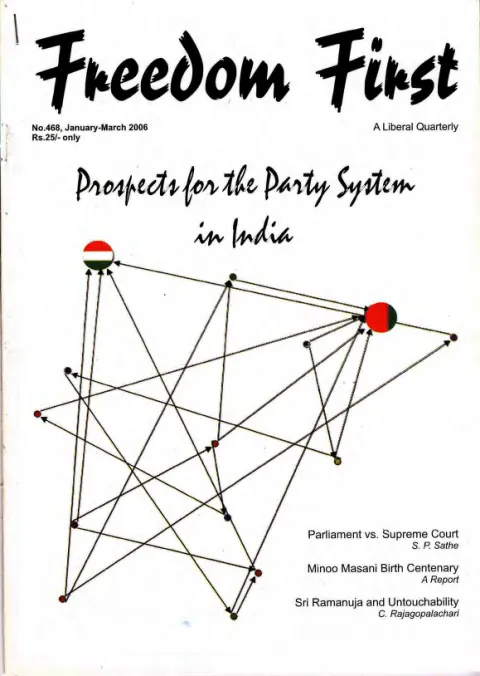
Prospects for the Party System in India
By S. V. Raju, S. P. Sathe, Sharad Bailur, Sharad Joshi, C. Rajagopalachari
Publishers: Indian Committee for Cultural Freedom (ICCF), 3rd Floor, Army & Navy Building, 148, Mahatma Gandhi Road, Mumbai 400 001. Published by J. R. Patel for the Indian Committee for Cultural Freedom (ICCF) and printed by him at Kaiser-E-Hind Private Ltd., Plot No.A-191, Road No.16A, MIDC, Wagle Industrial Estate, Thane (W) - 400 604. · Mumbai · 2006
52 pages
Freedom First
Summary
Freedom First No.468 (January-March 2006), a liberal quarterly in its 54th year of publication, leads with a cover feature titled “Prospects for the Party System in India,” a symposium of essays examining coalition politics after the fragmentation of the Congress-dominated one-party system. Contributors in the rendered pages include Amit Dholakia on the party system in the era of coalition politics, A. Vaidyanathan (in the first of a two-part extract from the Fifth Dr. Ambirajan Memorial Lecture) on the political class and development in India, Sharad Bailur’s polemical case that coalitions are an aberration rather than a sign of political maturity, and V. N. Torgal’s skeptical assessment of prospects for a two-party system. The issue opens with a regular “With Many Voices” digest of press quotations, a report by S. V. Raju on the Minoo Masani Birth Centenary commemorations held across several Indian cities, and a posthumously published essay by Professor S. P. Sathe (who died March 10, 2006, shortly after submitting it) on Parliament versus the Supreme Court over the expulsion of MPs for a cash-for-questions scandal. The editorial (“Between Ourselves”) frames the whole issue around the shift from Congress one-party dominance to a two-coalition system (NDA and UPA) and invites reader debate on whether this outcome is desirable.
Key points
-
Freedom First No. 468 (Jan-Mar 2006) devotes its cover feature, “Prospects for the Party System in India,” to a symposium on coalition politics after the fragmentation of Congress’s one-party dominance.
-
Amit Dholakia traces India’s shift from the “Congress system” to today’s fragmented, arithmetic-driven coalitions, warning of an “end of ideology” and calling for legislation on party funding and candidate vetting.
-
A. Vaidyanathan’s Ambirajan Memorial Lecture credits India’s constitutional design and watchdog institutions with a resilient democracy, while arguing the political class has hollowed out institutional independence through manipulated appointments.
-
Sharad Bailur, revisiting a 1998 Freedom First argument, insists coalitions are an aberration of splintering ambition rather than voter sophistication, and proposes a two-round electoral runoff system while defending universal suffrage against Nani Palkhivala’s proposed literacy restriction.
-
V. N. Torgal argues the BJP’s post-Ayodhya rise, not deliberate design, produced today’s bipolar contest, and warns this drift could devour liberal and secular forces in a diverse country better served by decentralisation.
-
S. V. Raju reports on Minoo Masani Birth Centenary commemorations held across several Indian cities.
-
The late Professor S. P. Sathe’s posthumously published essay examines Parliament versus the Supreme Court over the expulsion of MPs in a cash-for-questions scandal.
Essays
Many Voices
Dholakia traces the transformation of India’s party system from the ‘Congress system’ of one-party dominance (lasting until 1989) to today’s fragmented, multi-coalition landscape, driven by party splits, identity-based mobilization (Dalit/backward-caste politics and Hindutva post-Ayodhya), and the erosion of ideological distinctiveness between parties. He argues the NDA and UPA are loose, transactional coalitions held together by power-sharing rather than shared ideology, and that this has produced an ‘end of ideology’ in which parties chase parliamentary arithmetic rather than policy consensus. He closes with proposals for reform: comprehensive legislation to regulate party funding, candidate vetting, and internal party democracy, plus a push to restore the ‘coalition dharma’ needed for durable governance.
- Argues India is the only post-colonial state with genuinely free, wide-open multi-party competition
- Traces fragmentation to erosion of Congress’s coalitional character from the mid-1960s and identity-based mobilization in the 1990s
- Describes NDA and UPA as loose coalitions formed around power-sharing rather than ideology
- Warns of an ‘idea-less, value-less, amoral’ politics driven by arithmetic of numbers rather than policy consensus
- Calls for legislation on party funding, candidate criminal-background vetting, and an ombudsman for political parties
Minoo Masani Birth Centenary - A Report
By S. V. Raju
In the first installment of the Fifth Dr. Ambirajan Memorial Lecture (the second part, on politics and development, to follow in the next issue), Vaidyanathan distinguishes ‘politics’ as the mediation of competing social interests from ‘politicians’ as the individuals who exercise that function within a constitutional framework. He credits India’s constitutional design (fundamental rights, separation of powers, federalism, watchdog institutions like the Election Commission and CAG) with producing a resilient polity that has weathered the Emergency and sustained regular free elections. But he argues the political class has systematically abused its discretion over appointments to watchdog bodies and the bureaucracy, hollowing out institutional independence, while revenue collection, public-sector finances, and delivery of social welfare have all deteriorated due to waste and corruption. He ends the rendered portion noting that pressure for reform is growing from the judiciary, the Election Commission, the media, and grassroots demand for panchayat devolution.
- Distinguishes politics (mediation of competing social interests) from politicians (individuals who exercise that function)
- Credits India’s constitutional design and watchdog institutions for a broadly resilient democracy since independence
- Argues the political class has manipulated appointments to watchdog institutions, weakening their independence
- Links declining ideology and rising coalition fluidity to shortened political time horizons and competitive populism
- Sees growing counter-pressure from judiciary, Election Commission, media, and panchayat devolution demands
- This is part one of two; the role of politics in development is reserved for the next issue
Parliament vs. Supreme Court
By S. P. Sathe
Bailur revisits an argument he first made in Freedom First in 1998 (“Coalition Politics and the Need for Electoral Reform,” No.438) to insist that coalitions are not a sign of democratic maturity but an aberration produced by splintering, self-interested politicians. He rejects the idea that voters have grown more sophisticated, arguing instead that fragmented, contradictory voting patterns cancel each other out and produce paralysis rather than consensus, citing the stalled airport privatisation fight as an example. His proposed fix is a two-round electoral system: an open first round, followed by a runoff restricted to the top two vote-getters, which he argues would restore single-party majorities and eliminate splinter parties, alongside retaining universal suffrage against Nani Palkhivala’s proposed suffrage restriction to the educated.
- Reprises a 1998 Freedom First argument that coalitions are an aberration, not evidence of new political maturity
- Argues splintering of parties reflects politicians’ personal ambition (‘Me and Mine’), not ideology or voter sophistication
- Cites the airport privatisation standoff, kept alive by Communist coalition partners, as an example of coalition paralysis
- Proposes a two-round electoral system (open first round, top-two runoff) to restore single-party majorities
- Explicitly defends retaining universal adult suffrage against Nani Palkhivala’s suggestion of restricting the vote to the educated
Cover Feature: The Party System in the Era of Coalition Politics
By Amit Dholakia
Torgal, a retired teacher and freedom-struggle veteran from Gulbarga, surveys the long history of debate over a two-party system in India going back to the early independence era (Asoka Mehta, George Fernandes) and argues that the BJP’s post-Ayodhya rise, not any deliberate design, is what has produced today’s de facto Congress-versus-BJP contest. In the portion rendered here, he warns this bipolar drift could turn into a ‘Frankenstein’ devouring liberal and secular forces, and argues a two-party system is neither realistic nor desirable for a country as regionally and socially diverse as India, which he believes is better served by Gandhian decentralisation of power than by concentrating politics into two national blocs.
- Traces the two-party debate to early post-independence discussions among socialists like Asoka Mehta and George Fernandes
- Argues the BJP only became viewed as a Congress alternative after the Ayodhya-era Rath Yatra, not by original design
- Warns the BJP could grow into a force devouring liberal, rationalist and Gandhian values
- Considers a two-party system undesirable for a large, regionally diverse India, favoring decentralisation instead
- This essay continues past the rendered pages (TOC lists it running to p.19, overlapping with the next essay by Sharad Joshi); coverage here is partial
Generated by the v1.5 extraction pipeline. Awaiting editorial review.
Metadata and summary are AI-extracted from the source PDF and reviewed for editorial accuracy. The original work is available via the Read PDF tab above (where present); paragraph-level citation inside the PDF is deferred to a future engagement.