periodical issue
Freedom First
The Reservation Conundrum
By Sharad Bailur, Sharad Joshi
Published by J. R. Patel for the Indian Committee for Cultural Freedom (ICCF) and printed by him at Kaiser-E-Hind Private Ltd., Plot No A-191, Road No 16A, MIDC, Wagle Industrial Estate, Thane (W) - 400 604. Publishers: Indian Committee for Cultural Freedom (ICCF), 3rd Floor, Army & Navy Building, 148, Mahatma Gandhi Road, Mumbai-400 001. · Mumbai · 2006
52 pages

Freedom First
Summary
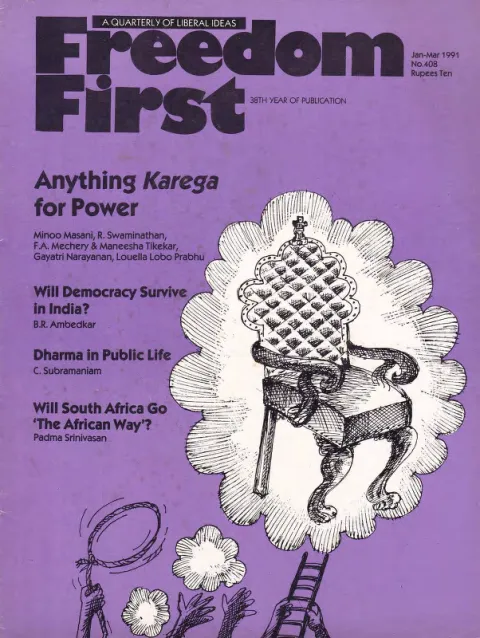
Freedom First No. 470 (July 2006), the liberal quarterly’s 54th year, devotes its cover feature to a return engagement with reservations: 21 years after a 1985 Freedom First/Indian Liberal Group seminar on the same subject, the magazine reports on a second seminar held in Mumbai on 10 June 2006, convened in response to Union Minister Arjun Singh’s proposal to extend OBC reservation by 27% in central higher-education institutions. In the rendered pages, the volume-level material (editor’s note, reader-quote digest, and the editor’s ‘Of Cabbages and Kings’ column) frames the issue against contemporary events — the Da Vinci Code controversy, threats against Taslima Nasreen, and coalition politics around disinvestment — before the cover feature proper takes over. The seminar report opens with an overview by Dr. Usha Thakkar arguing that identity politics has displaced the constitutional vision of reservations as a time-bound ‘enabling provision,’ followed by Brig. S. C. Sharma’s historical background tracing reservation from princely-state origins through the Kalelkar and Mandal Commissions. J. B. D’Souza’s contribution interrogates the concept of ‘merit’ as itself a product of unequal access to schooling and coaching, using Bihar’s ‘Super 30’ coaching experiment as a counter-model to top-down quota gimmicks. Sharad Bailur frames the debate as fundamentally about equality versus market logic, arguing private-sector reservation is unworkable because the sector answers to shareholders, not government, and offers the story of a Dalit classmate who chose the open category over reservation as an illustration of market-blind mobility. R. K. Hebsur’s essay (seen only through its opening pages) begins examining who OBCs are and argues a ‘double game’ is being played by both dominant landed castes and the state in defining backwardness.
Key points
-
Freedom First No. 470 (July 2006) devotes its cover feature to a return engagement with reservations, reporting on a June 2006 Mumbai seminar convened after Union Minister Arjun Singh proposed extending OBC reservation by 27% in central higher-education institutions.
-
Dr. Usha Thakkar argues identity politics has displaced the constitutional vision of reservation as a time-bound “enabling provision,” surveying wildly conflicting OBC population estimates from the Mandal Commission, NSS, and CSDS.
-
Brig. S. C. Sharma traces reservation’s history from princely-state origins through the Kalelkar and Mandal Commissions to the 2005 constitutional amendment extending quotas to private institutions, comparing India’s experience to the modest community-level gains of US civil-rights-era affirmative action.
-
J. B. D’Souza argues “merit” prized by elite exams is itself manufactured by expensive schooling, pointing to Bihar’s “Super 30” coaching programme as the grassroots intervention Mandal recommended but which was ignored.
-
Sharad Bailur frames the debate through Rawls’s Theory of Justice, arguing private-sector reservation is unworkable because firms answer to shareholders, and tells the story of a Dalit classmate who chose the open category over reservation to become Chief Secretary.
-
R. K. Hebsur’s opening pages argue a “double game” is underway around OBC classification, with dominant landed non-Savarna castes lobbying for inclusion to capture benefits.
Essays
The Reservation Conundrum … An Overview
By Usha Thakkar
Dr. Usha Thakkar’s overview essay argues that India’s reservation policy, meant as a time-limited enabling provision for SCs and STs, has been captured by identity politics and electoral opportunism, with the Mandal Commission’s implementation turning caste into the central axis of political calculus. She surveys the OBC-quota arithmetic controversy — conflicting estimates of OBC population share from the Mandal Commission (52.4%), NSS 1999-2000 (32-36%), and Yogendra Yadav/CSDS (40-44%) — and argues government policy has been reactive and unimaginative rather than grounded in reliable data or deprivation indexes. She contends reservations politicize education, entrap the young in caste consciousness, and were never meant as permanent crutches, citing H. M. Seervai’s 1985 Freedom First article. She closes arguing for innovative, targeted affirmative-action mechanisms rather than blanket quotas.
- Reservations were designed as time-bound enabling provisions for SCs/STs, not permanent entitlements, but have continued indefinitely
- OBC population estimates vary wildly across sources: Mandal Commission (52.4%), NSS 1999-2000 (32-36%), CSDS/Yogendra Yadav (40-44%)
- Political parties expand reservation networks to court voter support, and social groups seek inclusion to capture benefits
- Pratap Bhanu Mehta’s Knowledge Commission resignation letter is cited: better-designed deprivation indexes could target affirmative action more effectively than caste quotas
- Reservations politicize academic institutions and entrap the young generation in caste identities rather than fostering merit-neutral access
… The Background: How it all Began
By S. C. Sharma
Brig. (Retd.) S. C. Sharma’s background paper traces the history of reservation policy from its pre-independence origins in Kolhapur (1902), Mysore (1921), and the Bombay Presidency (1935), through the First Backward Classes Commission under Kakasaheb Kalelkar (1953-55, rejected by Nehru and Home Minister Govind Ballabh Pant) and the Mandal Commission under B.P. Mandal (1978-80), which classified 52% of the population as OBC using eleven criteria of social, educational, and economic backwardness. He recounts the decade-long delay before V. P. Singh implemented the Mandal report in 1990, the ensuing student riots and self-immolations, subsequent Supreme Court rulings (the 1992 50% quota cap and 27% OBC quota upheld, the 2005 exclusion of caste quotas from unaided private institutions and the ‘creamy layer’ exclusion), and the 2005 constitutional amendment extending reservation to private, non-minority institutions including proposed extension to IITs, IIMs, and postgraduate medical courses — the immediate trigger for the 2006 student protests. He closes drawing a US comparison: despite decades of civil-rights-era affirmative action, black Americans’ community-level position (educational and economic outcomes, incarceration rates) improved only modestly even as some individuals advanced, an outcome he sees echoed in India’s experience with the ‘creamy layer.’
- Reservation predates independence: introduced in Kolhapur (1902), Mysore (1921), Bombay Presidency (1935)
- Kalelkar Commission (1953-55) report was rejected; Mandal Commission (1978-80) estimated OBCs at 52% of population using 11 backwardness criteria
- V. P. Singh’s 1990 implementation of Mandal triggered student riots and self-immolations
- Supreme Court capped quotas at 50% (1963), upheld 27% OBC quota (1992), excluded caste quotas from unaided private institutions and mandated creamy-layer exclusion (2005)
- The Dec 2005 constitutional amendment to Article 15 extending reservation to private institutions set up the current push to extend quotas to IITs, IIMs, and PG medical courses
- US affirmative-action experience since the 1950s shows individual black Americans advanced but community-level indicators (prison population, overall economic parity) improved little
… In Education
By J. B. D’Souza
J. B. D’Souza argues the entire premise of the anti-reservation position — that ‘merit’ is being sacrificed — is flawed, since the merit prized by elite examinations and interviews is itself manufactured by expensive schooling and coaching unavailable to the poor. He recounts serving on UPSC interview panels where candidates were judged on arbitrary trivia unrelated to competence, and cites Praful Bidwai’s characterization of merit as a cover for inherited privilege. D’Souza contends that increasing seats in IITs and IIMs is not a real solution since institutional capacity (faculty, labs, libraries) cannot be conjured on demand, and that reserved-seat students without adequate coaching will simply drop out. He points to Bihar’s ‘Super 30’ coaching classroom — underprivileged students coached by a police officer and an academic, achieving rising JEE success rates — as the kind of grassroots intervention Mandal itself recommended but which was ignored. The essay closes on government indifference to primary and secondary education (roughly 6% of GDP spent, high dropout and functional-illiteracy rates despite over-100% enrollment figures) and criticizes top-down quota gimmicks as no substitute for building education from the primary level up, citing Montek Singh Ahluwalia’s caution to the Prime Minister on school-level access.
- Merit prized in competitive exams is a function of expensive schooling and coaching, not innate ability — ‘this so-called merit is produced really by schooling in expensive schools’
- D’Souza’s UPSC interview-panel experience: candidates judged on irrelevant trivia (flight routes, what tie to wear), undermining claims that current selection is meritocratic
- Bihar’s ‘Super 30’ programme — underprivileged students coached for free by a police officer and academician — achieved a 100% JEE success rate and models what Mandal itself recommended
- Government spends roughly 6% of GDP/GSDP on education, among the lowest among developing countries, with high dropout rates (67% in classes 1-10) despite reported enrollment above 100%
- Top-down reservation at elite institutions (IITs, IIMs, PG medical) is a ‘gimmick’ compared to fixing primary and secondary education access and quality
… Employment and Reservations
By Sharad Bailur
Sharad Bailur frames the reservation debate as fundamentally about equality, invoking John Rawls’ Theory of Justice, and splits employment into unorganised (rural agricultural and service, over 70% of all employment) and organised (public and private sector) categories. He argues the private sector is market-driven and merit-based by necessity and that imposing reservation there will fail, illustrating with the historical failure of Indira Gandhi-era ‘social control’ of banks (which private banks, backed by ‘The Syndicate,’ simply ignored) and V. P. Singh/Ram Vilas Paswan’s failed attempt to make the Right to Work a Fundamental Right modeled on the Soviet Constitution. He contends wages for even landless, illiterate labour are market-set rather than caste-set, evidenced by inter-state labour migration for work. Bailur closes with the story of a Dalit (‘sweeper caste’) classmate, Pyarelal Kureel, who outperformed him academically, chose to sit the IAS exam in the open category rather than use his reservation entitlement, and is now a Chief Secretary — offered as a model of achievement without quota dependence — and gestures toward Kerala’s high-literacy, high-mobility ‘melting pot’ model as worth studying for what it has done for employment absent heavy reliance on reservation.
- Frames the debate via Rawls’ Theory of Justice: people are not equal, hence laws exist to give equal opportunity, not to assert equal ability
- Splits employment into unorganised (70%+ of total, rural agricultural/service) and organised (public/private) sectors
- Private-sector reservation will fail because private firms answer to shareholders and market survival, not government mandate — illustrated by the failed ‘social control’ of banks under Indira Gandhi
- V. P. Singh/Ram Vilas Paswan’s attempt to make Right to Work a Fundamental Right (modeled on the Soviet Constitution) is criticized as ignoring that Soviet ‘right to work’ meant public-sector-only labour without separation of powers
- Tells the story of classmate Pyarelal Kureel, from the sweeper caste, who chose the open category for the IAS exam over his reservation entitlement and became a Chief Secretary
- Points to Kerala’s 100% literacy and matrilineal legacy as a model of mobility worth studying regarding employment and reservation
… The Alternative …
By R. K. Hebsur
In the portion seen, R. K. Hebsur’s essay opens by examining who the Scheduled Castes, Scheduled Tribes, and OBCs are, noting that SC/ST identification has been settled and largely uncontested since 1935 (SCs given 8.33% job reservation in 1943, post-Matric scholarships from 1944) while the definition of OBCs was left unresolved by the Constitution’s framers and deferred to a future commission. He observes that unlike time-bound legislative reservations, SC/ST/OBC reservations in jobs and education are not time-bound and may continue indefinitely. Hebsur argues a ‘double game’ is underway, played first by powerful, dominant non-Savarna castes — landed, numerically strong, and politically influential — who lobby for OBC inclusion to capture benefits, though the essay is cut off before describing the second party to this ‘double game.’
- SC/ST identification has been stable and uncontested since 1935; SCs received 8.33% job reservation in 1943 and post-Matric scholarships from 1944
- The Constitution left the definition of ‘Other Backward Classes’ unresolved, deferring it to a future commission, unlike the settled SC/ST lists
- Unlike time-bound legislative reservations, job and education reservations for SC/ST/OBC are open-ended and may continue indefinitely
- State governments drew inconsistent OBC lists reflecting local non-Brahmin or backward-caste political movements
- Hebsur argues a ‘double game’ is being played around OBC classification, with dominant landed non-Savarna castes as one party to it (essay cut off before the second party is named)
Generated by the v1.5 extraction pipeline. Awaiting editorial review.
Metadata and summary are AI-extracted from the source PDF and reviewed for editorial accuracy. The original work is available via the Read PDF tab above (where present); paragraph-level citation inside the PDF is deferred to a future engagement.