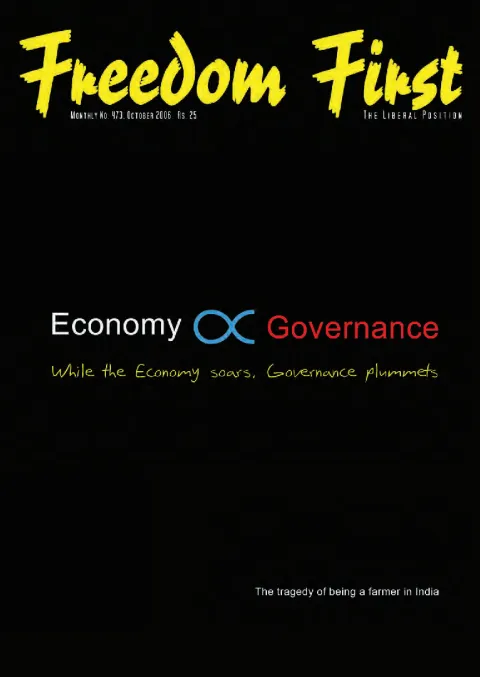
periodical issue
Freedom First
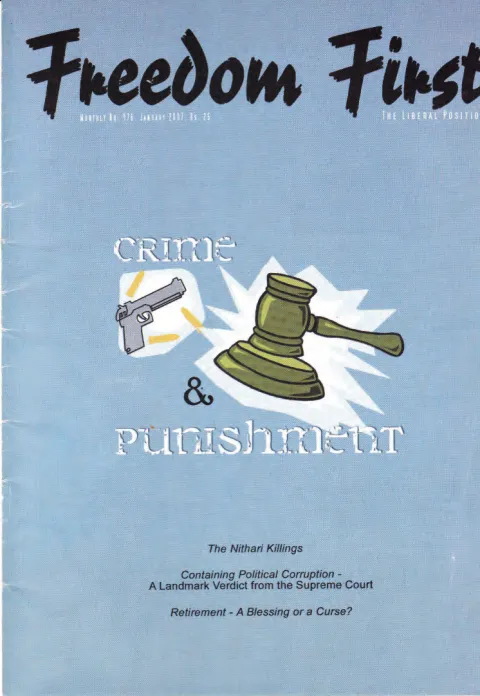
Crime & Punishment
By Sharad Joshi, G. Giridhar Prabhu
Publishers: Indian Committee for Cultural Freedom (ICCF), 3rd Floor, Army & Navy Building, 148, Mahatma Gandhi Road, Mumbai 400 001. Published by J. R. Patel for the Indian Committee for Cultural Freedom (ICCF) and printed by him at Kaiser-E-Hind Private Ltd., Plot No.A-191, Road No.16A, MIDC, Wagle Industrial Estate, Thane (W) - 400 604. · Mumbai · 2007
48 pages
Freedom First
Summary
This is the January 2007 issue (No. 476, 54th year of publication) of Freedom First, the Bombay-based liberal quarterly/monthly founded by Minoo Masani, edited by S. V. Raju with R. Srinivasan as Associate Editor, published by the Indian Committee for Cultural Freedom (ICCF). The cover story is ‘Crime and Punishment,’ and in the rendered pages the issue opens with a tribute to the late constitutional jurist H. M. Seervai (1906-1996), the ‘Many Voices’ column of quoted commentary, and a run of essays responding to the Nithari (Noida) child-killings and the broader crisis of policing and criminal justice in India. Subsequent essays in the rendered portion take up Kishore Mahbubani’s predictions about India’s civilizational role, political corruption and criminal-politician nexus following a Supreme Court verdict, Ashok Karnik’s ‘Point Counter Point’ column on the Prime Minister’s Sachar-related remarks, the Singur land-acquisition controversy, television news standards, Subroto Roy’s polemic on the absence of a genuine liberal party in India, and P. R. Dubhashi’s piece on farmer suicides and agrarian distress in Vidarbha. The volume’s argumentative centre in the rendered pages is a critique of institutional failure — policing, the judiciary, political accountability, and rural governance — read through a classical-liberal lens.
Key points
-
Freedom First No. 476 (January 2007) leads with the cover story “Crime and Punishment,” opening with a tribute to constitutional jurist H. M. Seervai on his birth centenary.
-
Ashok Karnik’s cover essay surveys crime and punishment in India, crediting the RTI Act and reversed verdicts in the Mattoo and Lall cases as hopeful signs while indicting the police as the most feared yet least trusted institution and citing a conviction rate of only 6.5%.
-
R. Srinivasan and Seetha’s companion essays frame the Nithari child-killings as evidence that “the Right to Life has become a casualty,” with Seetha identifying affluent Noida employers as a “collective culprit” for ignoring the missing children’s disappearance.
-
Singapore diplomat Kishore Mahbubani’s reproduced speech predicts India will increasingly claim credit for democratic traditions while rediscovering indigenous political thought and resuming its historic role as a civilisational meeting point.
-
Ganesh Sovani’s essay on political corruption cites India’s worsening Transparency International ranking and notes that no Indian politician has ever been jailed on corruption charges, due to Section 19 immunity in the Prevention of Corruption Act.
-
Subroto Roy argues neither the Congress-Left establishment nor the BJP-RSS opposition offers a genuine classical-liberal alternative, concluding India still lacks a non-geriatric, non-sycophantic liberal party.
-
P. R. Dubhashi’s “Rural Perspective” argues farmer suicides across five states reflect deep structural agrarian distress, criticising the finance minister for prioritising stock indices over rural distress.
Essays
Essay 1
An unsigned tribute marking the birth centenary of H. M. Seervai (1906-1996), the constitutional lawyer and author of Constitutional Law of India, A Critical Commentary. It recounts his career as Advocate General of Maharashtra (1957-1974), his refusal of judgeships and the Attorney Generalship, and honours conferred on him including the Padma Vibhushan (1972) and Corresponding Fellowship of the British Academy (1981). It notes his other books, including Partition of India: Legend and Reality, and quotes The Economist’s assessment that his account of Partition places responsibility on Mountbatten.
- H. M. Seervai served as Advocate General of Maharashtra for 17 years (1957-1974) and resigned over the Law and Judiciary Minister’s actions.
- His magnum opus, Constitutional Law of India, A Critical Commentary, ran to four editions from 1967 until his death in 1996.
- He declined judgeships on the Bombay High Court and Supreme Court, and the post of Attorney General of India.
- He began his career teaching English Literature at Elphinstone College before his nearly 70-year legal career.
- The Economist is quoted praising his book Partition of India: Legend and Reality as the authoritative account, attributing chief responsibility for Partition violence to Mountbatten.
Many Voices
The recurring ‘Many Voices’ column, a compilation of quoted remarks from public figures and commentators on current events — crime, gender violence, judicial reform, senior citizens’ issues, and the Nithari killings. Sources quoted include Kuldip Nayar, Amnesty International’s Zubaida Irene Khan, Chief Justice Y. K. Sabharwal, Burkha Dutt, Sucheta Dalal, Bibek Debroy, and a cartoon on censorship of film content.
- Compiles quotations from Indian and international media on topics including crime, judicial reform, and gender violence.
- Includes Chief Justice Y. K. Sabharwal’s remarks on dropping the ‘Your Lordship’ honorific from court usage.
- Includes Bibek Debroy’s comment connecting a Noida drain uncleaned since 1994 to the Nithari case and broader failures of policing across India, not just Uttar Pradesh.
Crime and Punishment
By Ashok Karnik
Ashok Karnik’s cover essay surveys the state of crime and punishment in India, opening with the proverb ‘crime does not pay’ and asking whether it still holds. He credits the RTI Act and a run of judicial reversals (Priyadarshini Mattoo, Jessica Lall, Nitish Katara, Shibu Soren) as hopeful signs, but devotes most of the essay to indicting the police as the most feared yet least trusted public institution, citing poor training, corruption, and mishandling of major cases (Mattoo, Lall, the Marine Drive rape case, Khairlanji, Nithari). He also faults the judiciary for chronic delay (citing a 6.5% conviction rate) and the legal profession for exploiting procedural loopholes, before closing with a qualified list of remedies: RTI, PIL, and media/TV-driven public pressure.
- Argues the RTI Act and a string of reversed high-profile verdicts (Mattoo, Lall, Katara, Soren) suggest cautious optimism about accountability.
- Describes the police as the most feared and least trusted public institution, citing the Mattoo, Lall, Marine Drive, Khairlanji, and Nithari cases as evidence of systemic failure.
- Cites a conviction rate of only 6.5% and blames both judicial delay and defence-lawyer tactics for undermining the criminal justice system.
- Criticizes politicians for opposing measures to insulate the police from political interference and for shielding tainted colleagues from prosecution.
- Proposes RTI, Public Interest Litigation, and sustained media/TV pressure as the main levers available to citizens.
The Nithari Killings
By R. Srinivasan
R. Srinivasan’s essay frames the Nithari killings as evidence that ‘the Right to Life has become a casualty in today’s India,’ linking it to a pattern of state failure to protect minorities and the poor — invoking the 1993 Bombay riots, Delhi and Gujarat violence, ULFA killings of migrant labourers in Assam, and the Khairlanji Dalit murders. It criticizes the Noida police for refusing to register complaints about missing children over an extended period and contrasts this with swift police action to recover a kidnapped child from an affluent family. A boxed excerpt from Pratap Bhanu Mehta (The Indian Express) argues the case exposes a class divide embedded in the structure of the police force itself.
- Frames the Nithari killings as part of a broader pattern of state failure to protect minorities, Dalits, and the poor (citing 1993 Bombay, Delhi, Gujarat, Assam/ULFA, Khairlanji).
- Notes nearly 70 people massacred in Assam by ULFA, mostly migrant labourers.
- Describes Noida police refusing to register complaints for weeks despite over thirty children missing from one locality.
- Contrasts this indifference with prompt police action recovering a kidnapped child of an affluent, influential family.
- Includes a boxed excerpt of Pratap Bhanu Mehta arguing the class divide is structurally inscribed within the police force, not just an attitude of individual officers.
Nithari and Us - Another Culprit
By Seetha
Seetha’s essay identifies a ‘collective culprit’ in the Nithari case: the affluent Noida residents who employed the missing children’s parents as domestic staff, and who, she argues, must have known about the disappearances yet did nothing. She extends this into a broader critique of urban middle-class ‘candle vigil’ activism (the Jessica Lal and Priyanka Chopra cases), arguing it substitutes symbolic outrage for sustained civic engagement, and closes by calling for individual behavioural change rather than performative protest.
- Argues Noida’s affluent residents, employers of the missing children’s parents, share collective responsibility for ignoring the disappearances.
- Questions whether any employer helped their domestic staff search for missing children or approach police.
- Critiques candle-vigil activism around the Jessica Lal and Priyanka Chopra cases as an easy, low-cost substitute for real civic engagement.
- Quotes Barkha Dutt’s Hindustan Times column admitting media complicity through selective, class-driven news coverage.
- Calls for a change in individual behaviour as the only real route to systemic change, rather than one-off symbolic gestures.
Three Predictions about India
By Kishore Mahbubani
A reproduced extract from a speech by Singapore diplomat Kishore Mahbubani, Dean of the Lee Kuan Yew School of Public Policy, delivered at the University of Pennsylvania in November 2006, introduced by Eustace D’Souza. Mahbubani makes three predictions: Indians will wear less Western clothing as India rises; India will increasingly claim credit for democratic and rule-of-law traditions while rediscovering indigenous political thought (Ashoka, Akbar); and India will resume a historic role as a meeting point between civilizations, potentially bridging Western and Islamic worlds. A boxed excerpt elaborates his critique of Western pundits’ assumed civilizational superiority, including Gandhi’s famous quip about Western civilization.
- Predicts Indians will wear progressively less Western clothing even as India becomes a great power, unlike Japan’s trajectory.
- Predicts India will increasingly claim democratic, human-rights, and rule-of-law traditions as its own while rediscovering Ashoka and Akbar.
- Predicts India will resume its historic role as a civilizational meeting point, potentially bridging the West and the Islamic world.
- Argues the West should see itself as guardian of ‘human civilization’ rather than ‘Western civilization’ specifically.
- Reproduces Gandhi’s quip that Western civilization ‘would be a good idea’ as a rebuke to assumed Western moral superiority.
Containing Political Corruption
By Ganesh Sovani
Ganesh Sovani’s essay on political corruption discusses India’s declining Transparency International rankings, the criminal-politician nexus enabled by the electoral system, and legal barriers (Section 19 of the Prevention of Corruption Act) that have prevented any politician from being jailed on corruption charges. It cites the unimplemented Vora Committee report and the prosecutions of J. Jayalalitha, Prafulla Kumar Mohanta, and K. Karunakaran as examples of prolonged, sanction-delayed proceedings, in the context of a Supreme Court verdict addressed later in the piece (only partially rendered).
- India’s Transparency International Corruption Perception Index ranking worsened from 69th (1999) to 83rd (2004) among 176 nations.
- Cites former CVC N. C. Vittal’s estimate that black money accounts for 40% of India’s GDP.
- Describes the Vora Committee report on the politician-criminal nexus as never acted upon by successive governments.
- States that no politician in India has ever been jailed on corruption charges, attributing this to Section 19 immunity in the Prevention of Corruption Act.
- Cites a 2002 India Today survey finding 965 of 5,539 UP assembly candidates had serious criminal records.
Point Counter Point
By Ashok Karnik
Ashok Karnik’s recurring ‘Point Counter Point’ column presents both sides of current controversies. In the rendered pages it covers three items: the Prime Minister’s remarks on minorities having ‘first claim on resources’ and the ensuing parliamentary uproar over alleged Muslim appeasement; the Singur land-acquisition dispute in West Bengal, where the CPM government’s pursuit of a Tata automobile factory drew opposition from Mamata Banerjee, Medha Patkar, and Arundhati Roy; and the ‘dumbing down’ of 24-hour TV news into infotainment, illustrated by examples of sensationalist coverage balanced against TV’s role in reviving stalled cases like Priyadarshini Mattoo’s and Nitish Katara’s.
- Debates the PM’s ‘first claim on resources’ remark on minorities and whether the resulting Parliament disruption was justified given the PMO’s clarification.
- Frames the Singur controversy as the CPM’s ‘comeuppance’ for its own historic opposition to industrial development, while questioning the sincerity of opponents like Medha Patkar and Arundhati Roy.
- Criticizes TV news channels for prioritizing TRP-driven sensationalism (godmen, snake-women) over substantive coverage.
- Credits TV-driven public pressure with helping reopen the Priyadarshini Mattoo and Nitish Katara cases.
- Closes each item with open questions rather than firm conclusions, per the column’s stated ‘two sides’ format.
A Liberal Party for India
By Subroto Roy
No summary was extracted for this article. Listed for completeness.
The Reservation Conundrum: The Government’s Motives are Suspect
By Sharad Joshi
In the visible portion (page 15, mid-essay), Subroto Roy argues that both the Congress-Left establishment and the BJP-RSS opposition have failed to offer a genuine classical-liberal or principled conservative alternative for India, faulting decades of deficit finance, a bloated bureaucracy and military, a starved judiciary, and damaged rule of law. He criticizes the BJP for coarse, backward-looking nationalism rather than modern conservative leadership, and Congress for lacking any ideology beyond sycophancy toward the Gandhi family, suggesting Sonia Gandhi withdraw from politics for the party’s health. He concludes that India still lacks a non-geriatric, non-sycophantic liberal political party.
- Argues neither the Congress-Left establishment nor the BJP-RSS opposition offers a genuine classical-liberal or principled-conservative alternative.
- Blames decades of deficit finance and bureaucratic/military bloat for starving India’s judiciary and damaging the rule of law.
- Criticizes the BJP-RSS for regressing into ‘coarse fascism’ and anti-Muslim/anti-Christian rhetoric rather than developing modern conservative leadership.
- Argues the Congress has no ideology beyond sycophancy toward the Gandhi family and suggests Sonia Gandhi withdraw from politics.
- Concludes that a liberal political party — necessarily non-geriatric and non-sycophantic — remains absent from Indian politics.
The Rural Perspective: Farmers in Distress
By P. R. Dubhashi
P. R. Dubhashi’s essay on farmer suicides in Maharashtra, Karnataka, Andhra Pradesh, Kerala, and irrigated Punjab argues the phenomenon reflects deep agrarian distress that politicians addressed only after sustained media outrage. It criticizes the finance minister for ignoring farmer suicides while fixating on stock market indices, and describes the Prime Minister’s Rs. 3,750-crore relief package for six Vidarbha districts as inadequate and unsatisfying to agitating farmer leaders. Dubhashi links the crisis to the era of liberalization and economic reform, arguing structural causes (rain-fed dependence, lack of irrigation investment, low productivity) long predate the suicides.
- Farmer suicides across Maharashtra, Karnataka, Andhra Pradesh, Kerala, and Punjab reflect deep rural economic distress rather than mere indebtedness.
- Government response came only after sustained media attention, following an earlier ineffective state package.
- The finance minister is criticized for prioritizing stock market indices over rural distress in budget speeches.
- The Prime Minister announced a Rs. 3,750-crore package for six Vidarbha districts, split between loan restructuring and irrigation/horticulture investment, which failed to satisfy farmer leaders.
- Argues the liberalization and economic reform era bears responsibility for the agrarian crisis, a claim reform advocates are reluctant to accept.
Generated by the v1.5 extraction pipeline. Awaiting editorial review.
Metadata and summary are AI-extracted from the source PDF and reviewed for editorial accuracy. The original work is available via the Read PDF tab above (where present); paragraph-level citation inside the PDF is deferred to a future engagement.