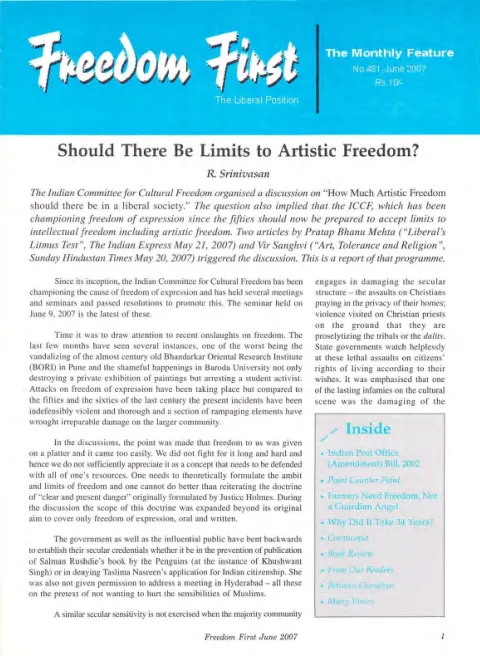
periodical issue
Freedom First
The Liberal Position
By Sharad Joshi
Published by J. R. Patel for the Indian Committee for Cultural Freedom (ICCF), 3rd Floor, Army & Navy Building, 148, Mahatma Gandhi Road, Mumbai 400 001, and printed by him at Kaiser-E-Hind Private Ltd., Plot No.A-191, Road No.16A, MIDC, Wagle Industrial Estate, Thane (W) - 400 604. · Mumbai · 2007
48 pages
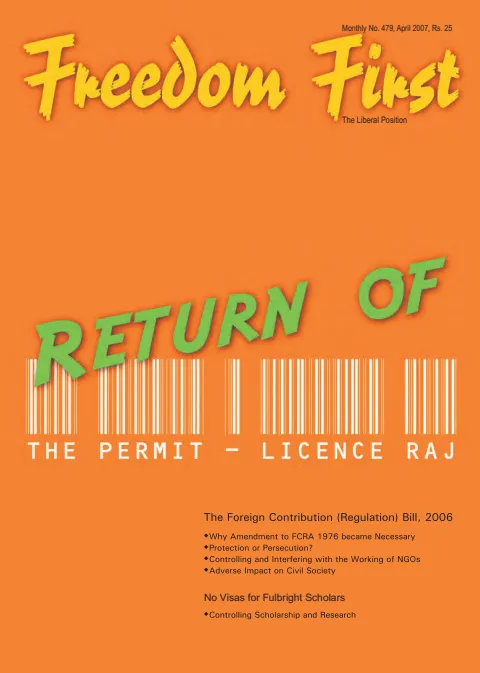
Freedom First
Summary
Freedom First No. 479 (April 2007), the classical-liberal monthly published by the Indian Committee for Cultural Freedom (ICCF) under founder Minoo Masani’s legacy and editor S. V. Raju, leads with a cover package titled “Return of the Permit-Licence Raj,” targeting the UPA government’s Foreign Contribution (Regulation) Bill, 2006. Three contributors — advocate Ganesh Sovani, former Intelligence Bureau official Ashok Karnik, and the NGO umbrella body VANI — debate the Bill from different angles: Sovani cautiously defends the need for some regulation of foreign funds given security concerns (citing the 2006 Mumbai train blasts), Karnik frames it as a ‘protection or persecution’ dilemma and proposes a compromise threshold, and VANI’s unsigned critique calls the Bill ‘draconian’ and a threat to civil society. The issue also carries P. M. Kamath’s essay on the Government of India’s obstruction of Fulbright visiting scholars, framing it as a Cold War-era bureaucratic reflex misapplied to a changed world, plus the regular columns ‘Many Voices’ (press quotations), ‘Of Cabbages and Kings’ (topical commentary), and Ashok Karnik’s ‘Point Counter Point’ feature debating the Bofors case reopening, OBC reservations, and Rahul Gandhi’s Deoband remarks. Sharad Joshi’s ‘Reaping the Whirlwind’ (Rural Perspective) begins on page 19 of the rendered set but is cut off almost immediately.
Key points
-
Freedom First No. 479 (April 2007) devotes its cover package, “Return of the Permit-Licence Raj,” to the UPA government’s Foreign Contribution (Regulation) Bill, 2006, debated from three angles.
-
Ganesh Sovani cautiously defends the need for regulation given security concerns, citing the 2006 Mumbai train blasts and a CBI finding against the Abdul Kalam Azad Islamic Awakening Centre for concealing foreign donations.
-
Ashok Karnik, a former Deputy Director of the Intelligence Bureau, frames the Bill as a “protection or persecution” dilemma, proposing a compromise threshold exempting NGOs receiving less than a set annual sum.
-
The Voluntary Action Network India’s unsigned critique calls the Bill “draconian,” warning its 50% cap on administrative expenses and subjective “political nature” test would especially harm small research NGOs.
-
P. M. Kamath criticises the government’s practice of delaying visas for Fulbright scholars as an outdated Cold War reflex, given more than 7,500 scholars have used the exchange programme since 1950.
-
Ashok Karnik’s “Point Counter Point” debates the reopened Bofors case following Quattrocchi’s arrest, the Supreme Court’s stay on OBC reservations, and Rahul Gandhi’s Deoband remarks disowning responsibility for the Babri Masjid demolition.
Essays
Move to Amend ‘Foreign Contribution Regulation Act, 1976’
By Ganesh Sovani
Ganesh Sovani’s essay traces the FCRA back to Indira Gandhi’s Emergency-era law restricting foreign contributions to political and civil society organisations, then reviews the 2006 amendment Bill introduced by the UPA government. He argues that with over 32,000 foreign-funded NGOs in India and documented cases of illegal receipt of foreign donations (citing the CBI’s January 2007 finding against the Abdul Kalam Azad Islamic Awakening Centre), reasonable regulation is justified given the security stakes, invoking the 11 July Mumbai train blasts as an example of what unchecked foreign-funded modules can do. He supports the Bill’s proposed cap on administrative expenses, penalties for false declarations, and expanded scope covering individuals such as journalists and civil servants, concluding that the interests of the country should outweigh NGO inconvenience.
- FCRA 1976 was introduced by Indira Gandhi during the Emergency to guard against hostile foreign powers funding political destabilisation.
- Over 32,000 NGOs in India receive foreign funding, many reliant on it due to lack of domestic resources.
- CBI uncovered the Abdul Kalam Azad Islamic Awakening Centre illegally receiving and concealing foreign donations via Saudi and Delhi bank accounts.
- The 2006 Bill proposes a 50% cap on administrative expenses from foreign funds and criminal penalties (1-5 years) for false declarations.
- The Bill extends scope to prohibit certain individuals (authors, journalists, judges, civil servants) from foreign hospitality/funding.
- Sovani concludes the amended FCRA is a reasonable, not draconian, response given security risks.
Protection or Persecution
By Ashok Karnik
Ashok Karnik, a former Deputy Director of the Intelligence Bureau, examines the FCRA amendment as a tension between legitimate state protection from foreign interference and persecution of genuine NGOs. He lists the state’s aims (keeping foreign funds out of policymaking, opinion-making, political parties, and cultural organisations) as understandable in principle, but argues the Bill’s methods are disproportionate: most misused funds move through hawala and black money rather than banking channels, and the government lacks any track record of detecting FCRA violations in 30 years. He proposes a compromise: subject only NGOs receiving large sums (e.g. $1 million/year) to FCRA scrutiny, closing the loophole of NGOs splitting themselves to dodge limits.
- Karnik lists five state aims behind the FCRA: preventing foreign influence on policymaking, opinion-makers, political parties, cultural organisations, and cross-purpose use of funds.
- He notes no data exists on how many violations FCRA 1976 actually caught in 30 years, questioning its efficacy.
- Most misused foreign funds flow through hawala/black money, not regulated banking channels that FCRA targets.
- He proposes exempting NGOs below a funding threshold (e.g., $1 million/year) from FCRA to reduce bureaucratic harassment of genuine recipients.
- He closes by citing Gandhi on wanting India’s ‘windows’ open to world cultures without being ‘blown off my feet.‘
A Needless Bill
This unsigned critique, prepared by the Voluntary Action Network India (VANI), argues the Foreign Contribution (Regulation) Bill, 2006 is draconian and would choke India’s non-profit sector. It walks through the Bill’s most damaging provisions: a blanket, subjectively-applied prohibition on foreign funding for ‘organisations of a political nature,’ vague national-interest standards inviting politicised enforcement, mandatory five-year registration renewals with fees (replacing permanent, free registration), a 50% cap on administrative expenses that would especially hurt small research-only NGOs, and a bar on foreign contributions to any entity engaged in producing news or current-affairs broadcasts — which VANI contrasts with the government’s own 2002 and 2005 decisions to allow substantial foreign equity in print and FM radio. VANI concludes the Bill contradicts the government’s own 2006 Draft National Policy on the Voluntary Sector, which favours an enabling environment for NGOs, and calls for the Bill’s repeal rather than reinforcement.
- VANI calls the Bill ‘draconian’ and warns it would adversely affect the working of civil society under the guise of regulating foreign money.
- The Bill bars foreign funds to ‘organisations of a political nature, not being political parties’ — a subjective standard set by the Central Government.
- Registration renewal every five years, with new fees, replaces the current permanent, free FCRA registration.
- A 50% cap on administrative expenses would be especially harmful to small, single-grant research organisations.
- The Bill would bar foreign contributions to any company/correspondent/editor producing audio-visual news or current-affairs content — contradicted by 2002 and 2005 decisions permitting 26% FDI in print media and 20% FDI in private FM radio.
- VANI argues the Bill runs counter to the government’s own 2006 Draft National Policy on the Voluntary Sector, which favours an enabling environment for NGOs.
No Visas for Fulbright Scholars
By P. M. Kamath
P. M. Kamath, a retired Professor of Politics at Mumbai University and Fulbright alumnus, criticises the Indian government’s practice of delaying or denying visas to American Fulbright scholars, or pressuring them to change research topics — something he says would be unthinkable of a genuine democracy. He recounts the Fulbright programme’s 1948 origins (converting US war-surplus disposal funds into scholarly exchange) and its Indian implementation from 1950, noting more than 7,500 scholars have crossed in both directions. He argues Indian policymakers’ Cold War-era suspicion of visiting Americans — including Indira Gandhi’s Emergency-era demand for visa ‘reciprocity’ — is a fallacious and outdated mindset, especially now that US public opinion toward India has warmed since 2005-06. Kamath, drawing on his own two Fulbright fellowships and a 1977 interview with Senator J. William Fulbright himself, argues India should expand rather than restrict the programme, and floats his own long-standing proposal for Indian ‘Gandhi Fellowships’ for South Asian scholars.
- Fulbright fellowships began in 1948 via a US Senate bill using proceeds from disposal of war surplus materials; introduced in India in 1950.
- More than 7,500 Indian and American scholars have used the exchange programme; Kamath says returnees came back ‘much enriched.’
- During the Emergency, Indira Gandhi grew suspicious of visiting Americans and proposed reciprocal visa caps, which Kamath calls a fallacious standard.
- Kamath’s own 1977 interview with Senator J. William Fulbright confirmed the programme carried Cold War ‘winning friends’ aims alongside pure scholarship.
- Kamath argues current Indian bureaucrats retain an outdated Cold War mindset despite warmer India-US relations since Bush’s 2006 visit.
- He calls for expediting visas without interfering in scholars’ chosen research topics, and for India to consider Gandhi Fellowships for South Asian scholars.
Point Counter Point
By Ashok Karnik
In this recurring ‘Point Counter Point’ feature, Ashok Karnik presents paired opposing viewpoints on three current controversies: the reopened Bofors case following Ottavio Quattrocchi’s arrest in Argentina; the Supreme Court’s stay on 27% OBC reservations in higher education and the political responses to it; and Rahul Gandhi’s remarks at Deoband disowning responsibility for the Babri Masjid demolition. Each item gives a skeptical view followed by a rebuttal, without resolving toward one side, characteristic of the column’s format.
- On Bofors: one view questions whether continued pursuit (Rs. 200 crore spent, no convictions) is worthwhile; the counterpoint argues political interventions across multiple governments (1987-2007) show a pattern of shielding Quattrocchi.
- On OBC reservations: one view criticizes the government’s reliance on outdated 1931 census data and rejection of a creamy-layer exclusion; frames it as vote-bank politics.
- On Rahul Gandhi’s Deoband remarks: he is portrayed as making a calculated bid for Muslim votes in UP by disowning the Babri Masjid demolition and blaming Narasimha Rao, while the rebuttal notes Rajiv Gandhi’s own role in opening Ram Mandir locks and allowing the Ayodhya ‘shilanyas’ in 1989.
Generated by the v1.5 extraction pipeline. Awaiting editorial review.
Metadata and summary are AI-extracted from the source PDF and reviewed for editorial accuracy. The original work is available via the Read PDF tab above (where present); paragraph-level citation inside the PDF is deferred to a future engagement.