periodical issue
Freedom First
Should There Be Limits to Artistic Freedom?
By Sharad Joshi
Publishers: Indian Committee for Cultural Freedom (ICCF), 3rd Floor, Army & Navy Building, 148, Mahatma Gandhi Road, Mumbai 400 001. Published by J. R. Patel for the Indian Committee for Cultural Freedom (ICCF) and printed by him at Kaiser-E-Hind Private Ltd., Plot No.A-191, Road No.16A, MIDC, Wagle Industrial Estate, Thane (W) - 400 604. · Mumbai · 2007
16 pages
Freedom First
Summary
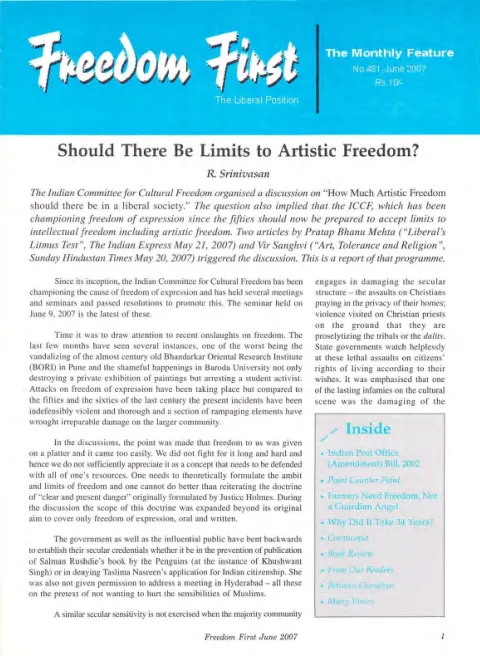
This is Freedom First No. 481 (June 2007), the monthly magazine of the Indian Committee for Cultural Freedom (ICCF). The lead feature reports on an ICCF-sponsored discussion, ‘How Much Artistic Freedom Should There Be in a Liberal Society,’ prompted by the Baroda University vandalism incident and controversy over M. F. Hussain’s paintings, with participants debating the ‘clear and present danger’ doctrine, religious sensitivity, and selective secularism. The issue otherwise assembles the magazine’s regular columns and standalone opinion pieces: two pieces on the proposed Indian Post Office (Amendment) Bill, 2002 arguing it will entrench monopoly and corruption; Ashok Karnik’s recurring ‘Point Counter Point’ debating the Sethusamudram project and psephological failures around the 2007 UP election; Sharad Joshi on agricultural price policy; Shashi Shekhar on the Ninth Schedule and the Supreme Court’s January 2007 ruling; Firoze Hirjikaka’s ‘Cornucopia’ column on Mumbai governance and rising religious intolerance; an obituary for Professor S. V. Kogekar; a book review of Prem Shankar Jha’s ‘The Twilight of the Nation State’; readers’ letters; and the editor’s ‘Between Ourselves’ and ‘Many Voices’ back-page columns.
Key points
-
Freedom First No. 481 (June 2007) leads with a report on an ICCF-sponsored discussion on artistic freedom, prompted by the Baroda University vandalism incident and the M. F. Hussain painting controversy.
-
R. Srinivasan’s report surveys the debate between Justice Holmes’s “clear and present danger” free-speech standard and calls for artistic freedom to be bounded by religious sensitivity, noting the asymmetry in how majority and minority religious sensitivities are treated.
-
Bharat Jhunjhunwala and Ganesh Sovani argue the Indian Post Office (Amendment) Bill, 2002 would entrench a loss-making Department of Posts monopoly and invite corruption, proposing courier taxation instead of restriction.
-
Sharad Joshi criticises a proposal for a new price-fixing board with compulsory agricultural procurement, arguing for scrapping the Essential Commodities Act’s restrictions instead so farmers can capture market prices.
-
Shashi Shekhar traces the Constitution’s Ninth Schedule from Nehru’s 1951 First Amendment to the Supreme Court’s January 2007 ruling opening post-1973 Schedule laws to judicial review, arguing India still lacks a genuine right-of-centre constituency committed to individual freedom.
-
Firoze Hirjikaka’s “Cornucopia” catalogues a string of 2007 religious-vigilantism incidents, warning that public silence toward fundamentalist violence mirrors the conditions that enabled Nazi persecution in Germany.
-
An obituary for Professor S. V. Kogekar accompanies his final book review of Prem Shankar Jha’s “The Twilight of the Nation State,” which he praises for its critique of US unilateralism while faulting its romanticised view of national sovereignty.
Essays
Should There Be Limits to Artistic Freedom?
By R. Srinivasan
R. Srinivasan reports on an ICCF-organised discussion on how much artistic freedom a liberal society should tolerate, triggered by newspaper columns from Pratap Bhanu Mehta and Vir Sanghvi. The piece surveys recent attacks on expression — the vandalizing of the Bhandarkar Oriental Research Institute, the Baroda University exhibition raid and arrest of a student, and the furore over M. F. Hussain’s paintings — and airs both sides: that freedom of expression must be defended robustly using Justice Holmes’s ‘clear and present danger’ test, versus that artistic freedom should be bounded by public morality and sensitivity to religious sentiment. It notes the asymmetry in how the state and ‘secular’ opinion treat majority versus minority religious sensitivities (Rushdie, Taslima Nasreen) and records a general agreement that some via media between absolute artistic freedom and public order is needed.
- ICCF discussion held June 9-10, 2007, sponsored by the Hilla and Dosi C. Vakeel Endowment
- Triggered by Pratap Bhanu Mehta’s ‘Liberal’s Litmus Test’ and Vir Sanghvi’s ‘Art, Tolerance and Religion’ columns
- Cites the Bhandarkar Oriental Research Institute vandalism and Baroda University exhibition raid as recent free-expression flashpoints
- Discussion invoked Justice Oliver Wendell Holmes’s ‘clear and present danger’ doctrine, extended beyond its original speech-only scope
- Notes selective secular sensitivity: Salman Rushdie and Taslima Nasreen restricted, but Hindu icons freely used in controversial art
- Participants concluded a via media is needed between unlimited artistic freedom and public order/decency
- Session attended by a named list of journalists, lawyers, and social activists (see Participants box)
Indian Post Office (Amendment) Bill, 2002: A Recipe for Increasing Corruption / The Indian Postal Service Needs A Makeover
By Bharat Jhunjhunwala and Ganesh Sovani
Bharat Jhunjhunwala argues against the Indian Post Office (Amendment) Bill, 2002, which would bar courier companies from carrying letters under 150 grams and impose a Universal Service Obligation levy. He contends the bill will worsen, not reduce, the government’s budget deficit by slowing the courier-driven economy and will hand government regulators new opportunities for bribery, proposing instead that courier companies be taxed rather than restricted, following the mobile-telephony subsidy model. Ganesh Sovani’s companion piece, ‘The Indian Postal Service Needs A Makeover,’ describes the Department of Post’s structural inefficiency (550,000 employees, Rs. 1,400 crore annual loss) and argues the amendment would dismantle a successful private courier system to re-establish an unearned state monopoly.
- Bill would ban courier carriage of letters under 150g and force couriers to charge 2.5x Speed Post rates
- Jhunjhunwala predicts the bill increases both the fiscal deficit and corruption opportunities for regulators
- Cites Bharat Sanchar Nigam Limited’s Access Deficit Charge model in mobile telephony as an alternative approach
- Sovani notes DoP has 550,000 employees and 155,000 branches yet loses Rs. 1,400 crore annually
- Sovani argues international practice is trending toward postal privatization, not monopoly, citing the UK, Netherlands, Germany, New Zealand, and Japan
- Both authors agree the bill favors bureaucratic control over consumer-serving competition
Point Counter Point
By Ashok Karnik
Ashok Karnik’s recurring debate column presents both sides of three controversies: the Sethusamudram shipping canal project (ecological/heritage objections to the Ram Setu versus the government’s economic and scientific rebuttals), the failure of psephologists to predict Mayawati’s 2007 UP election victory, and ‘censorship through fear’ targeting artists such as M. F. Hussain and incidents involving Richard Gere and Shilpa Shetty.
- Sethusamudram debate pits ecological and Ram Setu heritage claims against government cost-benefit and scientific findings
- Notes the ISRO scientist cited by project opponents was exposed as a fraud
- Psephologists uniformly failed to predict Mayawati’s BSP majority in the 2007 UP election
- Censorship section asks why nude art disproportionately targets Hindu deities rather than other religious icons
- Concludes that a free society’s essence is tolerance for what one does not personally approve of
Farmers Need Freedom, Not a Guardian Angel
By Sharad Joshi
Sharad Joshi criticizes a proposal from a ruling-party MP to create a new autonomous board to fix remunerative agricultural prices via minimum support prices and compulsory government procurement. He argues this duplicates existing bodies (CACP, FCI, NAFED) and inherits the same flawed cost-of-production methodology that has produced wildly inconsistent historical estimates. His preferred solution is scrapping the Essential Commodities Act’s restrictions on storage, transport, processing, and export, which he argues would let farmers capture market-based remunerative prices without new bureaucracy, aided by IT and futures markets.
- Responds to a treasury-bench MP’s proposal for a new price-fixing board with compulsory procurement powers
- Argues the CACP’s cost-of-production methodology is already unreliable, citing wildly inconsistent historical per-hectare cost estimates
- Attributes farmer suicides debate to government deflection from the real cause: deliberately depressed agricultural prices
- Credits IT and futures markets with letting farmers arbitrage price and location without new government machinery
- Notes Punjab and Haryana farmers already resisting compulsory FCI wheat procurement
Why Did It Take 34 Years?
By Shashi Shekhar
Shashi Shekhar traces the history of the Constitution’s Ninth Schedule from Nehru’s First Amendment in 1951 through successive abuses — including the Emergency-era 39th and 40th amendments — up to the Supreme Court’s January 2007 ruling that post-1973 Ninth Schedule laws are subject to judicial review if they violate Articles 14, 19, 20, or 21. He argues the 34-year absence of legal challenge reflects the lack of any genuine right-of-centre constituency in India committed to the primacy of individual freedom, contrasted with pro-market individuals who treat capitalism as an end in itself.
- First Amendment (1951) introduced Articles 31A/31B and the Ninth Schedule to protect land-reform laws from judicial review
- Traces successive amendments (4th, 17th, 29th, 34th, 39th, 40th, 47th, 66th, 76th, 78th) that expanded the Schedule’s scope and immunity
- Supreme Court’s January 2007 ruling (following the Keshavanand Bharati basic-structure precedent) opened post-April 1973 Ninth Schedule laws to judicial review
- Law Minister H. R. Bhardwaj downplayed the ruling’s impact on executive functioning
- Argues India lacks a genuine right-of-centre movement grounded in individual freedom, not just market capitalism
Cornucopia: Mumbai Will Never Be World Class / The Talibanization of India
By Firoze Hirjikaka
Firoze Hirjikaka’s ‘Cornucopia’ column runs two pieces. ‘Mumbai Will Never Be World Class’ argues that Mumbai’s politicians and civic authorities have no genuine interest in reform because the city functions as their perpetual source of easy money, making initiatives like BMC dissolution or world-class infrastructure politically impossible. ‘The Talibanization of India’ catalogues recent incidents of religious and cultural vigilantism — interfaith couple attacks, a Sindhi fatwa on women, the Star News office ransacking, Shiv Sena’s effigy-burning of Richard Gere — and warns that a silent majority’s inaction mirrors the conditions that allowed Nazism to take hold in Germany.
- Argues BMC dissolution and city-management reform will never happen because Mumbai’s status quo benefits all political parties financially
- Predicts multinational-linked businesses will relocate to Bangalore, Hyderabad, or Chennai rather than yield to parochial job-reservation agitation
- Lists a string of 2007 incidents of religious/communal vigilantism: interfaith marriage attacks, a Sindhi community fatwa, Star News office vandalism, Shiv Sena’s Richard Gere effigy-burning
- Draws an explicit analogy between Indian public silence toward fundamentalist violence and German public silence that enabled Nazi persecution of Jews
- Calls on readers to defend India’s imperfect democracy and individual freedoms before fundamentalists destroy them
Professor S. V. Kogekar, R.I.P.
An obituary for Professor S. V. Kogekar (2 March 1914 - 26 May 2007), political scientist and former Principal of Fergusson College, Pune, who studied under Harold Laski at the London School of Economics and held numerous national academic and government advisory posts. The obituary notes his last piece of writing, a review of Prem Shankar Jha’s ‘The Twilight of the Nation State,’ completed in longhand just weeks before his death and printed immediately below.
- Kogekar graduated from Bombay University and LSE, studying under Harold Laski
- Served as Principal of Fergusson College, Pune (1957-1964) and Vice Chancellor of Tilak Maharashtra Vidyapeeth
- Held posts on the Forward Markets Commission, All India Political Science Association, and UGC-related bodies
- Delivered a notable 1976 Kale Memorial Lecture during the Emergency arguing against extending Parliament’s term
- His final book review, of Prem Shankar Jha’s work, was written in longhand shortly before his death
Book Review: The Twilight of the Nation State, Globalisation, Chaos And War by Prem Shankar Jha
By Professor S. V. Kogekar
In his final published review, S. V. Kogekar assesses Prem Shankar Jha’s ‘The Twilight of the Nation State,’ which argues that globalisation is producing systemic disorder rather than the peace and prosperity once predicted, given the erosion of the nation-state ‘container’ established by the 1648 Treaty of Westphalia. Kogekar praises Jha’s 700-year survey of capitalism’s development and his scathing critique of US unilateralism (especially in Iraq) but faults the book for romanticizing the sovereign nation-state while glossing over the exploitation, denial of rights, and imperial violence committed under national sovereignty. He notes the book offers no feasible remedy for the disorder it diagnoses, though he still recommends it as worth reading and pondering.
- Book surveys 700 years of capitalist development, crediting the 1648 Treaty of Westphalia with founding the nation-state as an economic ‘container’
- Jha views globalisation’s undermining of national sovereignty as a ‘great calamity,’ removing that container
- Kogekar counters that the sovereign nation-state era also included empire, exploitation, and denial of human rights
- Book offers a scathing critique of US policy, including Iraq, and of Western-imposed globalisation costs on developing countries
- Kogekar finds the book lacks any proposed remedy or alternative ‘container’ to replace declining national sovereignty
From Our Readers
Reader letters address US and NATO military strategy in Afghanistan and Iraq (arguing for a three-region UN-administered solution), a review of ‘Religion, Politics and Violence’ praised for candidly discussing Islamic-sanctioned violence, and the proposed FCRA Bill (2006), which one reader argues is a justified response to NGO fund misuse even though genuine objections about bureaucratic overreach remain valid, citing SEWA and Grameen Bank as examples of foreign-fund-free social service.
- One letter proposes three autonomous UN-administered regions in Iraq as a solution, with India contributing to a UN force
- A letter praises a book review for directly naming Islamic religious violence rather than deflecting to Western culpability
- Another letter defends the FCRA Bill (2006) given 8,673 of 32,000 NGOs failed to file mandatory fund-use returns
- Cites Ela Bhatt’s SEWA and Muhammad Yunus’s Grameen Bank as models of social service without foreign funding
Between Ourselves …
By Editor
The editor’s ‘Between Ourselves’ column reflects on the magazine’s earlier enthusiasm about Mayawati’s UP election win, reframes this issue’s focus on rising free-expression violations (via the Baroda incident) rather than election analysis, previews next month’s cover story ‘China Friend or Foe?’, and invites reader engagement. The accompanying ‘Many Voices’ column compiles short quotations from contemporary press commentary on Indian politics, governance, and journalism.
- Editor revisits prior month’s optimistic coverage of Mayawati’s UP victory
- This issue’s central theme reframed as freedom-of-expression violations rather than electoral analysis
- Previews July 2007 cover story: ‘China Friend or Foe?’
- ‘Many Voices’ compiles press quotations from Arvind Kala, Pratap Bhanu Mehta, Fali Nariman, Fidel Castro, and others on Indian politics and society
- Masthead confirms Founder Minoo Masani, Editor S. V. Raju, Associate Editor R. Srinivasan, publisher Indian Committee for Cultural Freedom (ICCF)
Generated by the v1.5 extraction pipeline. Awaiting editorial review.
Metadata and summary are AI-extracted from the source PDF and reviewed for editorial accuracy. The original work is available via the Read PDF tab above (where present); paragraph-level citation inside the PDF is deferred to a future engagement.