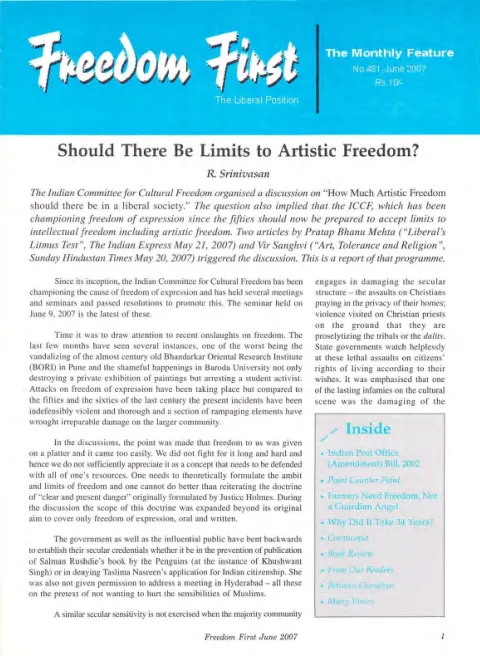
periodical issue
Freedom First
The Liberal Position
By Sharad Joshi
Publishers: Indian Committee for Cultural Freedom (ICCF), 3rd Floor, Army & Navy Building, 148, Mahatma Gandhi Road, Mumbai 400 001. Published by J. R. Patel for the Indian Committee for Cultural Freedom (ICCF) and printed by him at Kaiser-E-Hind Private Ltd., Plot No.A-191, Road No.16A, MIDC, Wagle Industrial Estate, Thane (W) - 400604. · Mumbai · 2007
16 pages
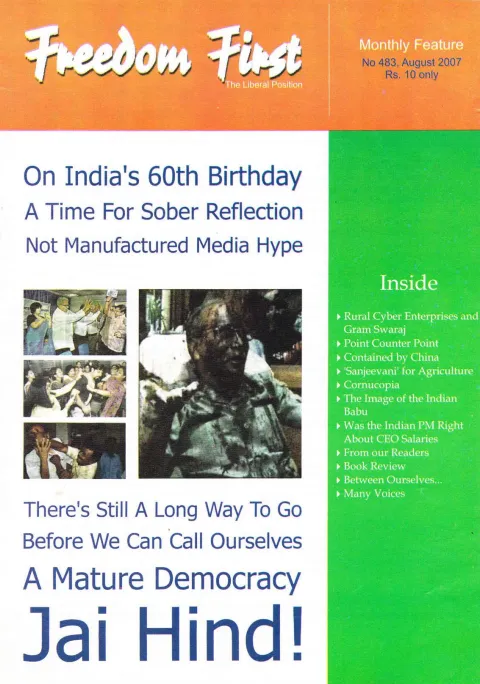
Freedom First
Summary
Freedom First No. 483 (August 2007) is the Indian Committee for Cultural Freedom’s monthly liberal magazine, published as India marked its 60th Independence anniversary. The cover frames the issue’s editorial stance — ‘A Time For Sober Reflection Not Manufactured Media Hype’ — and the issue delivers on that framing across a mix of signed opinion essays, a recurring ‘Point Counter Point’ debate column, a recurring ‘Cornucopia’ column, reader letters, a book review, and the editor’s own notes. Contributors range from economists and think-tank writers to farm leaders, retired civil servants, journalists, and activists, addressing rural ICT enterprise, contemporary geopolitics (Lal Masjid, the London/Glasgow bomb plot, Dr. Haneef’s deportation, Sanjay Dutt’s sentencing), India’s China border strategy, agricultural success stories against a backdrop of farmer distress, communal intolerance after Godhra, a Hindu prayer controversy in the US Senate, bureaucratic culture in Indian administration, CEO pay versus government overreach, press freedom for Tibet activism, and a review of a biography of Baba Amte. The volume closes with the editor’s ‘Between Ourselves’ note (announcing an October theme on constitutional reform) and a ‘Many Voices’ digest of press quotations on current affairs.
Key points
-
Freedom First No. 483 (August 2007), published as India marked its 60th Independence anniversary, frames its stance as “sober reflection, not manufactured media hype.”
-
P. Koshy argues rural cyber enterprises, backed by NGOs like n-Logue and the Byrraju Foundation, can create jobs and realise a pragmatic Gandhian “gram-swaraj” while warning of a coming “creative destruction” phase.
-
Nitin Pai’s “Contained by China” argues China deliberately keeps the border dispute unresolved as a containment tool, recommending India reconstitute the Rajya Sabha along US Senate lines to give border states like Sikkim and Arunachal Pradesh equal representation.
-
Sharad Joshi’s “Sanjeevani for Agriculture” profiles farm success stories that occurred despite, not because of, government intervention, including Madhavrao More’s champagne-rivalling “Pimpagne” wine venture shut down by licensing rules.
-
Firoze Hirjikaka’s “Cornucopia” argues post-Godhra Hindu nationalism has grown assertive enough to rival Islamist intolerance, citing the Bhandarkar Institute vandalism and Shiv Sena’s cybercafe attacks over Orkut.
-
Faiyaz Hardwarewala argues the Prime Minister was wrong to publicly criticise high CEO salaries on grounds of government overreach into private company affairs, not because the salaries are deserved.
-
Prof. V. C. Phadke reviews Anita Kainthla’s biography of Baba Amte, tracing his transformation from a wealthy young man to founder of the Anandwan leprosy settlement and participant in the Narmada Bachao Andolan.
Essays
Rural Cyber Enterprises and Gram Swaraj Through ICT Applications
By P. Koshy
P. Koshy argues that rural cyber enterprises, powered by ICT/IT applications, can create jobs, curb rural-to-urban migration, and realize a pragmatic ‘gram-swaraj’ in the spirit of Gandhi. He surveys the growth of village cybercafes and NGO-driven rural BPO initiatives (citing n-Logue, Tarahat, the MS Swaminathan Foundation, Byrraju Foundation, and Drishtee), predicts continued growth in India’s broadband and IT services revenue, and calls for outsourcing non-strategic government functions and e-governance data management to rural cyber enterprises. He closes by warning that the sector’s growth will require India to manage a ‘creative destruction’ phase as new technology displaces old jobs.
- Rural cyber enterprises (cybercafes, ICT service points) have spread even to remote villages, driven by youth entrepreneurship and NGO support.
- NGOs such as n-Logue, Tarahat, the MS Swaminathan Foundation, Byrraju Foundation, and Drishtee have helped rural entrepreneurs set up ICT enterprises.
- IT-related services revenue is projected to reach Rs 81,000 crores by 2010, with broadband usage growing at 20% per month per the Internet Service Providers Association of India.
- Outsourcing majors are shifting operations to tier II/III cities and could eventually move to rural BPOs, as Byrraju Foundation has already done in Hyderabad.
- The author recommends outsourcing non-strategic government functions and e-governance data management (citing Andhra Pradesh’s e-governance initiative) to rural cyber enterprises.
- Rural cyber enterprises are framed as a pragmatic route to Gandhian ‘gram-swaraj’ by creating jobs and reducing migration to cities.
- The essay invokes Schumpeter’s ‘creative destruction’ to warn that new technology both creates and destroys jobs, posing a policy challenge.
Point Counter Point
By Ashok Karnik
Ashok Karnik’s recurring ‘Point Counter Point’ column presents paired, opposing takes on four current controversies: the Pakistani army’s raid on Lal Masjid in Islamabad and what it means for Musharraf’s balancing act between the US and jihadi sympathizers; the failed London-Glasgow bomb plot and the media’s tendency to label perpetrators by profession or city (‘Bangalore Bombers’, ‘Doctor Bombers’); the deportation of Dr. Mohammed Haneef from Australia and whether Australian authorities were justified; and the six-year sentencing of Sanjay Dutt under arms law, debating whether his post-1993 good conduct should mitigate punishment for possessing weapons from people he knew to be gangsters. A boxed excerpt from Ramesh Ramanathan’s Mint column, ‘India is a Nation that’s awash with mediocrity,’ closing the section calls for a national push toward excellence as India turns 60.
- On Lal Masjid: one view frames Musharraf’s raid as a forced but welcome crackdown on jihadi sympathizers; the counter-view warns Musharraf may still strike quiet deals with anti-Indian militant groups.
- On the London-Glasgow bomb plot: one view criticizes media labels like ‘Bangalore Bombers’; the counter-view argues the incident disproves the notion that any society is immune to jihadi radicalization.
- On Dr. Haneef’s deportation: one view sympathizes with Haneef as a victim of his cousins’ alleged terrorist links; the counter-view holds Australia was within its rights and that Haneef is not necessarily a hero.
- On Sanjay Dutt’s sentencing: one view says his 14 years of good behavior should count for something; the counter-view insists judgment must rest on the offence itself — illegal weapons acquired from known gangsters — and praises Judge Kode for standing firm.
- A separate excerpted piece by Ramesh Ramanathan (Janaagraha co-founder), reprinted from Mint, argues India’s culture of mediocrity needs a national mantra of excellence, akin to post-war Japan’s quality turnaround.
Contained by China
By Nitin Pai
Nitin Pai argues that China deliberately keeps the Sino-Indian border dispute unresolved as a strategic instrument of containment, even as it settles borders with nearly every other neighbour. He traces China’s hardened stance — exemplified by foreign minister Yang Jiechi’s remarks and the denial of visas to residents of Arunachal Pradesh — to a broader strategy combining cooperation and containment, using proxies (Pakistan, Myanmar, Bangladesh, Sri Lanka, Nepal) and the border dispute itself to check India’s rise. He warns against repeating ‘Nehru’s mistakes’ of the late 1950s and recommends India respond not just with reactive infrastructure building but with deeper political integration of its border states, including reconstituting the Rajya Sabha along the lines of the US Senate to give small border states like Sikkim, Arunachal Pradesh, and Nagaland equal representation.
- China’s foreign minister Yang Jiechi stated that settled populations do not affect China’s territorial claims, reversing an earlier bilateral principle agreed upon during Premier Wen Jiabao’s visit.
- China has denied visas to residents of Arunachal Pradesh, implying they are Chinese nationals.
- The essay frames China’s strategy toward India as a mix of cooperation (trade, multilateral fora) and containment (border dispute, regional proxies).
- China has cultivated strategic proxies beyond Pakistan — Myanmar, Bangladesh, Sri Lanka, and Nepal — to hem in India regionally.
- The author warns that a Communist-backed ruling coalition in Delhi makes it harder for India to take a firmer line against China, calling this a possible repeat of ‘Nehru’s mistakes’ in the late 1950s.
- Pai recommends reconstituting the Rajya Sabha along US Senate lines, giving states like Sikkim, Arunachal Pradesh, and Nagaland equal seats, as a more effective and democratic way to integrate border regions than infrastructure spending alone.
‘Sanjeevani’ for Agriculture
By Sharad Joshi
Sharad Joshi asks why Indian agriculture, once among the world’s most advanced, has degenerated to a state of crisis and farmer suicides, and answers with a set of success stories that occurred largely without, or despite, government intervention. He profiles Bishop Arackal and Sunil Joseph’s Peermade Development Society, which converted tribal farmers in Kerala to certified organic spice and tea production for export; Madhavrao More’s ‘Pimpagne’ sparkling wine venture in Nashik, which was strong enough to worry French champagne producers before EU non-trade barriers and Indian licensing restrictions forced its closure; Bhanwarlal Jain of Jalgaon, who built an integrated drip-irrigation, organic manure, and food-processing enterprise from a small landholding; Sardar Bhupender Singh Mann’s troubled dairy enterprise Kisan Dudh Udyog Ltd; and the Sanjeevani Health Research Center in Haryana. Joshi concludes that government should stop announcing large subsidy packages while simultaneously maintaining counterproductive regulatory interventions in agriculture.
- The essay opens by asking how Indian agriculture, once the world’s most advanced, fell into crisis, framing this as more urgent than the usual question of ‘what should be done.’
- The Peermade Development Society in Kerala, founded by Bishop Arackal and led by Sunil Joseph, converted tribal farming to certified organic spices and tea for European and US export markets.
- Madhavrao More’s ‘Pimpagne’ sparkling wine from Nashik was rated competitive with French champagne, but an EU non-trade barrier and Indian government licensing rules requiring export-only sales forced the factory’s closure.
- Bhanwarlal Jain of Jalgaon built a large agricultural enterprise combining drip irrigation manufacture, organic manure, and fruit/vegetable processing from a small original landholding, but has not received government recognition such as a Padmashree.
- Sardar Bhupender Singh Mann’s dairy company Kisan Dudh Udyog Ltd (KDUL) struggled due to indiscriminate licensing of competing projects and government-engineered depression in milk prices from free import of butter oil and milk powder.
- The Sanjeevani Health Research Center in Haryana, founded by Mr. Viz, combines a large organic farm with a nature-cure health clinic.
- Joshi concludes that success in Indian agriculture has come mainly despite, not because of, government help, and recommends ending both new subsidy packages and existing counterproductive regulatory interventions.
Cornucopia: Godhra Has A Lot to Answer For / So Help Me, Brahma
By Firoze Hirjikaka
Firoze Hirjikaka’s ‘Cornucopia’ column runs two pieces. In ‘Godhra Has A Lot to Answer For,’ he argues that the post-Godhra communal carnage unleashed a newly assertive, intolerant strain of majoritarian Hindu politics — citing attacks on the Bhandari Oriental Institute, threats over Aamir Khan’s film, an obscenity row in Baroda, and the Shiv Sena’s vandalizing of cybercafes over Orkut access — and warns that India risks perpetuating a ‘two-nation’ polarization of its own making unless the ‘silent majority’ pushes back. In ‘So Help Me, Brahma,’ he examines the first-ever Hindu prayer opening the US Senate on July 12, its disruption by Christian activists from ‘Operation Save America,’ and uses the episode to question the inconsistency of America’s own church-state separation doctrine.
- Hirjikaka argues that militant Hindu nationalism has grown assertive enough to rival the intolerance once associated mainly with Islamist extremism.
- He cites the ransacking of the Bhandari Oriental Institute over David Lane’s book, threats against Aamir Khan’s film screening in Gujarat, an obscenity row over a private art exhibition in Baroda, and Shiv Sena’s vandalizing of Mumbai cybercafes over Orkut access.
- He credits Internet service provider Sify for refusing to buckle under Shiv Sena pressure regarding Orkut.
- The essay frames India’s growing majority-versus-minority polarization as a self-inflicted echo of the old British ‘two-nation theory’.
- In the companion piece, the US Senate was opened for the first time by a Hindu prayer on July 12, 2007, which was disrupted by three arrested members of ‘Operation Save America’.
- Hirjikaka questions the inconsistency of US church-state separation doctrine, noting court oaths still invoke God even as prayer is barred from schools.
The Image of the Indian Babu
By Sadanand B. Kumta
Sadanand B. Kumta, a retired Director of Technical Education for Gujarat, reflects wryly on 35 years in government service and the changed connotations of the term ‘government servant.’ Using anecdotes — including a young software engineer’s resignation over being compared unfavourably to a ‘government servant’ — he satirizes the modern Indian bureaucrat (‘babu’) as a self-perpetuating species whose ‘work culture’ consists mainly of files, and links bureaucratic hostility to the Right to Information Act to a fear of transparency.
- Kumta opens with the observation that being called a ‘government servant’ is now considered an insult, contrasting his own long, willing service.
- He recounts a young software engineer’s resignation after being compared unfavourably by a boss to a ‘government servant’.
- He characterizes the modern bureaucrat (‘babu’) as having annexed and colonised professional and technical government departments.
- He argues most bureaucrats are unhappy with the Right to Information Act because it demands transparency.
- The essay closes with a wry point that calling government servants an insult sits oddly alongside continued demands for reservations in government service.
Was the Indian PM Right in Grumbling, about High CEO Salaries
By Faiyaz Hardwarewala
Faiyaz Hardwarewala argues that the Indian Prime Minister was wrong to publicly criticize high CEO salaries, not because CEOs necessarily deserve them, but because government has no business interfering in the internal affairs of private companies. He contends that historical experience — from the USSR’s working class to India’s own pre-liberalization license-permit era — shows that socialism and government control widen, rather than narrow, the rich-poor gap, whereas post-liberalization India has for the first time given workers a real chance to rise through merit. He closes (in the continuation on page 14) urging that the same liberalizing logic be extended to the agrarian sector.
- The author states the PM was wrong to criticize CEO salaries, on grounds of government overreach into private company affairs rather than any claim that the salaries are deserved.
- He argues the real issue is whether individual rights to life and property may be curtailed for a collective ‘good’ such as narrowing the rich-poor gap.
- He compares the Indian PM’s ‘overreach’ unfavourably to what would be criticized as judicial overreach if the judiciary gave unsolicited advice to government.
- He argues socialism and government control of the economy, wherever attempted in the last century, widened rather than narrowed the rich-poor gap, citing the USSR and India’s pre-liberalization license-permit era.
- He argues post-liberalization India has, for the first time, given workers a real chance to rise on merit rather than political connections.
- The essay (concluded on page 14) calls on advocates for workers to apply the same deregulatory logic to India’s agrarian sector.
From Our Readers (On India’s President Mrs. Pratibha Patil; The Post Office Amendment Act; When India Dances to the Communist Chinese Tune)
By K. Vedamurthy / Brig. S. C. Sharma (Retd.) / Shibayan Raha
The ‘From Our Readers’ section reprints two letters by K. Vedamurthy of Chennai to The Hindu (which had declined to publish them) concerning President Pratibha Patil’s election and inaugural speech, criticizing what he calls politically divisive rhetoric from UPA-Left supporters and omissions in Patil’s speech (no mention of predecessor APJ Abdul Kalam, no South Indian freedom fighters named). A second letter from Brig. S. C. Sharma responds to a prior Freedom First article on the Post Office Amendment Bill, arguing against postal subsidies and suggesting courier companies help fund a cost study of postal services instead. Shibayan Raha, a Friends of Tibet campaigner, then recounts the Delhi Police’s heavy-handed suppression of an August 4, 2007 Tibet solidarity run at Jawaharlal Nehru Stadium, framing it as India appeasing China at the cost of free assembly.
- K. Vedamurthy’s letters to The Hindu, republished at his request since The Hindu declined to run them, criticize divisive rhetoric around President Pratibha Patil’s election and note omissions in her inaugural speech.
- Vedamurthy notes Patil’s speech made no reference to predecessor Dr. APJ Abdul Kalam and named no South Indian freedom fighters other than misidentifying Sarojini Naidu’s regional origin.
- Brig. S. C. Sharma responds to an earlier Freedom First piece on the Indian Post Office Amendment Bill, opposing postal subsidies and suggesting a courier-industry-funded cost study of Postal Department services instead.
- Shibayan Raha, a Friends of Tibet campaigner, describes the Delhi Police sealing off the Majnu ka Tilla Tibetan settlement and blocking an August 4, 2007 ‘International Run for Tibet’ at Jawaharlal Nehru Stadium after cancelling permission without explanation.
- Raha frames the incident as the Indian government appeasing China’s regime at the expense of its own citizens’ constitutional freedoms, days before India’s 60th Independence anniversary.
Book Review: Baba Amte, by Anita Kainthla
By Prof. V. C. Phadke
Prof. V. C. Phadke reviews ‘Baba Amte’ by Anita Kainthla (Viva Books, 2005, with a foreword by the Dalai Lama), a biography of social reformer Murlidhar Devidas ‘Baba’ Amte. The review traces Amte’s transformation from a wealthy, worldly young man — pen-friends with film stars, participant in the Quit India movement — to founder of the Mahayogi Sewa Samiti and its leprosy rehabilitation settlement at Anandwan near Warora, his Bharat Jodo and Knit India padyatras, his involvement in Medha Patkar’s Narmada Bachao Andolan, and the honors (Ramon Magsaysay, Padma Vibhushan, and a returned Padmashri in protest of the Narmada dam project) he received. Phadke calls the book ‘both educative and inspiring’ and recommends it especially to younger readers.
- The book, authored by Anita Kainthla with a foreword by the Dalai Lama, was published by Viva Books in 2005.
- Baba Amte (born Murlidhar Devidas Amte, 26 December 1914) transitioned from a worldly, wealthy youth to founder of the Mahayogi Sewa Samiti (1951) and its leprosy settlement at Anandwan near Warora.
- Amte undertook long padyatras including the 107-day ‘Bharat Jodo’ campaign (Kanyakumari to Kashmir, 1985) and a second march from Itanagar to Okha covering roughly 7,500 km.
- He joined Medha Patkar’s Narmada Bachao Andolan and lived near the dam-affected river for a decade.
- He received the Ramon Magsaysay Award, the Damien Dutton Award, a UN Human Rights award, and the Padma Vibhushan, and returned his Padmashri in protest against the Narmada Dam Project.
- The reviewer praises the book’s lucid style and extensive interview/field-survey research and recommends it, especially for younger readers.
Between Ourselves…
The issue closes with the editor’s ‘Between Ourselves’ note, saluting Nehru on India’s 60th birthday alongside P. V. Narasimha Rao for economic liberalization, and announcing an October 2007 cover feature titled ‘India’s Polity Needs a U Turn.’ This is followed by ‘Many Voices,’ a digest of quotations from Indian press commentary (The Indian Express, Mint, The Times of India, The Statesman, Hindustan Times, Dawn) on topics including President Kalam’s legacy, the Jamia Millia Islamia naming controversy, Pakistan’s military rule, post-independence complacency, and the attack on author Taslima Nasreen by Andhra Pradesh MLAs. A masthead lists Freedom First’s founder (Minoo Masani), editor (S. V. Raju), associate editor (R. Srinivasan), advisory board, and publisher (Indian Committee for Cultural Freedom).
- The editor salutes both Jawaharlal Nehru (as architect of India’s parliamentary democracy) and P. V. Narasimha Rao (for economic liberalization) on India’s 60th Independence anniversary.
- The editor announces an October 2007 cover feature titled ‘India’s Polity Needs a U Turn’ and invites reader submissions.
- ‘Many Voices’ compiles press quotations from figures including Pratap Bhanu Mehta, Amit Varma, Vir Sanghvi, Javed Akhtar, Akbaruddin Owaisi, and Barkha Dutt on topics such as President Kalam’s popularity, the attack on Taslima Nasreen, and Pakistan’s military rule.
- The masthead confirms Freedom First’s founder as Minoo Masani, editor S. V. Raju, associate editor R. Srinivasan, and publisher the Indian Committee for Cultural Freedom (ICCF), Mumbai.
Generated by the v1.5 extraction pipeline. Awaiting editorial review.
Metadata and summary are AI-extracted from the source PDF and reviewed for editorial accuracy. The original work is available via the Read PDF tab above (where present); paragraph-level citation inside the PDF is deferred to a future engagement.