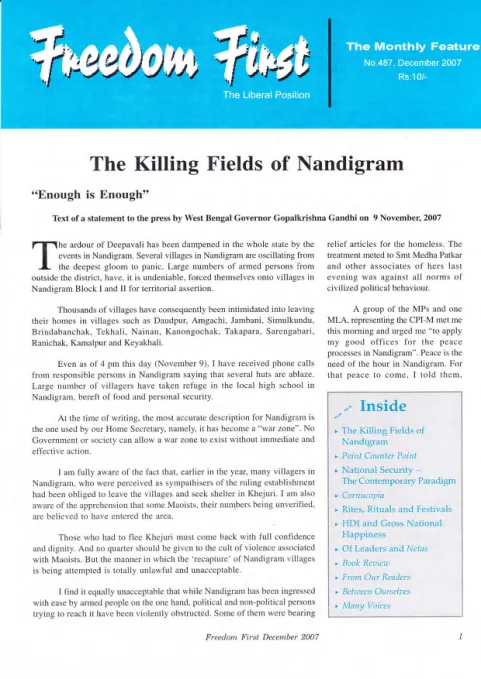
periodical issue
Freedom First
The Liberal Position
By Minoo Masani
Published by J. R. Patel for the Indian Committee for Cultural Freedom (ICCF) and printed by him at Kaiser-E-Hind Private Ltd., Plot No.A-191, Road No.16A, MIDC, Wagle Industrial Estate, Thane (W) - 400 604. · Mumbai · 2007
20 pages
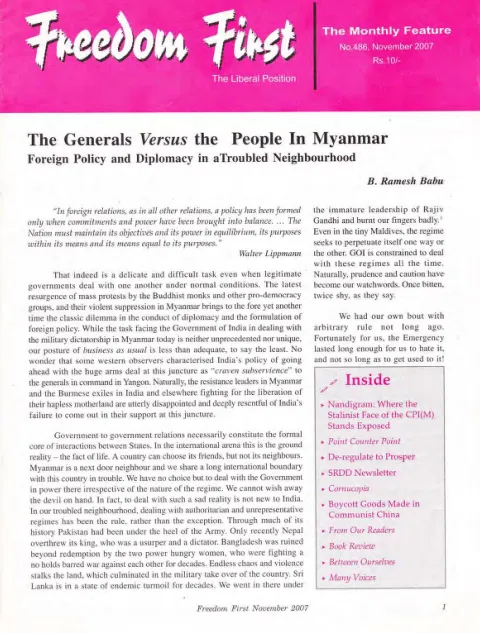
Freedom First
Summary
This is the November 2007 issue (No. 486) of Freedom First, the Bombay-based monthly of the Indian Committee for Cultural Freedom, edited by S. V. Raju. The lead feature, B. Ramesh Babu’s “The Generals Versus the People in Myanmar,” argues that India’s realpolitik dealings with the Yangon junta over the 2007 monk-led protests reflect a defensible but under-articulated balance between national-interest diplomacy and moral support for Myanmar’s pro-democracy movement, and reprints extracts of a 1965 Minoo Masani speech on what a Swatantra government would have done differently on planning and controls. Ashok Karnik’s recurring “Point Counter Point” debates whether India is a soft or a confused state, covers the Myanmar dilemma, chronic terrorism failures, and rising vigilantism. Nitin Raut’s essay accuses the CPI(M) of running a Stalinist, violent land-grab operation at Nandigram with the UPA’s tacit complicity. Uppili R.’s “De-regulate to Prosper” uses the Bollywood film Guru and a McKinsey study to argue that delicensing (as in the automobile sector) drives growth that continued regulation (as in agriculture) suppresses. The issue carries the Society for the Right to Die with Dignity’s newsletter in full, including R. N. Bhaskar’s essay defending euthanasia and the right to die with dignity, the Society’s 9th General Meeting minutes, and excerpts from H. D. Shourie’s 2005 Supreme Court writ petition seeking recognition of a fundamental right to die with dignity and a legally valid “Living Will.” Other pieces include Firoze Hirjikaka’s column on the hardening of Gujarati Hindu communal attitudes since Godhra and Narendra Modi’s political rise, a media-industry piece on the sacking of Afternoon Despatch & Courier’s CEO, a boycott campaign against Chinese-made goods on human-rights and environmental grounds, reader letters on the Indo-US nuclear deal and the Dalai Lama’s Congressional Gold Medal, C. A. Kalyanpur’s undelivered address on India’s China/Tibet policy, a book review of Vithal Kamat’s memoir, and the editor’s notes and a compilation of press quotations (“Many Voices”) on Nandigram and Indian politics.
Key points
-
Freedom First No. 486 (November 2007) leads with B. Ramesh Babu’s essay on India’s realpolitik dealings with Myanmar’s junta during the 2007 monk-led protests, reprinting extracts of a 1965 Minoo Masani speech on what a Swatantra government would have done on planning and controls.
-
Nitin Raut condemns the CPI(M)‘s handling of the Nandigram land conflict, accusing armed cadres of suppressing villagers resisting SEZ acquisition with alleged police and administration connivance, and criticising the UPA’s silence.
-
Uppili R.’s “De-regulate to Prosper” uses the film Guru and a 2001 McKinsey report to argue delicensing, as in the automobile sector, drives growth that continued agricultural regulation suppresses.
-
The Society for the Right to Die with Dignity’s newsletter carries R. N. Bhaskar’s essay invoking Camus to argue for a right to die with dignity, alongside excerpts from H. D. Shourie’s 2005 Supreme Court writ petition seeking a “Living Will.”
-
Firoze Hirjikaka’s “Cornucopia” reflects on how Gujarati Hindu political attitudes hardened since Godhra into support for Narendra Modi despite the Tehelka sting’s revelations of complicity in the violence.
-
An excerpted campaign piece from saveourearth.co.uk makes the case for boycotting Chinese-made goods on human-rights, environmental, and product-safety grounds, citing sweatshop labour, organ harvesting, and melamine-tainted goods.
-
C. A. Kallianpur’s undelivered welcome address argues Indian public discourse is selectively silent about Chinese colonialism in Tibet and elsewhere while remaining vocal about Western colonialism.
Essays
The Generals Versus the People In Myanmar: Foreign Policy and Diplomacy in a Troubled Neighbourhood
By B. Ramesh Babu
B. Ramesh Babu’s cover feature examines India’s diplomatic posture toward Myanmar’s military junta during the 2007 crackdown on Buddhist-monk-led pro-democracy protests. He argues India’s ‘business as usual’ approach, including a large arms deal signed even as protesters were being killed, has drawn criticism as ‘craven subservience,’ but defends realist government-to-government engagement as a practical necessity given shared borders, cross-border terrorism concerns, and China’s readiness to fill any vacuum India leaves. He contends India could have done more short of confrontation: delaying military hardware delivery, publicly demanding Aung San Suu Kyi’s release, and letting civil society and opposition parties voice support more openly. The essay closes urging India to use its democratic pluralism to keep channels open with whichever government eventually emerges in Myanmar. An inset sidebar reprints extracts from a 1965 speech by Minoo Masani to the Swatantra Forum in Calcutta, describing what a Swatantra-led government would have done: a ‘Holiday from Planning,’ abolition of the permit-licence raj, and a shift from non-alignment to a policy of interdependence.
- India’s Myanmar policy is criticised as ‘craven subservience’ for proceeding with an arms deal during the junta’s crackdown on monks
- Author argues government-to-government dealing with authoritarian regimes is standard practice in India’s troubled neighbourhood, citing Pakistan, Nepal, Bangladesh, Sri Lanka
- China’s readiness to back the Yangon junta and the loss of a gas deal to China complicate India’s options
- Author proposes India could delay delivery of military hardware, publicly back Aung San Suu Kyi’s release, and let civil society groups voice support more openly, without abandoning government-to-government ties
- Distinguishes between ‘domination’ (Big Brother) and ‘leadership by example’ as models for India’s regional conduct
- Sidebar: Minoo Masani’s 1965 Swatantra Forum speech sketches a Swatantra government’s three priorities — halting the Five-Year Plans, ending the permit-licence raj, and replacing non-alignment with interdependence
A Dream Only Partially Fulfilled (extracts from a 1965 Minoo Masani speech in Calcutta)
By Minoo Masani
No summary was extracted for this article. Listed for completeness.
Point Counter Point: India – A Soft State? / The Myanmar Maze / Chain of Failures? / Vigilantism
By Ashok Karnik
Ashok Karnik’s recurring ‘Point Counter Point’ column presents paired pro/con arguments on four topical questions: whether India is a soft (or confused) state given its handling of terrorism and populist pressures; the diplomatic dilemma posed by Myanmar’s junta and whether India has abandoned its earlier moral positioning; the recurring ‘chain of failures’ in preventing terror attacks despite intelligence alerts; and the rise of vigilante summary justice amid a collapsing criminal justice system, referencing the Justice Malimath Committee’s 2003 warnings.
- Debates whether India’s caution on POTA/TADA, coalition constraints, and the stalled nuclear deal reflect weakness or considered restraint
- Argues India’s 1988 support for Aung San Suu Kyi (Jawaharlal Nehru Award) contrasts with its quieter posture toward Myanmar in 2007, driven by competing security and economic interests with China
- Highlights repeated terror attacks (Malegaon, Hyderabad twice, Ajmer, Ludhiana) and the pattern of alerts followed by post-attack buck-passing between Centre and States
- Traces rising vigilantism (Vaishali/Bihar lynching, Nagpur court killing) to public loss of faith in a slow, ineffective judiciary, citing the Malimath Committee’s recommendations
- Closing box reprints a Vipul Mudgal (Hindustan Times) argument that the judiciary must adapt to India’s changing economic realities without compromising judicial independence
Nandigram: Where the Stalinist Face of the CPI(M) Stands Exposed
By Nitin Raut
Nitin Raut’s essay condemns the CPI(M)-led West Bengal government’s handling of the Nandigram land conflict, describing armed CPI(M) cadres suppressing villagers resisting SEZ land acquisition with the alleged connivance of police and administration. He criticises the UPA’s silence, contrasts the muted response to Nandigram with the uproar that would follow similar violence elsewhere in India, and calls out NGOs and the National Human Rights Commission for failing to investigate CPI(M)-ruled states. The essay (continued on page 18) concludes that Nandigram exposes Communism as a bankrupt, Stalinist ideology exploiting the weakness of the UPA coalition, and expresses hope that Nandigram could catalyse the collapse of communism in India as the fall of the Soviet Union did elsewhere.
- CPI(M) cadres are accused of using firearms to suppress Nandigram villagers resisting SEZ land acquisition, with police/administration complicity
- UPA national leadership, including the Prime Minister, is criticised for total silence on Nandigram despite the UPA’s dependence on Left support
- Contrasts the muted reaction to CPI(M) violence with the intense media/NGO/judicial response that similar violence elsewhere in India would provoke
- Accuses the National Human Rights Commission and NGOs of selective silence on communist-ruled West Bengal and Kerala
- Frames Nandigram as exposing the ‘Stalinist face’ of CPI(M) and a fossilised, bankrupt Communist ideology
- Closing section (p.18) argues West Bengal’s CPI(M)/Left Front rule has left the state economically backward, comparable to the late Soviet Union, and hopes Nandigram could herald communism’s collapse in India
De-regulate to Prosper
By Uppili R.
Uppili R.’s ‘De-regulate to Prosper’ opens with the Bollywood film Guru as an allegory for entrepreneurship stifled by the License Raj, then turns to a 2001 McKinsey report (‘India — Emerging to Surging’) arguing that regulatory barriers, especially government ownership and control, are the primary drag on India’s growth, potentially costing 4% of GDP and 75 million jobs if removed. The essay contrasts the delicensed automobile sector, which grew from 2 million to 9.7 million vehicles produced between 1991 and 2006, with the still tightly regulated agriculture sector, whose productivity growth remains capped near 2.5% and where farmer suicides have followed from unremunerative prices and lack of institutional credit. He proposes a ‘strong-weak’ regulatory model (government as facilitator rather than controller) as the template for accelerating India’s development. A boxed item afterward reprints Justice Krishna Iyer’s account of Lord Denning’s famous ‘Why Denning is an Ass’ anecdote about judicial immunity from public criticism.
- Uses the film Guru (Gurukant Desai/Dhirubhai-style entrepreneur) as an allegory for entrepreneurship constrained by the License Raj
- Cites a 2001 McKinsey report estimating deregulation could add 4% to India’s GDP growth and create ~75 million jobs
- Contrasts automobile sector delicensing (vehicle production up from 2 million in 1991 to 9.7 million in 2006) with continued heavy regulation of agriculture
- Notes agriculture’s productivity growth is capped near 2.5%, attributed to government control over prices, storage, transport, and limited farm credit (only 11% of targeted bank loans), contributing to farmer suicides
- Proposes a ‘strong weak’ model — government as developer/facilitator rather than controller — to replicate automobile-sector-style growth in other sectors
- Sidebar: Justice Krishna Iyer’s account of the ‘Why Denning is an Ass’ episode, on judges’ inability to publicly rebut criticism
SRDD Newsletter: They Shoot Horses, Don’t They? / Organisational Matters / A Writ Petition in the Supreme Court to legalise “The Living Will”
By R. N. Bhaskar
The Society for the Right to Die with Dignity (SRDD) newsletter for November 2007 leads with R. N. Bhaskar’s essay ‘They Shoot Horses, Don’t They?’, which uses Albert Camus’s reflections on whether life is worth living to argue for a right to die with dignity, distinguishing passive euthanasia (withholding treatment) from active euthanasia (direct intervention, with or without consent) and concluding that a person’s life belongs to them, hence they should have the right to end it when living becomes unbearable. This is followed by minutes from the Society’s 9th General Meeting (10 June 2007) covering membership fees, a tribute to the late Professor Sadanand Varde, a new Executive Committee headed by Dr. Nagraj Huilgol, and obituaries for committee member Mr. N. V. Khote and long-time member Mr. Pinakin Shah. The newsletter closes with excerpts from the synopsis of H. D. Shourie’s April 2005 Supreme Court writ petition (Shourie died two months after filing it) seeking recognition of the ‘right to die with dignity’ as a fundamental right under Article 21 and legal validity for a ‘Living Will and Attorney Authorisation’ document, citing Gian Kaur vs. State of Punjab and Francis Coralie Mullin vs. Administrator, Union Territory of Delhi.
- R. N. Bhaskar invokes Albert Camus’s question ‘Is life worth living?’ to frame the moral case for a right to die with dignity
- Distinguishes passive euthanasia (withholding treatment, largely legal) from active euthanasia (direct intervention, with or without consent, highly controversial)
- Concludes that if a person’s life belongs to them, they should have the right to end it when living with dignity is no longer possible
- SRDD’s 9th General Meeting (10 June 2007) reported 195 members, adopted new membership fee tiers, and elected Dr. Nagraj Huilgol as Chairman and Dr. Surendra Dhelia as General Secretary
- The Society mourned the deaths of Professor Sadanand Varde (its former Chairman), committee member N. V. Khote, and long-time member Pinakin Shah
- H. D. Shourie’s April 2005 Supreme Court writ petition (his last act before his death two months later) sought a declared fundamental right to die with dignity and legal recognition of a ‘Living Will,’ citing Gian Kaur vs. State of Punjab (1996) and Francis Coralie Mullin vs. Administrator, UT of Delhi (1981)
Cornucopia: Has the ‘Gujaratis’ World View Changed? / Our Corporate Emperors
By Firoze Hirjikaka
Firoze Hirjikaka’s ‘Cornucopia’ column reflects on how the political outlook of Gujarati Hindus has hardened since the 2002 Godhra riots, transforming an apolitical, commerce-focused community, in his account, into supporters of Narendra Modi despite documented complicity in post-Godhra violence revealed by the Tehelka sting operation. He questions the reasoning by which Modi’s economic achievements are seen to offset or excuse communal violence, drawing an explicit comparison to Adolf Hitler’s economic achievements in Germany to challenge that logic.
- Describes Gujaratis as historically apolitical and commerce-focused before Godhra, based on personal friendships
- Argues post-Godhra violence transformed the community’s outlook, with even educated Gujaratis defending Modi’s rule despite the Tehelka sting revelations
- Notes the political calculation among Modi’s opponents about whether the Tehelka revelations help or hurt him electorally
- Challenges the ‘economic development excuses violence’ reasoning by comparing it to Adolf Hitler’s economic record in Germany
Our Corporate Emperors,
An unsigned commentary, ‘Our Corporate Emperors,’ uses the abrupt September 2007 sacking of Afternoon Despatch & Courier CEO Farzana Contractor by proprietor Kamal Morarka as a case study in the outsized egos of Indian business heads, arguing the dismissal (ostensibly over a mistaken photo caption) reflected imperial management style rather than genuine performance concerns, and laments the decline of the newspaper since founding editor Behram Contractor’s death.
- The Afternoon’s CEO Farzana Contractor was abruptly sacked by proprietor Kamal Morarka after a caption mistakenly listed her as editor
- Author argues the swift, humiliating dismissal reflects a pattern of imperial, ego-driven management among Indian business heads
- Notes The Afternoon’s declining advertising revenue under Contractor’s tenure but credits her with maintaining editorial quality since founding editor Behram Contractor’s death
- Concludes Contractor never stood a chance against Morarka’s greater institutional power
Boycott Goods Made in Communist China
‘Boycott Goods Made in Communist China,’ excerpted from the website saveourearth.co.uk and opening with a quote from Lhasang Tsering (advisor to the Made in China boycott campaign), makes the case for a consumer boycott of Chinese goods on human-rights grounds (sweatshop labour, suppression of Tibetans, organ harvesting from executed prisoners, trafficking of women and children), environmental grounds (China as the world’s leading polluter, illegal rainforest timber imports for ‘shabby chic’ furniture, heavy reliance on coal power), and product-safety grounds (toxic toys, contaminated food and toothpaste). It calls on readers to stop buying Chinese-made Christmas goods as an ethical and political statement, while explicitly not urging a boycott of Chinese restaurants or shops run by people who left China to escape persecution.
- Frames the boycott as a moral stand against an oppressive regime, not merely a symbolic act, quoting campaign advisor Lhasang Tsering
- Documents human rights abuses: sweatshop conditions, torture of Tibetans, an estimated 15,000 cases of trafficking of women and children, and organ harvesting from executed prisoners (citing Wang Guoqi’s account reported in the Guardian)
- Details China’s environmental record: world’s leading polluter, 80% coal-dependent electricity with 554 new power stations planned, illegal rainforest timber imports feeding Western ‘shabby chic’ furniture demand
- Cites product-safety scandals: melamine-tainted pet food, lead-laced Sponge Bob toys, antifreeze-laced toothpaste, and diethylene-contaminated cough syrup linked to deaths in Panama
- Explicitly frames the campaign as support for the Chinese people and Tibetans, not an attack, and asks readers not to boycott local Chinese restaurants or shops run by those who fled persecution
- Sidebar cites Keith Bradsher (New York Times) on Wall Street’s ties to Chinese state surveillance technology firms, invoking Orwell’s 1984
From Our Readers: Indo-US Nuclear Deal – Thorium is Not the Answer / Congressional Medal for The Dalai Lama
By B. P. Rastogi; S. C. Panda
The ‘From Our Readers’ letters page carries two items: a detailed technical rebuttal from B. P. Rastogi (a 36-year Bhabha Atomic Research Centre veteran) disputing N. S. Venkataraman’s earlier Freedom First article on the Indo-US nuclear deal, explaining why thorium is not a straightforward alternative fuel and reviewing the history of India’s nuclear power programme and its constraints since Pokhran-I; and a shorter letter from S. C. Panda welcoming the US Congressional Gold Medal awarded to the Dalai Lama, criticising China’s routine objections to honours for him and highlighting Tibetan human rights concerns.
- B. P. Rastogi rebuts a prior Freedom First (September 2007) article by N. S. Venkataraman, arguing thorium requires far more fissile material enrichment than uranium and is not a simple substitute fuel
- Rastogi traces the history of India’s nuclear power generation, including reliance on UK, Canadian, US, and French fuel/technology, and the post-Pokhran-I international isolation of India’s nuclear programme
- Notes nuclear power contributes only 3% of India’s electricity and argues the Indo-US nuclear deal aims to bring India back into the global nuclear mainstream
- S. C. Panda’s letter praises the US Congress for awarding the Dalai Lama its Gold Medal and criticises China’s routine framing of such honours as interference
India’s China Policy: “Indians are Useful Idiots” – the unread Welcome Address of C. A. Kallianpur
By C. A. Kallianpur
This piece reprints the ‘Welcome Address’ C. A. Kalyanpur, National Coordinator of Friends of Tibet (India), would have delivered at a September 13, 2007 India International Centre panel discussion on ‘India’s China Policy — Need for an Overhaul,’ had he not been drugged and robbed en route to Delhi. The address argues that Indian commentary on colonialism focuses on Western imperialism while remaining silent about ongoing Chinese colonial control over Tibet, Manchuria, Inner/Southern Mongolia, Eastern Turkestan, and Yunnan/Guangxi-Zhuang, and criticises Indian intellectuals and media for uncritically accepting Neville Maxwell’s account of the 1962 war and for failing to confront China’s own record even while readily criticising Pakistan.
- Argues Indian public discourse is selectively silent about Chinese colonialism in Tibet and other regions, while vocal about Western colonialism
- Recounts a personal exchange with Tibet scholar Dr. Alastair Lamb’s critic Dr. Alex McKay at Dharamshala, illustrating divergent views on Britain’s role in Tibet’s early-20th-century history
- Criticises an unnamed national daily’s editor and a regular Indian Express contributor for asymmetric treatment of ‘Greater Tibet’ versus ‘Greater China’
- Cites Chinese Premier Chou En-lai’s reported remark that Indians are ‘useful idiots’ as emblematic of India’s naive China policy
- Notes the author was drugged and robbed while travelling by train to the conference and was found later in a government hospital in Mathura, missing for several days
Book Review: Idli, Orchid and Will Power by Vithal Venkatesh Kamat
By Professor Chari
Professor Chari reviews Vithal Venkatesh Kamat’s memoir ‘Idli, Orchid and Will Power’ (Orchid Books, 2005), tracing Kamat’s rise from a job in a London restaurant to building The Orchid, an award-winning environmentally friendly hotel in Mumbai. The review highlights anecdotes of Kamat’s resourcefulness (improving Idli fermentation technique, fulfilling a last-minute order for 2,000 laddoos) as illustrations of the grit and determination the book holds up as a model for aspiring entrepreneurs, noting the book is dedicated to the late Behram Contractor (‘Busybee’).
- Reviews Vithal Venkatesh Kamat’s memoir ‘Idli, Orchid and Will Power’ (2005, 246 pages, Rs.150)
- The Orchid hotel won the ECOTEL award for most environmentally friendly hotel at a 1999 Durban conference
- Recounts anecdotes of Kamat’s early career at a London restaurant (Shaan) and his problem-solving approach to food preparation and large custom orders
- Frames the book as valuable for aspiring entrepreneurs beyond the hotel industry, emphasising grit and singleness of purpose
- Notes the book is dedicated to the late Behram Contractor (‘Busybee’), an avid gourmet
Between Ourselves …
By Editor
The editor’s ‘Between Ourselves’ column criticises the CPI(M)‘s growing arrogance in propping up the UPA government while treating West Bengal as beyond central oversight, citing former CPI(M) minister Ashok Mitra’s own criticism of the party, and blames the BJP’s weak opposition role for enabling this dynamic; it also announces subscription renewal deadlines and a forthcoming April 2008 issue on the future of parliamentary democracy. The accompanying ‘Many Voices’ page compiles press quotations on Nandigram, West Bengal politics, capitalism versus communism, and other topical remarks from commentators including Harsha Bhogle, Niranjan Rajadhyaksha, Pratap Bhanu Mehta, and former CPI(M) minister Ashok Mitra.
- The editor accuses CPI(M) leaders (Karat, Mrs. Karat, Yechury) of behaving as though ruling India rather than merely supporting the UPA coalition, citing former CPI(M) minister Ashok Mitra’s own criticism
- Blames the BJP’s weak opposition role for enabling CPI(M)‘s outsized influence over the UPA government
- Announces subscription renewal terms and a forthcoming April 2008 issue on the future of parliamentary democracy and the kind of political parties needed to protect liberal democracy
- ‘Many Voices’ compiles quotations from Ashok Mitra (Hindustan Times) on Nandigram and Mamata Banerjee, Harsha Bhogle on cricket captaincy, Niranjan Rajadhyaksha on East/West Germany and capitalism versus communism, a Nobel museum curator on Gandhi, and Pratap Bhanu Mehta on Nandigram as a political opportunity for various actors
Generated by the v1.5 extraction pipeline. Awaiting editorial review.
Metadata and summary are AI-extracted from the source PDF and reviewed for editorial accuracy. The original work is available via the Read PDF tab above (where present); paragraph-level citation inside the PDF is deferred to a future engagement.