periodical issue
Freedom First
The Liberal Position
Freedom First · 2009
28 pages
Freedom First
Summary
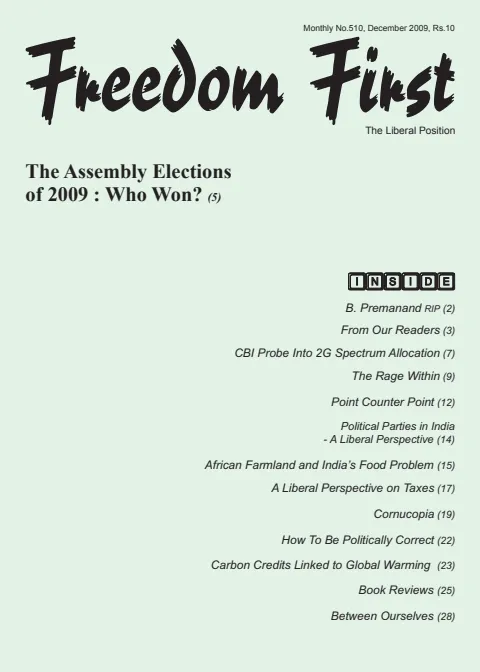
The rendered pages show the December 2009 issue of Freedom First as a liberal periodical responding to current Indian politics, corruption, governance failure, internal security, and economic policy. The issue opens with a tribute to rationalist B. Premanand and reader letters on national security, political-party control, corruption, open government, development leakages, and the itinerant life of military service. Its major political pieces assess the October 2009 Assembly elections, the BJP’s role as opposition, allegations around 2G spectrum allocation, and the spread of Maoist/Naxalite violence amid wider institutional decay.
Key points
-
A tribute to rationalist B. Premanand remembers his village-to-village science demonstrations, his magazine Indian Skeptic, and his deathbed declaration rejecting rumours that illness had turned him toward religion.
-
Nitin G. Raut argues the October 2009 Assembly election results should not be read as a sweeping Congress mandate, attributing the Maharashtra victory partly to opposition fragmentation from the MNS split and faulting the BJP for weak leadership and opposition-for-opposition’s-sake tactics.
-
Keshav Rau criticises Prime Minister Manmohan Singh’s public comments giving a ‘clean chit’ during the 2G spectrum allocation investigation as undermining the independence of the CBI and Central Vigilance Commission.
-
H. R. Bapu Satyanarayana reads strikes, caste and regional unrest, Maoist violence, and corruption as symptoms of a deeper national disaffection produced by political degeneration and compromised institutions, while acknowledging India’s agricultural, scientific, and military achievements.
-
Ashok Karnik’s “Point Counter Point” weighs the Maharashtra election result against continuing MNS-style vote splitting and street violence, and dismisses Pakistani claims linking India to Taliban violence as domestic propaganda.
-
Giridhar Prabhu argues Indian political parties operate in ways hostile to constitutional democracy, calling for party constitutions to be reviewed against democratic norms and party resources separated from state resources.
-
Neelakant Patri examines Indian companies buying or leasing African farmland for food production, linking the trend to India’s food-security concerns amid monsoon failure and pulse and sugar shortages.
-
Sanjeev Sabhlok’s second part on liberal taxation argues for a broader tax base, less regressive taxation, and lower company taxes, while Firoze Hirjikaka’s “Cornucopia” criticises the Maharashtra government’s delayed air support for police during a Naxalite ambush in Gadchiroli.
Essays
B. Premanand RIP
The tribute presents B. Premanand as a leading Indian rationalist, atheist, and debunker of supernatural claims. It describes his village-to-village science demonstrations, his magazine Indian Skeptic, his book Science versus Miracles, and his deathbed declaration rejecting rumours that illness had turned him toward religion.
- Premanand is framed as a modern heir to India’s Charvaka tradition.
- The article emphasizes rationalism, science communication, and public exposure of fraudulent godmen.
- His deathbed declaration rejects supernaturalism, rebirth, and conversion rumours.
From Our Readers
The reader letters range across defence preparedness, internal security, corruption, political-party hierarchy, transparency, and welfare leakage. Several letters press for stronger armed forces, open public records, protection of the Right to Information Act, independent monitoring of social-sector spending, and better anti-corruption systems.
- A retired soldier argues that India needs security reform, intelligence coordination, and stronger armed forces.
- Other letters criticize autocratic control within political parties and corruption in public administration.
- The RTI Act is defended as essential to open government.
- Development spending is criticized for leakage before it reaches the poor.
The Assembly Elections of 2009 : Who Won?
By Nitin G. Raut
Nitin G. Raut argues that the October 2009 Assembly results should not be read as a sweeping Congress mandate. He calls the Congress victory in Maharashtra and Haryana partly arithmetic and partly the product of opposition fragmentation, especially the MNS split in Maharashtra, while faulting the BJP for weak leadership, internal disarray, and opposition-for-opposition’s-sake on the India-US nuclear deal.
- The Congress-NCP victory in Maharashtra is described as narrow and undeserved by performance.
- Rahul Gandhi’s visits to Dalit homes are dismissed as symbolic politics rather than structural concern for poverty.
- The BJP is urged to modernize, move beyond non-issues, and act as a responsible national opposition.
- The conclusion warns that parochial parties, Taliban pressures, and Maoist-Naxalite insurgency threaten Indian democracy and security.
CBI Probe Into 2G Spectrum Allocation
By Keshav Rau
Keshav Rau criticizes Prime Minister Manmohan Singh’s public comments on the 2G spectrum investigation, arguing that they undermined the Central Vigilance Commission and compromised the perceived independence of the CBI. The article treats both the Prime Minister’s clean chit and the BJP’s demand for the minister’s removal as premature interventions before an investigation could run its course.
- The article explains the 2G allocation controversy as a question of opaque pricing and possible lost public revenue.
- It recalls earlier attempts to protect vigilance inquiries and investigative independence.
- It argues that public comments by ministers during an investigation create a dangerous precedent.
- It warns that the credibility of both the CBI and CVC could be damaged.
The Rage Within
By H. R. Bapu Satyanarayana
H. R. Bapu Satyanarayana reads strikes, caste and regional unrest, Maoist violence, corruption, weak public services, and external security pressures as symptoms of a deeper national disaffection. He argues that protests are often not only claims for specific rights but expressions of a broader rage produced by political degeneration, lawlessness, poverty, and compromised institutions.
- The Maoist struggle is linked to tribal dispossession, state indifference, and failed development.
- The article condemns corruption and claims that scandals have taught citizens to expect impunity.
- It balances criticism with acknowledgment of India’s agricultural, scientific, IT, diaspora, and military achievements.
- It warns that China, Bangladesh-linked infiltration, Tamil politics, and corruption all affect national security.
Point Counter Point
By Ashok Karnik
Ashok Karnik’s Point Counter Point presents paired arguments on the Maharashtra elections, state action against Naxalites, and Pakistan’s claims about Indian links to the Taliban. The column repeatedly weighs democratic fragmentation, violence by non-state actors, and strategic propaganda, while ending with a reader’s call to honour India’s armed forces with the seriousness seen in other countries.
- One side welcomes a clear Maharashtra result; the other warns that MNS-style vote splitting and street violence remain dangerous.
- The column rejects romantic or ideological justifications for violence by non-state actors.
- It treats Pakistani claims linking India to Taliban violence as propaganda for domestic consumption.
- A closing note criticizes India for neglecting public commemoration of soldiers’ sacrifices.
Political Parties in India - A Liberal Perspective
By Giridhar Prabhu
Giridhar Prabhu argues that Indian political parties operate in ways hostile to constitutional democracy. He calls for party constitutions to be reviewed against democratic principles, party resources to be separated from state resources, and party organizations to be treated as accountable institutions rather than private vehicles for feudal, dictatorial, totalitarian, or socialist practices.
- Party constitutions are judged against the Preamble and democratic norms.
- The article says honest citizens are driven away from political life by present party practices.
- It argues that party constitutions should be subject to constitutional and legal frameworks.
- The author presents reform of parties as necessary for liberal democracy.
African Farmland and India’s Food Problem
By Neelakant Patri
Neelakant Patri examines Indian companies buying or leasing African farmland to grow food for Indian consumption. He notes the international rush for farmland by China, South Korea, Saudi Arabia, Egypt, and Gulf states, then connects the trend to Indian food security, monsoon failure, pulse and sugar shortages, import pricing, and the government’s obligation to maintain subsidised food supplies.
- The article asks whether Indian farmland ventures in Africa should be welcomed or treated cautiously.
- It links overseas farming to concerns about future food shortages and India’s public stocks.
- It warns that Indian import announcements can encourage suppliers to raise prices.
- It raises the ethical risk that exported food could leave host-country populations short.
A Liberal Perspective on Taxes
By Sanjeev Sabhlok
Sanjeev Sabhlok’s second part on liberal taxation rejects both utopian low-tax thinking and India’s socialist pattern of low overall taxation combined with poor public goods. He argues for taxation sufficient to fund core state functions, a broader tax base, less regressive taxation, lower company taxes with franked dividends, reduced indirect taxes, and eventual movement toward a broadly flat system after governance reform.
- The essay argues that citizens, rather than companies, are the proper subjects of taxation.
- It criticizes regressive taxation, especially light treatment of capital gains and heavy indirect taxes on the poor.
- It says India should raise tax collection only alongside governance reforms.
- It proposes broad annual income and wealth returns as part of poverty elimination and tax-base expansion.
Cornucopia
By Firoze Hirjikaka
Firoze Hirjikaka’s Cornucopia section begins with a critique of the recurring Bombay/Mumbai naming controversy, treating it as political intimidation rather than civic improvement. It then criticizes the Maharashtra government’s handling of a Naxalite ambush in Gadchiroli, contrasting the delay in sending air support for police with easy helicopter access for an election candidate, and begins a third reflection on natural disasters and apocalyptic anxiety that is cut off at page 20.
- The Bombay/Mumbai dispute is framed as a manufactured controversy exploited by the MNS.
- The author argues that political jingoism changed little in the daily life of ordinary citizens.
- The Gadchiroli piece criticizes bureaucratic and electoral priorities that left police without timely support.
- The final visible section begins to ask whether recent floods, earthquakes, tsunamis, and climate anxieties point to wider planetary crisis.
Generated by the v1.5 extraction pipeline. Awaiting editorial review.
Metadata and summary are AI-extracted from the source PDF and reviewed for editorial accuracy. The original work is available via the Read PDF tab above (where present); paragraph-level citation inside the PDF is deferred to a future engagement.