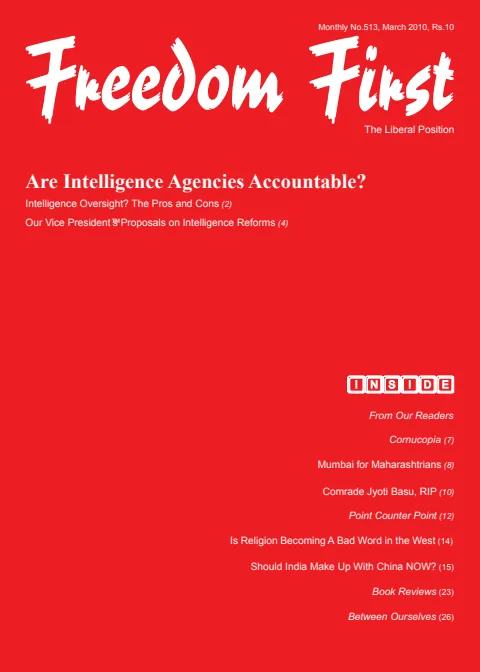
periodical issue
Freedom First
The Liberal Position
By Meera Sanyal, Sadanand B. Kumta, Firoze Hirjikaka, Sunita, R. C. Saxena, Ashok Karnik, N. S. Venkataraman, Nitin G. Raut, V. Venkateswaraprasad, Firoze Hirjikaka, Brig. F. S. B. Mehta (Retd.), Ashok Karnik
Freedom First · 2010
28 pages
Freedom First
Summary
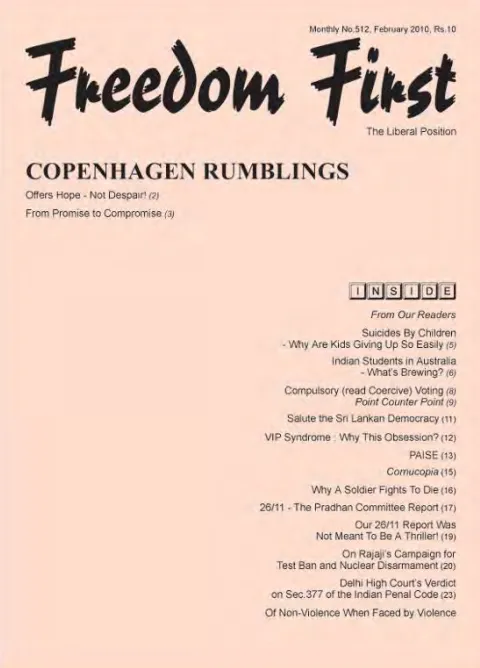
The rendered pages show the February 2010 issue of Freedom First, organized around contemporary liberal commentary, letters, and short essays. The opening cover foregrounds the Copenhagen climate summit, and in the rendered pages the issue repeatedly returns to climate policy, energy, development, and governance: Meera Sanyal argues that Copenhagen should be read as an opportunity for practical Indian innovation rather than despair, Sadanand B. Kumta criticizes the Copenhagen accord as a compromise that weakens Kyoto-style obligations, and Ashok Karnik stages competing arguments on climate negotiations in his Point Counter Point column.
Key points
-
Meera Sanyal’s climate essay reads the Copenhagen summit’s failure as less important than practical lessons India can draw from local climate action, proposing solar PV electrification of villages instead of abstract emissions formulas.
-
Sadanand B. Kumta reviews the Kyoto Protocol and Copenhagen accord, arguing the outcome left targets vague and effectively benefited the United States and China while leaving India’s declared defence of developing-country interests outmanoeuvred.
-
Firoze Hirjikaka’s essay on child suicides links youth despair and violence to academic pressure, consumption, peer pressure, and parental indulgence, calling for parents to restore the discipline of saying no.
-
Sunita, writing from Australia, challenges the framing of attacks on Indian students as simply racist, arguing that crime, precarious work, poor assimilation, and media amplification all complicate the picture following Nitin Garg’s death.
-
R. C. Saxena attacks Gujarat’s compulsory voting legislation as illiberal and coercive, arguing the Constitution creates neither a right nor a duty to vote.
-
Ashok Karnik’s “Point Counter Point” weighs Copenhagen as either failure or pragmatic progress, debates the merits of creating new smaller states, and separates procurement concerns over bullet-proof jackets from the mistaken belief that equipment failure caused 26/11.
-
N. S. Venkataraman praises Sri Lanka’s decision to hold a presidential election soon after its civil conflict as a sign of democratic confidence, while flagging unresolved concerns about press harassment and reassurance to Tamil civilians.
-
Nitin G. Raut criticises India’s VIP culture through the Shah Rukh Khan airport-detention controversy, arguing legal equality and security should not be subordinated to celebrity status.
-
Ashok Karnik analyses the Pradhan Committee report on 26/11, praising its speed and integrity while criticising public fixation on leaked bullet-proof jacket files over the deeper failures in threat appreciation, coastal security, and intelligence handling.
Essays
From Our Readers
The rendered letters pages defend Freedom First’s anti-totalitarian origin story, discuss the magazine’s future, praise Tata relief work after 26/11, demand ecological action in the Nilgiris after landslides, compare Indian inquiry commissions with the United States 9/11 Commission, and argue that proportional representation and run-off voting could reduce criminality and distortion in Indian elections.
- A reader links Freedom First to Minoo Masani’s struggle against communist totalitarianism and asks it to keep fighting misgovernance, terrorism, Naxalism, and corruption.
- A letter praises the Tata Public Service Welfare Trust for supporting families affected by the 26/11 attacks.
- D. Raman attributes Nilgiris landslide damage to ignored ecological warnings, slope construction, deforestation, and official corruption.
- Jyotibhai Desai contrasts the openness and urgency of the 9/11 Commission with Indian inquiry practices.
- Subhash Athale argues that India’s electoral system blocks honest citizens and encourages a chain of graft.
Offers Hope - Not Despair!
By Meera Sanyal
Meera Sanyal’s climate essay reads the Copenhagen summit’s failure to produce a full protocol as less important than the practical lessons India can draw from the city of Copenhagen, grassroots environmental action, and commercially viable clean technology. She argues that India should move from abstract emissions formulas to concrete goals such as solar electrification of villages, presenting climate action as innovation, public-goods protection, and development.
- The essay argues that political failure at Copenhagen need not produce despair.
- Copenhagen city is presented as an example of measurable, local climate planning.
- The piece praises local activism, corporate clean-technology investment, and younger voters’ concern for public goods.
- India is criticized for being projected as obstructionist rather than visionary in climate diplomacy.
- The practical policy proposal is solar PV electrification for Indian villages.
From Promise to Compromise
By Sadanand B. Kumta
Sadanand B. Kumta reviews the Kyoto Protocol, the Copenhagen summit, India’s negotiating position, and the final accord. He argues that the Copenhagen outcome left targets vague, made Kyoto’s future uncertain, allowed more international scrutiny, and benefitted the United States and China while leaving India outmaneuvered despite its declared defence of developing-country interests.
- The Kyoto Protocol’s planned emission reductions are described as largely unrealized.
- The Copenhagen summit is presented as acrimonious, divided among rich countries, BASIC countries, the G-77, and other states.
- India’s official stand stresses development, equitable burden-sharing, and Kyoto commitments.
- Kumta argues that MRV and consultation diluted India’s position.
- The essay closes by calling the accord a compromise and warning of ecological disaster.
Suicides By Children - Why Are Kids Giving Up So Easily
By Firoze Hirjikaka
Firoze Hirjikaka asks why children and young adults appear to be succumbing to despair and violence so easily. The essay links youth suicide and crime to academic pressure, rising consumption, peer pressure, instant gratification, and parental indulgence, ending with a call for parents to rediscover the discipline of saying no.
- Recent child suicides are treated as signs of a wider youth crisis.
- The essay distinguishes contemporary pressures from older forms of hardship and rebellion.
- It links spending power, fashion, media, and instant entertainment to poor frustration tolerance.
- Parents are criticized for extreme pampering and for making every desire seem reachable.
- The proposed remedy is not policy but restored parental limits.
Indian Students in Australia - What’s Brewing?
By Sunita
Sunita’s essay, written from Australia, challenges the framing of attacks on Indian students as simply and primarily racist. She acknowledges frightening violence and Australia’s damaged image, but argues that crime, student vulnerability, precarious work, poor assimilation, media amplification, and bilateral politics all complicate the picture.
- The essay opens with concern about attacks on Indian students, including Nitin Garg’s death.
- Australia’s international education sector is described as economically important and under pressure.
- Sunita argues that race may be present but is not the sole or primary cause of attacks.
- The essay urges better induction, cultural adaptation, security, and policing around colleges and migration agents.
- It warns that media-driven hate worsens anxiety for students and families.
Compulsory (read Coercive) Voting
By R. C. Saxena
R. C. Saxena attacks Gujarat’s compulsory voting legislation as illiberal, retrograde, and coercive. He argues that voting is an expression of will that cannot be compelled, that the Constitution does not impose a fundamental duty to vote, and that coercion would convert citizens into subjects.
- The Gujarat Local Authorities Laws amendment is criticized as contrary to liberal democracy.
- The essay argues that voting is a discretionary expression, not something that can be forced.
- Saxena says Indian democracy is already representative enough given its diversity and party system.
- He denies that the Constitution creates either a right or duty to vote.
- The closing question asks what compelling public interest could justify compulsory voting.
Point Counter Point
By Ashok Karnik
Ashok Karnik’s Point Counter Point presents paired arguments on Copenhagen climate negotiations, demands for new states, and bullet-proof jackets after 26/11. The format stresses that public questions have competing sides: Copenhagen can be read as either a failure dressed up as compromise or as a pragmatic work in progress; smaller states can be seen as responsive decentralization or administrative fragmentation; and jacket procurement can signal either corruption or unrealistic expectations about protective gear.
- The column explicitly frames itself as a way to examine more than one side of an issue.
- On climate, it contrasts disappointment at Copenhagen with a defence of the accord as imperfect progress.
- On state reorganization, it balances local self-government against fragmentation and administrative cost.
- On bullet-proof jackets, it separates procurement concerns from the mistaken belief that equipment failure caused 26/11.
- A Google Blog excerpt attached to the page frames Chinese censorship as a free-speech issue.
Salute the Sri Lankan Democracy
By N. S. Venkataraman
N. S. Venkataraman praises Sri Lanka’s decision to hold a presidential election soon after civil conflict and sees the former military chief’s candidacy as evidence of democratic confidence. The essay also notes unresolved concerns: harassment of journalists, insufficient reassurance to Tamil civilians, and the need for the government to make post-war democracy more credible.
- The essay presents Sri Lanka’s presidential election as a sign of national confidence after war.
- A former military chief contesting the presidency is treated as especially democratic.
- Venkataraman compares harsh Sri Lankan election rhetoric with practices in India and the United States.
- The essay criticizes the government for not addressing international concerns about journalists.
- It calls for reassurance to Tamil communities in Jaffna and other affected areas.
VIP Syndrome : Why This Obsession?
By Nitin G. Raut
Nitin G. Raut criticizes India’s VIP culture through the controversy over Shah Rukh Khan’s detention at a United States airport. The essay argues that legal equality and national security should not be subordinated to celebrity status, and that India should learn from stricter anti-terror rules rather than expect foreign governments to relax them for elites.
- The essay dismisses the Shah Rukh Khan airport controversy as inflated political and media hype.
- Raut argues that the United States is entitled to enforce anti-terror laws seriously.
- Indian celebrity and political privilege are criticized as anti-democratic and above the law.
- VIP security is described as costly, socially corrosive, and sometimes dangerous to ordinary citizens.
- The essay calls for tougher security laws and less deference to celebrity sentiment.
PAISE
By V. Venkateswaraprasad
V. Venkateswaraprasad’s PAISE primer links poverty, agriculture, physical infrastructure, social infrastructure, education, health, and environment into a broad developmental agenda. The essay argues that poor people must be equipped to identify and solve their problems, that agriculture needs better education and markets, that infrastructure finance and power reform are essential, and that social harmony, education, health, and environmental stewardship must accompany material development.
- Poverty is defined as inability to address basic needs, and empowerment is framed as self-identification of problems.
- Agriculture is called the backbone of the Indian economy, with market access and middlemen presented as key issues.
- Infrastructure is defined broadly to include defence, roads, ports, power, telecom, education, and finance.
- Social infrastructure is tied to education, religious tolerance, individual respect, and harmony.
- The environmental section lists climate change, forests, energy, genetic engineering, pollution, and resource depletion.
Cornucopia
By Firoze Hirjikaka
The rendered Cornucopia page by Firoze Hirjikaka argues that post-9/11 security reactions, especially in air travel, have steadily eroded personal freedoms and given terrorists the power to disrupt ordinary life. A second item begins on bullet-proof jackets and missing files, calling the 26/11 jacket controversy routine and predictable, but it continues beyond the rendered pages.
- Airport security is portrayed as a succession of overreactions to inventive threats.
- The column argues that terrorists are effectively setting the terms of public inconvenience.
- It questions whether blanket procedures are less effective than intelligence-based security.
- The bullet-proof jacket item begins by rejecting sensational treatment of missing files.
- The second item is visibly incomplete in this chunk.
Why A Soldier Fights To Die
By Brig. F. S. B. Mehta (Retd.)
The rendered opening of ‘Why A Soldier Fights To Die’ presents Brig. F. S. B. Mehta’s introduction to notes by the late Brigadier Noshir Grant and then argues that India forgets soldiers quickly after wars such as Kargil. The visible section asks why soldiers accept death, arguing that the answer lies not in pay or promises but in honour, social prestige, regimental pride, and the cultivation of superiority in military identity. The article continues beyond the rendered pages.
- The piece is introduced as extracted from unpublished notes by Brigadier Noshir Grant.
- Kargil is used as an example of brief patriotic attention followed by forgetting.
- A poll is cited to show low interest among undergraduates and postgraduates in joining the armed forces.
- The visible argument says soldiers die because they are made to believe in honour and superior civic identity.
- The piece continues on a later page not rendered in this chunk.
26/11 - The Pradhan Committee Report
By Ashok Karnik
Ashok Karnik analyzes the Pradhan Committee report on the 26/11 attacks, praising the committee’s speed and integrity while criticizing the narrowness of its mandate and the public focus on leaks, jackets, and police blame. The visible pages summarize findings on Mumbai Police preparedness, command failures, coast-side coordination, neglected intelligence alerts, and the limits of a post-mortem report when reliable intelligence is the only way to prevent such attacks.
- The committee is described as a high-level inquiry with a limited role rather than a commission of inquiry.
- Karnik says media and opposition attention on leaks and missing bullet-proof jacket files obscured the prevention question.
- The report identified poor threat appreciation, intelligence handling, equipment readiness, and visible leadership.
- The article lists failures in Quick Response Teams, the control room, SOP adherence, coastal security, and treatment of Centre alerts.
- The visible conclusion argues that new agencies are no substitute for credible field intelligence.
Generated by the v1.5 extraction pipeline. Awaiting editorial review.
Metadata and summary are AI-extracted from the source PDF and reviewed for editorial accuracy. The original work is available via the Read PDF tab above (where present); paragraph-level citation inside the PDF is deferred to a future engagement.