periodical issue
Freedom First
The Liberal Position
By Christie Davies, V. Balachandran, Ashok Karnik, Firoze Hirjikaka, Ashok Karnik, Eustace D'Souza, Suresh C. Sharma, Ali Khwaja, Lt. Gen. Harbhajan Singh (Retd.), Firoze Hirjikaka, Bhaskar Roy
Freedom First · 2010
28 pages
Freedom First
Summary
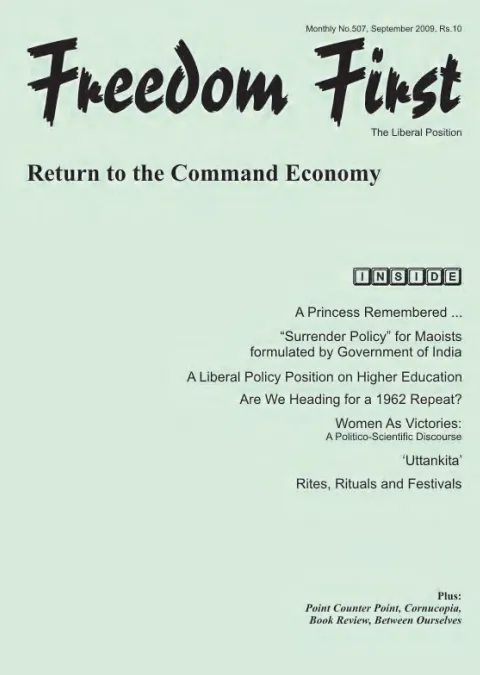
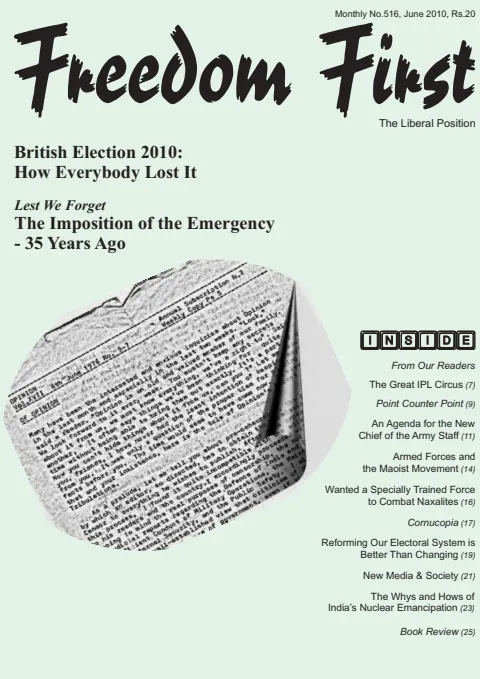
The rendered pages show the June 2010 issue of Freedom First as a liberal periodical issue organized around current affairs, constitutional memory, national security, and political accountability. The cover foregrounds the British election of 2010 and the thirty-fifth anniversary of the Emergency, while the body pages move through reader correspondence, party politics, terrorism, Maoist violence, Army reform, electoral disillusionment, India-Pakistan relations, consumer branding, and Nepal’s Maoists.
Key points
-
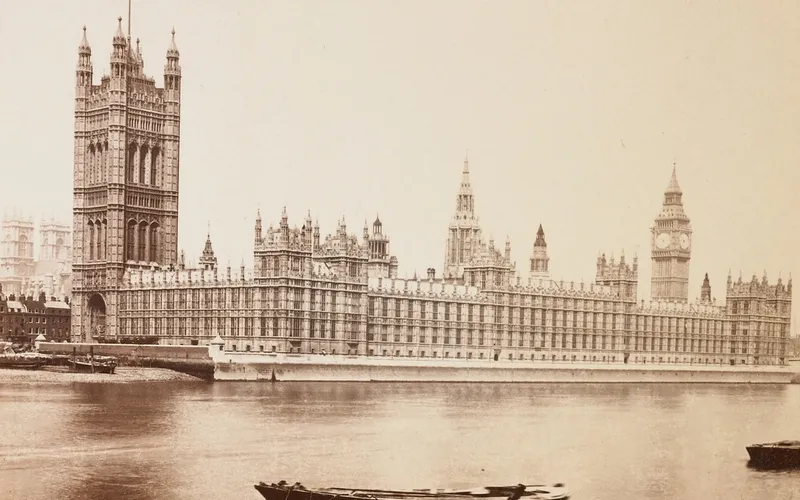
Christie Davies argues every major actor lost Britain’s 2010 general election, blaming Labour for fiscal and regulatory failure, criticising the Liberal Democrats’ unstable coalition with the Conservatives, and portraying British party leaders as remote, public-school elites.
-
The 35th-anniversary Emergency feature recalls the 1975 declaration through Minoo Masani’s account and reprints A. D. Gorwala’s 1976 record of the suppression of his journal Opinion, describing censorship, forfeiture threats, and postal obstruction as incompatible with an editor’s duty.
-
Firoze Hirjikaka’s “The Great IPL Circus” follows Lalit Modi, Shashi Tharoor, Sunanda Pushkar, and Sharad Pawar through the 2010 IPL scandal, arguing it revealed how public power, private enrichment, and celebrity culture overlapped.
-
Ashok Karnik’s “Point Counter Point” debates the Lalit Modi/Tharoor affair, criticises Arundhati Roy’s defence of Maoist violence, and weighs reformative criminal justice against capital punishment in the Ajmal Kasab death-sentence debate.
-
Eustace D’Souza’s agenda for the new Chief of the Army Staff calls for a Chief of Defence Staff, modernised equipment, urgent officer-shortage remedies, and stronger representation of military expertise in government, arguing the Sukna controversy should not distract from deeper institutional problems.
-
Suresh C. Sharma argues the Army should not be deployed against India’s own people except for aid to civil power, drawing on the Telangana, Nagaland, Mizoram, Kashmir, and Punjab insurgencies to warn that Army involvement in domestic intelligence would damage democratic values, against a counter-view calling for specially trained paramilitary forces against the Maoists.
-
Ali Khwaja’s “Why I Have Never Voted” explains his abstention through Bangalore municipal-election experience of intimidating canvassing, cash distribution, and winners taking office with less than half the votes cast.
-
Firoze Hirjikaka’s “What To Do About Pakistan” argues India must find concrete ways to impose costs on Pakistan rather than fixating symbolically on Hafiz Saeed, and a closing excerpt reports Nepal’s Maoists calling off an indefinite Kathmandu strike after governing worse than the politicians voters had rejected in 2008.
Essays
From Our Readers
No summary was extracted for this article. Listed for completeness.
British Election 2010: How Everybody Lost It
By Christie Davies
The reader letters in the rendered pages praise Freedom First as a continuing liberal voice, criticize crony capitalism and weakly regulated liberalisation, revisit Indo-Chinese relations and Tibet, and debate nuclear liability and public expenditure on symbolic statues. The letters repeatedly ask for clearer policy priorities: constitutional honesty, a stronger defence posture, responsible public spending, and revived access to earlier liberal writing.
- Readers describe Freedom First as a needed liberal journal but worry about its finances.
- One letter distinguishes liberalisation from crony capitalism and calls for equity and social justice.
- Another attacks Nehru’s China policy, defends Tibet’s separate status, and criticizes India’s handling of the McMahon Line.
- A third letter argues that coastal security and policing should take priority over expensive statues.
Is Terrrorism “existential” and an “acceptable risk?”
By V. Balachandran; Ashok Karnik
Christie Davies argues that every major actor lost the 2010 British general election: Labour through fiscal and regulatory failure, the Conservatives by inheriting responsibility without a majority, the Liberal Democrats by entering an unstable coalition, and the public by receiving a government built from incompatible parties. The essay closes by portraying British party leaders as socially remote, public-school elites whose instincts are poorly suited to capitalism or democracy.
- The essay frames the election result as a universal defeat rather than a coalition triumph.
- Labour is blamed for high spending, high regulation, borrowing, and postponing fiscal pain.
- The Liberal Democrats are presented as geographically limited and ideologically mismatched with the Conservatives.
- The essay criticizes British elites as patrician, remote, and insulated from ordinary voters.
The Imposition of the Emergency - 35 Years Ago
The Emergency anniversary feature recalls the declaration of Emergency through Minou Masani’s earlier Freedom First account and then reprints A. D. Gorwala’s 1976 account of the suppression of Opinion. The rendered pages stress censorship, forfeiture threats, postal obstruction, legal harassment, and the impossibility of continuing a journal under pre-censorship while still serving readers and country.
- The feature presents the Emergency as a constitutional coup d’etat and a ‘Black Day’.
- It highlights A. D. Gorwala’s Opinion as a little journal forced into cyclostyled publication.
- Gorwala describes pre-censorship as incompatible with an editor’s duty.
- The piece treats press freedom and open criticism of government as fundamental democratic rights.
This month in June 1953
The rendered archival page headed ‘This month in June 1953’ reprints Philip Spratt’s critique of anti-communist and peace-committee politics, along with short historical notes on Krishna Menon and Stalin’s son. Spratt’s piece treats one-sided peace campaigns as signs of communist influence when they condemn Western weapons but ignore communist aggression, especially in Korea.
- Philip Spratt argues that demands for peace can mask partisan support for communist aggression.
- The page connects anti-communist argument to Cold War debates over Korea and atomic weapons.
- A biographical note says Spratt renounced communism and later worked with M. N. Roy in the Radical Humanist movement.
- Short notes criticize Krishna Menon’s entry to Parliament and observe the irony of Stalin’s son being blocked by Soviet politics.
The Great IPL Circus
By Firoze Hirjikaka
Firoze Hirjikaka’s ‘The Great IPL Circus’ treats the IPL controversy as a morality play of money, celebrity, political patronage, and ego. The essay follows Lalit Modi, Shashi Tharoor, Sunanda Pushkar, Sharad Pawar, Praful Patel, film stars, cricket administrators, and shell-company allegations to argue that the scandal revealed how public power, private enrichment, and celebrity culture overlap.
- The essay presents the IPL as a spectacle of money, romance, sleaze, and embezzlement.
- It argues that Lalit Modi’s power depended on knowing too much and drawing others into dubious transactions.
- Shashi Tharoor’s resignation is framed as both a personal misjudgment and a political sacrifice.
- The essay claims political families and celebrity owners shared in the rewards while investigations risked dispersing the money trail.
The Fruits of War in Afghanistan
By Paul Rogers
No summary was extracted for this article. Listed for completeness.
Point Counter Point
By Ashok Karnik
Ashok Karnik’s ‘Point Counter Point’ presents opposing sides on Lalit Modi and Shashi Tharoor, Naxalite violence, and Kasab’s death sentence. The format gives readers short paired arguments: suspicion of corruption versus caution about destroying a successful enterprise, sympathy for structural injustice versus criticism of apologetics for Maoist violence, and reformative criminal justice versus capital punishment as deterrence and state assertion.
- The IPL debate weighs investigative suspicion against the possibility of smoke without fire.
- The Naxalite debate sharply criticizes Arundhati Roy’s defence or explanation of Maoist violence.
- The Kasab debate contrasts reformative criminal justice with a pro-death-penalty security argument.
- A side note cites a Mumbai police official on poor compliance with traffic rules.
An Agenda For the New Chief of the Army Staff
By Eustace D’Souza
Eustace D’Souza’s agenda for the new Chief of the Army Staff begins with the Army’s five roles and then argues that General V. K. Singh should address structural problems rather than media-driven controversies. The article calls for a Chief of Defence Staff, better use of the defence budget, urgent officer-shortage remedies, modernized equipment, selected use of women officers in non-combat roles, improved dialogue with retired personnel, and stronger representation of military expertise in government.
- The article defines the Army’s roles as external security, internal security, disaster relief, peacekeeping, and environmental restoration.
- It argues that the Sukna issue should not distract from deeper promotion, personnel, and institutional problems.
- It calls for a Chief of Defence Staff as a single-window voice on national security matters.
- It recommends equipment upgrades, better personnel management, and more direct communication with the media and political leadership.
The Status of Tibet
No summary was extracted for this article. Listed for completeness.
Armed Forces and the Maoist Movement
By Suresh C. Sharma
Suresh C. Sharma’s ‘Armed Forces and the Maoist Movement’ argues that the Army should not be employed against India’s own people except for aid to civil power and specific technical missions. The essay reviews insurgency history, democratic-country practice, intelligence limitations, political fronts, and the risk that Army involvement in internal intelligence and surveillance would damage democratic values.
- The essay distinguishes external aggression from internal violence and cautions against using the Army domestically.
- It uses earlier insurgencies in Telangana, Nagaland, Mizoram, Kashmir, Punjab, and West Bengal as historical comparisons.
- It emphasizes that successful counter-insurgency requires good intelligence, which the Army lacks in internal settings.
- It warns that politicized policing should not be solved by transferring the problem to the Army.
Why I Have Never Voted
By Ali Khwaja
Ali Khwaja’s ‘Why I Have Never Voted’ explains his abstention through Bangalore municipal-election experience: intimidating canvassing, cash distribution, low turnout, candidates winning without majority support, council disorder, and rent-seeking expectations around local offices. The essay is not an abstract rejection of democracy so much as a testimony that the available candidates and practices gave him no reason to vote.
- The author says he has never voted because he has not found suitable candidates.
- He describes local campaigning as unruly, intimidating, and money-driven.
- He notes that many winners gained office with less than half the votes cast.
- He links local office to expected recovery of campaign expenditure through corruption.
Wanted a Specially Trained Force to Combat Naxalites
The excerpt ‘Wanted a Specially Trained Force to Combat Naxalites’ takes the opposite tactical line from Sharma by arguing that the Maoist conflict lies between classic war and law-and-order policing. It recommends specially trained paramilitary forces, helicopters, communications, medical evacuation, human intelligence, and a new administrative cadre for Maoist-affected areas, while also blaming bad governance, police failure, and IAS-police dysfunction.
- The piece says Maoists were active in 20 of 28 states and had to be handled nationally.
- It calls for specialized paramilitary forces organized and trained on Army lines.
- It stresses mobility, UAVs, communications, medical evacuation, and human intelligence.
- It argues that administrative reform is inseparable from the security response.
What To Do About Pakistan
The rendered Cornucopia pages include Firoze Hirjikaka’s ‘What To Do About Pakistan’ and ‘Don’t Brand Me.’ The Pakistan piece argues that symbolic anger, isolation, and fixation on Hafiz Saeed do not produce leverage; India must think about concrete ways to impose costs if Pakistan remains defiant. ‘Don’t Brand Me’ shifts to consumer culture, arguing that branded clothing often sells status rather than meaningful difference because the same offshore factories may produce both premium labels and cheaper garments.
- The Pakistan essay criticizes both empty dialogue and empty refusal to talk.
- It argues that Hafiz Saeed has become a symbolic villain whose arrest would not by itself end terrorism.
- It calls for India to project power and impose costs rather than only repeat demands.
- The branding essay attacks the premium attached to designer labels and celebrates anonymity.
by Bhaskar Roy reports that Nepal
By The short excerpt ‘Nepal
The short excerpt ‘Nepal’s Maoists’ by Bhaskar Roy reports that Nepal’s Maoists called off an indefinite strike after Kathmandu had been held hostage by more than 100,000 cadres and supporters. It argues that the Maoists had won trust in 2008 because voters were disillusioned with democratic politicians and the monarchy, but then governed worse than ordinary politicians and pursued one-party communist rule.
- The excerpt centers on the May 2010 Maoist strike in Kathmandu.
- It notes the Maoists’ earlier electoral success in the 2008 parliamentary elections.
- It argues that Maoist rule forgot administration and country-running.
- It presents Nepal as a cautionary example for Maoist politics.
Generated by the v1.5 extraction pipeline. Awaiting editorial review.
Metadata and summary are AI-extracted from the source PDF and reviewed for editorial accuracy. The original work is available via the Read PDF tab above (where present); paragraph-level citation inside the PDF is deferred to a future engagement.