periodical issue
Freedom First
The Liberal Position
By S. V. Raju, Ajit Karnik, Rabindranath Tagore
Published by J. R. Patel for the Indian Committee for Cultural Freedom (ICCF) and printed by him at Union Press, 13 Homji Street, Fort, Mumbai 400 001. · Mumbai · 2011
40 pages
Freedom First
Summary
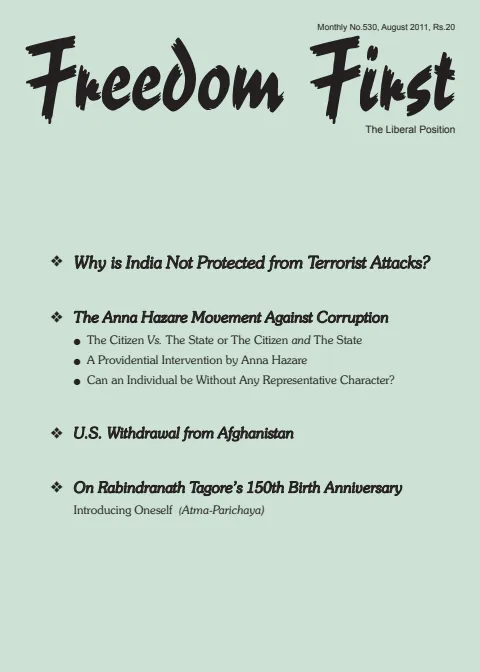
The August 2011 issue of Freedom First opens with an Independence Day editorial that credits P. V. Narasimha Rao with freeing the Indian economy from the old socialist pattern and dedicates the issue to him as “the real liberator of the Indian economy.” The issue then turns to terrorism, Anna Hazare’s anti-corruption movement, rural politics, elections, Afghanistan, Rajagopalachari correspondence, and Tagore’s 150th birth anniversary.
Within the rendered pages, V. Balachandran critiques India’s counterterrorism arrangements after repeated attacks, M. D. Kini defends citizen action against corruption, D. S. Ranga Rao praises Anna Hazare’s intervention against the Lokpal critics, and later visible articles debate representative character, rural concerns, and current affairs. Several later articles begin after the rendered range and are marked for later review.
Key points
-
The editorial dedicates the issue to P. V. Narasimha Rao as “the real liberator of the Indian economy,” crediting him with enabling Manmohan Singh’s reforms while criticising the Congress dynasty’s renewed control on India’s 65th year of independence.
-
V. Balachandran’s “Why is India Not Protected from Terrorist Attacks?” argues India’s counterterrorism policy repeatedly cycles through grief, blame of Pakistan and forgotten reforms, contrasting this with the post-9/11 United States’ Joint Terrorism Task Force model.
-
M. D. Kini’s “The Citizen Vs. The State or The Citizen and the State” defends citizen action through PIL, RTI and the proposed Lokpal, arguing the 2G, CWG and Adarsh scams were exposed by citizens and courts rather than state institutions.
-
D. S. Ranga Rao’s “A Providential Intervention by Anna Hazare” replies to Sharad Bailur’s July critique, arguing unelected civil-society bodies already operate within government, such as the National Advisory Council, and defending the Lokpal as an accountability mechanism.
-
Ashok Karnik’s Point Counter Point continues the magazine’s recurring format, following the issue’s rural-perspective article and preceding material on the May 2011 elections.
-
The editorial criticises dynastic control over the Indian state and asks why Manmohan Singh did not resign when politically constrained.
Essays
Between Ourselves
By S. V. Raju
The editorial reflects on India entering its 65th year of independence with mixed feelings: survival as a democracy, but with deep damage from dynastic politics and socialist economic shackles. It argues that India’s growth spurts occurred when Congress dominance weakened and gives special credit to P. V. Narasimha Rao for enabling Manmohan Singh to open the economy.
The editor criticizes the dynasty’s renewed control, asks why Manmohan Singh did not resign when constrained, and dedicates the issue to Narasimha Rao as the real liberator of the Indian economy.
- Marks India’s 65th year of independence with pride and unease.
- Credits P. V. Narasimha Rao with enabling economic liberalization.
- Criticizes dynastic control over the Indian state.
- Dedicates the issue to Narasimha Rao as the real liberator of the Indian economy.
Why is India Not Protected from Terrorist Attacks?
By V. Balachandran
V. Balachandran’s “Why is India Not Protected from Terrorist Attacks?” argues that India’s counterterrorism policy repeatedly follows a cycle of grief, blaming Pakistan, promising reform, forgetting reforms, and repeating the pattern after the next attack. He contrasts this with the post-9/11 United States’ Joint Terrorism Task Force model and criticizes India’s fragmented intelligence, policing, and bureaucratic security arrangements.
The article points to institutional confusion between central and state responsibilities, historical baggage from the Government of India Act, and weak coordination as reasons India remains vulnerable.
- Describes India’s counterterrorism response as repetitive and unserious.
- Contrasts India with the United States’ post-9/11 Joint Terrorism Task Force model.
- Criticizes fragmented intelligence and security coordination.
- Links current dysfunction to inherited constitutional and administrative arrangements.
The Citizen Vs. The State or The Citizen and the State
By M. D. Kini
M. D. Kini’s “The Citizen Vs. The State or the Citizen and the State” responds to Sharad Bailur by defending citizen action through PIL, RTI, and the proposed Lokpal. Kini argues that scams such as 2G, CWG, and Adarsh were exposed by citizens rather than by state institutions and that Anna Hazare and Baba Ramdev raised legitimate questions about corruption and black money.
The essay treats citizen agitation not as an anti-democratic shortcut but as a necessary demand for accountability when elected institutions fail to function properly.
- Defends citizen action as a democratic accountability mechanism.
- Argues that PIL, RTI, and Lokpal can correct failures of ordinary institutions.
- Cites 2G, CWG, and Adarsh as cases exposed by citizens and courts.
- Treats Anna Hazare and Baba Ramdev’s agitations as responses to state failure.
A Providential Intervention by Anna Hazare
By D. S. Ranga Rao
D. S. Ranga Rao’s “A Providential Intervention by Anna Hazare” explicitly replies to Sharad Bailur’s July 2011 criticism of the Lokpal proposal. Rao argues that unelected civil society is already embedded in bodies such as the National Advisory Council when convenient to government, and that Hazare’s intervention forced attention to corruption that elected institutions were failing to confront.
The article presents Lokpal not as a usurpation of constitutional organs but as an independent body meant to check graft, transparency failures, and accountability gaps.
- Replies directly to Sharad Bailur’s critique of civil society and Lokpal.
- Contrasts criticism of Hazare’s civil society role with acceptance of other unelected advisory bodies.
- Argues that elected institutions were failing to address corruption.
- Defends the Lokpal as an accountability mechanism rather than an anti-democratic power grab.
Point Counter Point
By Ashok Karnik
Ashok Karnik’s Point Counter Point is visible in the rendered range and continues the magazine’s recurring format of weighing multiple sides of current public questions. It follows the rural-perspective article and precedes the material looking beyond the May 2011 elections.
The page-level detail was not fully inspected in this continuation pass beyond its placement and completion within the rendered pages.
- Continues the regular Point Counter Point feature.
- Appears after the issue’s anti-corruption and rural-politics pieces.
- Falls within the rendered range.
Generated by the v1.5 extraction pipeline. Awaiting editorial review.
Metadata and summary are AI-extracted from the source PDF and reviewed for editorial accuracy. The original work is available via the Read PDF tab above (where present); paragraph-level citation inside the PDF is deferred to a future engagement.