
periodical issue
Freedom First
The Liberal Magazine
By Sunil S. Bhandare, R. M. Mohan Rao
PUBLISHERS: Indian Committee for Cultural Freedom (ICCF) 3rd floor, Army & Navy Building, 148, Mahatma Gandhi Road, Mumbai 400001. PUBLISHED BY J. R. Patel for the ICCF and printed by him at Union Press, 13, Homji Street, Fort, Mumbai 400001. · Mumbai · 2015
24 pages
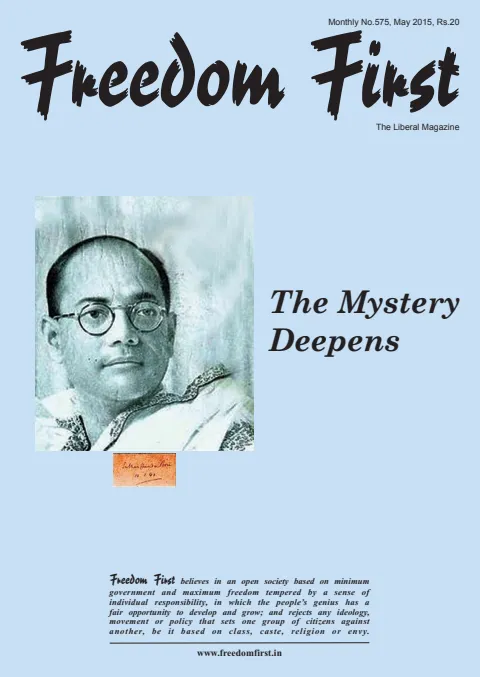
Freedom First
Summary
Freedom First No. 575 (May 2015), the monthly liberal magazine published by the Indian Committee for Cultural Freedom, opens with the cover story ‘The Mystery Deepens’ on Subhas Chandra Bose, prompted by the government’s 2015 declassification of intelligence files touching on surveillance of Bose’s relatives. Two features — by former Intelligence Bureau Deputy Director Ashok Karnik and former Cabinet Secretariat Special Secretary V. Balachandran — approach this from complementary angles: the enduring mystery of Bose’s fate, and the institutional history of Indian intelligence’s dependence on Britain’s MI-5, including the question of whether Jawaharlal Nehru personally authorised or merely tolerated the surveillance. The rest of the issue turns to contemporary politics and economy under the year-old Modi government: Sunil Bhandare weighs global optimism about India’s economy against domestic complaints that reform has not reached the ground; Firoze Hirjikaka warns of a creeping ‘saffronization’ of civil society; Ashok Karnik’s recurring ‘Point Counter Point’ feature stages both sides of three live controversies; B. Ramesh Babu previews Modi’s April 2015 tour of France, Germany and Canada (with a short, separately bylined item on Jammu & Kashmir policy appended on the same page); and Nitin Raut assesses the Lausanne framework nuclear agreement with Iran. Two long-running serialised features also continue: the first instalment of Usha Thakkar’s three-part history of the Swatantra Party in Gujarat, and the seventh instalment of R. M. Mohan Rao’s paper on agricultural policy and rural indebtedness.
Editorially, the issue holds to Freedom First’s founding liberal, minimum-government orientation, most visible in Hirjikaka’s and Karnik’s critiques of majoritarian politics and unchecked state coercion, and in the issue’s closing tribute to founder Minoo Masani on his 17th death anniversary. All 24 pages of the issue were rendered and reviewed, covering every article in the printed table of contents.
Essays
Netaji Betrayed?
By Ashok Karnik
Ashok Karnik, a former IB Deputy Director, surveys the unresolved mystery of Netaji Subhas Chandra Bose’s fate in light of newly reported IB/MI-5 surveillance of his relatives from 1948 to 1968. He runs through the competing theories of Bose’s disappearance — the 1945 air-crash death that many never accepted, rumours of survival in the Himalayas, Russia or Germany, and speculation around the sadhu Gumnami Baba — and argues that only declassification of the underlying IB files, not television debate, can settle the question. He speculates that Cold War-era anxiety about Soviet use of Bose to destabilise the Congress government may explain the surveillance’s odd persistence long after any political threat had passed.
- Reported IB/MI-5 surveillance of Bose’s relatives ran from 1948 to 1968, following the declassification of a subset of Intelligence Bureau files.
- Bose’s 1945 air-crash death was widely disbelieved, feeding decades of rumours (Himalayas, Russia, Germany) and speculation tied to the sadhu Gumnami Baba, who died in Ayodhya in 1985.
- Author argues Indian (IB) and British (MI-5) intelligence cooperated closely even after independence, which he frames as unsurprising rather than scandalous.
- Suggests the surveillance may reflect Cold War-era fear that the USSR could use a still-living Bose to undermine the Congress regime.
- Concludes that a national hero should have been treated with more honour despite political differences with Nehru, and that the truth may never emerge without full declassification.
Editorial
By R. Srinivasan
The unsigned editorial (initialed R.S.) frames the issue’s cover package around renewed public fascination with Subhas Chandra Bose following the surveillance-files controversy, and briefly previews the issue’s other contents: Bhandare’s economy piece set against Ramesh Babu’s account of Modi’s foreign tour, and Usha Thakkar’s new three-part series on the Swatantra Party’s history in Gujarat. It closes by marking the 17th death anniversary of Freedom First’s founder, Minoo Masani, on 27 May.
- Notes renewed public interest in Bose’s disappearance and the ‘alternative to Congress’ political mood of his era.
- Previews a three-part series on the Swatantra Party’s history in Gujarat by Dr. Usha Thakkar.
- Juxtaposes Sunil Bhandare’s economy article against B. Ramesh Babu’s piece on Modi’s foreign visit as offering divergent views of the Indian economic scene.
- Marks the 17th death anniversary of founder Minoo Masani on 27 May.
Was Jawaharlal Nehru Responsible for “snooping” on Bose?
By V. Balachandran
V. Balachandran, a former Special Secretary in the Cabinet Secretariat, traces the institutional lineage of Indian intelligence — from Col. Sleeman’s 1848 anti-thug operation through the Delhi Intelligence Bureau and ‘Indian Political Intelligence’ to independent India’s IB — to argue that the IB remained a ‘junior partner’ to Britain’s MI-5 well after 1947, including through a secretly stationed British ‘Security Liaison Officer.’ Drawing on Christopher Andrew’s declassified MI-5 history and other British archives, he identifies a persistent gap between Nehru’s stated foreign-policy positions (warmer USSR ties, condemning the Suez invasion) and the IB’s continued alignment with British intelligence priorities, including its surveillance of V. K. Krishna Menon despite Nehru’s trust in him. He cites declassified IPI records suggesting Bose was placed under watch as early as 1924 over suspected Comintern links, but concludes there is no official confirmation of whether Nehru personally knew of or authorised the family surveillance, and that only full declassification of IB and Bose-related files can resolve the question.
- Traces IB’s institutional roots from Sleeman’s 1848 ‘Thugee & Dacoity Department’ through the Delhi Intelligence Bureau and Indian Political Intelligence (begun 1909) to post-1947 IB.
- A secret British ‘Security Liaison Officer’ was stationed in New Delhi after 1947 with IB’s consent, arranged by MI-5’s Guy Liddell, keeping IB coordinated with British intelligence.
- Christopher Andrew’s declassified MI-5 history records a ‘loud disconnect’ between Nehru’s strategic policy and the priorities IB actually pursued, including watching V. K. Krishna Menon.
- Declassified IPI records reportedly show Bose was placed under watch from 1924, initially over suspected pro-communist/Comintern links via the revolutionary Abani Mukherjee.
- Author states there is no official record confirming whether Nehru personally authorised or knew of the surveillance of Bose’s family; only full declassification could settle this.
State of the Economy: Issues and Challenges
By Sunil S. Bhandare
Consulting economist Sunil S. Bhandare examines the ‘perception-reality divergence’ facing the Modi government roughly a year into office: strongly positive assessments from the IMF, ADB and Moody’s (which revised India’s credit outlook to ‘positive’) sit against business complaints that little has changed on the ground. He surveys the IMF’s and ADB’s shared policy prescriptions (energy and infrastructure bottlenecks, land and environmental clearance reform, agricultural-sector reform, labour-market flexibility, education), quotes Modi’s own frustration — voiced in a Hindustan Times interview — with businesses that call his government both pro-industry and unresponsive, and reviews the RBI’s cautious 7.8% growth forecast for 2015-16 against the Finance Minister’s more ambitious 8-8.5% budget target and its list of downside risks. He concludes that reconciling government intent with real-economy performance will be difficult, and that the government must fight ‘conflicting perceptions’ as much as pursue policy itself.
- IMF, ADB and Moody’s (April 2015) all revised India’s economic outlook upward, with Moody’s shifting India’s sovereign credit outlook to ‘positive.’
- Business and industry voices argue reforms have not translated into change ‘at the ground level,’ creating what Bhandare calls a ‘perception-reality divergence conundrum.’
- IMF-recommended reforms include energy/mining/power bottlenecks, infrastructure investment, land and environmental clearance simplification, agricultural reform, labour-market flexibility, and education.
- PM Modi, quoted from a Hindustan Times interview, expresses frustration that businesses simultaneously call his government pro-industrialist and say it does nothing for them.
- RBI projects 7.8% real GDP growth for 2015-16 versus the Finance Minister’s 8-8.5% budget target, contingent on liquidity, Budget implementation, inflation, monsoon and absence of shocks.
- Downside risks flagged include El Niño’s effect on agriculture, vegetable/fruit price volatility, global commodity swings, and China’s slowdown.
Saffronization is Creeping Up on Us
By Firoze Hirjikaka
Firoze Hirjikaka, a retired civil engineer and Freedom First advisory-board member, argues that ‘communalism, Hindu pride, saffronization’ is spreading through Indian civil society under the Modi government, even as many moderate supporters give Modi ‘a long rope’ for having defeated the Congress. He catalogues unfulfilled ‘achhe din’ promises — rising government travel expenses, continuing farmer suicides, protection of politically connected officials, the Ashok Khemka transfer — and disputes the CAG’s audit of the vaunted ‘Gujarat model’ (financial indiscipline, weak monitoring, a worsening sex ratio, slow Right to Education implementation). His central concern, though, is institutional ‘saffronization’: the RSS’s growing assertiveness (including a planned Delhi headquarters), compulsory Bhagwad Gita instruction in Haryana schools, communal rhetoric from figures like Subramanian Swamy and bodies like the VHP and Bajrang Dal, and the Gujarat Control of Terrorism and Organised Crime Bill’s expanded, confession-admitting police powers. He frames this as a drift toward fusing temple and state that threatens India’s secular constitutional order.
- Argues Modi’s core support persists among moderates mainly because he defeated the Congress, not because of delivered performance.
- Cites a CAG report faulting the ‘Gujarat model’ for financial indiscipline and poor departmental monitoring, and a worsening sex ratio despite Modi’s rhetoric on the girl child.
- Flags Haryana’s compulsory Bhagwad Gita school curriculum, with a similar move reportedly considered in Maharashtra.
- Criticises BJP figures (Subramanian Swamy) and allied organisations (RSS, VHP, Bajrang Dal) for communal rhetoric, including a VHP warning of a Muslim-majority India by 2050.
- Criticises the Gujarat Control of Terrorism and Organised Crime Bill for expanding police powers and admitting police-obtained confessions as court evidence.
- Warns that state endorsement of one religion’s ascendancy threatens India’s secular constitutional order and mandated separation of temple and state.
Point Counter Point
By Ashok Karnik
In this recurring feature, Ashok Karnik stages ‘Point’ and ‘Counter Point’ arguments on three live controversies without settling on a single view. The first (‘Protocol vs. Policy’) examines the diplomatic bind created when Pakistan invited Kashmiri separatist leaders to its National Day function alongside a junior Indian minister, debating whether the Modi government’s attendance was mere protocol or a sign of policy softening toward Pakistan. The second (‘What is Wrong, AAP?’) weighs whether the expulsion of Prashant Bhushan and Yogendra Yadav from AAP cost the party its ‘intellectual veneer’ or removed a source of ideological indiscipline, invoking Madhu Limaye’s account of the Janata Party’s earlier split over dual BJP/RSS membership. The third (‘The Missing VIP’) debates whether the government and Special Protection Group should have kept Rahul Gandhi’s extended absence from public life confidential, or whether that was a proper exercise of a protectee’s personal privacy.
- Frames three current disputes as balanced ‘Point/Counter Point’ arguments rather than taking a single editorial side.
- ‘Protocol vs. Policy’: Sushma Swaraj declined Pakistan’s National Day invitation over separatist attendance and sent junior minister V. K. Singh instead, exposing tension in the government’s declared hard line on Pakistan.
- ‘What is Wrong, AAP?’: debates whether Prashant Bhushan’s and Yogendra Yadav’s ouster hurt AAP’s credibility or ended a source of ideological friction, citing Madhu Limaye’s account of the Janata Party’s earlier BJP/RSS dual-membership split.
- ‘The Missing VIP’: questions whether keeping Rahul Gandhi’s SPG-protected whereabouts secret served or undermined his political standing.
Foreign Relations in the 21st Century: Modi Goes Abroad Again: Target Development Agenda at Home
By B. Ramesh Babu
International-relations specialist B. Ramesh Babu previews PM Modi’s April 2015 three-nation tour of France, Germany and Canada, framed by Modi’s own statement that the trip is ‘centered round supporting India’s economic agenda and creating jobs for youth.’ He details France’s agenda — the long-delayed 126-aircraft Rafale deal (with HAL/Dassault liability disputes still unresolved), the ITER nuclear-fusion collaboration, Indian Ocean coastal-surveillance cooperation, and potential French investment tied to a raised insurance FDI cap; Germany’s focus on manufacturing, skill development and clean energy via the Indo-German Chamber of Commerce; and Canada’s focus on civil nuclear/uranium cooperation, public-private partnerships and diaspora engagement. He concludes that India’s growth model has historically prioritised domestic effort over ‘FDI-fed and export-led growth,’ and that Modi is using foreign-policy wins to build momentum against domestic obstruction. The same page also carries a short, separately bylined item by H. R. Bapu Satyanarayana arguing that the BJP-PDP Jammu & Kashmir government’s ambivalent response to separatist leader Sayeed Gilani’s Pakistani-flag-hoisting in Srinagar risks emboldening further unrest, calling the BJP’s overall J&K strategy ‘an enigma.’
- Modi’s April 2015 tour targets France, Germany and Canada, framed explicitly around economic development and job creation.
- In France, the stalled 126-aircraft Rafale deal (HAL/Dassault compliance and liability disputes) and the ITER nuclear-fusion project are top agenda items, alongside coastal-surveillance and insurance-FDI cooperation.
- In Germany, the focus is manufacturing, skill development and clean energy via the Indo-German Chamber of Commerce, India’s largest foreign chamber.
- In Canada, the focus is civil nuclear cooperation/uranium supply, public-private partnership models, and a bilateral trade target of C$15 billion by 2015.
- Author argues India’s growth strategy has historically been domestically driven rather than ‘FDI-fed and export-led’ like the Asian Tigers or China.
- A separate short item on the same page (H. R. Bapu Satyanarayana) criticises the BJP-PDP J&K government’s uncertain response to Sayeed Gilani’s Pakistani flag-hoisting in Srinagar, warning the BJP’s J&K strategy risks ‘boomerang[ing]’ if unrest is not contained.
The Iranian Deal: Whose Fate Will it Seal?
By Nitin G. Raut
Advocate Nitin G. Raut analyses the 2 April 2015 Lausanne ‘Framework for Final Agreement’ between the P5+Germany and Iran over its nuclear programme, arguing that the deal’s vagueness — its one-year breakout-notice provision, unclear stockpile data, and dependence on Iran’s unelected Supreme Leader rather than its president — leaves its durability doubtful. He situates the deal within the broader Shia-Sunni contest for regional power (Iran’s backing of Hezbollah, Assad and Houthi forces against Saudi-led Sunni states), Israel’s strong opposition given Iran’s non-recognition of it, and draws a sceptical parallel to the 1994 US-North Korea nuclear framework, which Pyongyang later violated. He concludes that the Obama administration, in its final years, may be leaving a fragile and consequential nuclear legacy for its successor.
- Frames the Lausanne Framework Agreement (2 April 2015) as tentative, citing vague provisions in exchange for sanctions relief.
- Notes Iran’s Supreme Leader Ayatollah Khamenei can override elected President Rouhani, questioning the deal’s enforceability.
- Frames regional stakes as a Shia-Sunni struggle (Iran-backed Hezbollah, Assad and Houthi forces versus Saudi-led Sunni power), with Israel strongly opposed to the deal.
- Draws a critical parallel with the 1994 US-North Korea nuclear framework, which DPRK later violated ‘in breach more than in faith.’
- Concludes Obama’s administration may be bequeathing ‘a hot potato’ nuclear legacy to the next U.S. administration.
The Swatantra Party in Gujarat: A Shooting Star (Part I)
By Dr. Usha Thakkar
Historian Dr. Usha Thakkar opens a three-part history of the Swatantra Party’s rise and fall in Gujarat. Part I covers the party’s national founding on 4 June 1959 in Madras by C. Rajagopalachari (Rajaji), Minoo Masani, N. G. Ranga, V. P. Menon and others, in reaction to the Congress’s Nagpur-session agrarian programme (grain-trade takeover, land ceilings, cooperative farming). She traces the Gujarat branch’s founding (inaugurated 14 September 1959, first convention at Nadiad on 20 October 1960) under organiser Bhailalbhai ‘Bhaikaka’ Patel, the pre-existing rightist anti-Congress currents in Gujarat since 1952, and the deep social cleavage between land-owning Patidar farmers (angered by the Bombay Tenancy Act, 1948) and the more numerous but poorer Kshatriya communities. She narrates the Gujarat Kshatriya Sabha’s shift from a Congress alliance (1952, 1957) to a formal break and alliance with Swatantra by 1961, and closes Part I with the party’s 1962 Gujarat assembly results (26 of 154 seats) and Lok Sabha results (4 of 22 seats), plus Minoo Masani’s high-profile 1963 Rajkot by-election win over Congress.
- Swatantra Party founded 4 June 1959 in Madras by C. Rajagopalachari, Minoo Masani, N. G. Ranga, V. P. Menon and others, opposing the Congress’s Nagpur-session agrarian socialism.
- Gujarat branch inaugurated 14 September 1959; organiser Bhailalbhai ‘Bhaikaka’ Patel sought to unite land-owning Patidars and the more numerous, poorer Kshatriya communities despite long antagonism between them.
- Patidar resentment partly stemmed from the Bombay Tenancy Act, 1948; earlier (1952) rightist groupings won roughly 20% of the Gujarat vote but no real power due to disunity.
- The Gujarat Kshatriya Sabha moved from a Congress alliance (1952, 1957, formalised at Dakor in 1958) to a formal break with Congress (Bayad convention, 1961) and support for Swatantra, costing Congress the 1962 election.
- In the 1962 Gujarat assembly election, Swatantra won 26 of 154 seats (24.32% of votes) and 4 of 22 Lok Sabha seats, with particular strength in Kutch, Kaira and Panchmahal.
- Minoo Masani’s 1963 Rajkot Lok Sabha by-election win over Congress’s Jethalal Joshi, aided by Bhaikaka’s Patidar-Kshatriya coalition-building, is presented as a landmark blow to Congress/Nehru’s prestige.
The Rural Perspective: Agriculture and Rural Indebtedness - VII
By R. M. Mohan Rao
Agricultural economist R. M. Mohan Rao, in the seventh instalment of a serialised paper on farmer indebtedness, continues its policy-initiatives section with recommendations on safety nets against risk and uncertainty (village-based crop insurance with low premiums, transparent claims settlement, extended and timely minimum support prices, dedicated procurement agencies, market-extension services), on improving farming viability and profitability (livestock and dairy development targeting rural women, small-scale agro-processing, protecting poor farmers’ and farm labour’s livelihoods as the basis of trade and investment policy), and on cost-of-production fixes (affordable quality seed, timely MSP announcements, cost-effective technology for rain-fed land, reduced government market interference). He closes by arguing that agricultural technology must shift focus from raising output to raising the actual earnings of small and marginal farmers, and invites readers to request the full paper from Freedom First.
- Advocates recasting crop insurance around the village as the unit, with low premiums and transparent, banker/farmer-involved claims settlement.
- Calls for minimum support prices to be extended to more crops and announced before the sowing season, plus dedicated procurement/nodal agencies for major crops.
- Recommends livestock and dairy development targeting rural women, citing over 70 million rural households dependent on livestock without a national extension-support system.
- Cites Dr. M. S. Swaminathan’s view that safeguarding poor farmers’ and farm labour’s livelihoods should underlie all trade and investment policy.
- Calls for cost-effective, farmer-relevant technology for rain-fed, small and marginal farms, shifting policy focus from raising output to raising individual farmers’ earnings.
- Presents itself as part of a longer serialised paper and invites readers to request the full text; the page closes with a short ‘Poor Farmer’ verse (credited to laughingcolours.com) contrasting food-growers’ poverty with the wealth of consumer-goods makers.
Generated by the v1.5 extraction pipeline. Awaiting editorial review.
Metadata and summary are AI-extracted from the source PDF and reviewed for editorial accuracy. The original work is available via the Read PDF tab above (where present); paragraph-level citation inside the PDF is deferred to a future engagement.