
periodical issue
Freedom First
The Liberal Position
By Sunil S. Bhandare, R. M. Mohan Rao
PUBLISHERS: Indian Committee for Cultural Freedom (ICCF) 3rd floor, Army & Navy Building, 148, Mahatma Gandhi Road, Mumbai 400001. PUBLISHED BY J. R. Patel for the ICCF and printed by him at Union Press, 13, Homji Street, Fort, Mumbai 400001. · Mumbai · 2015
32 pages
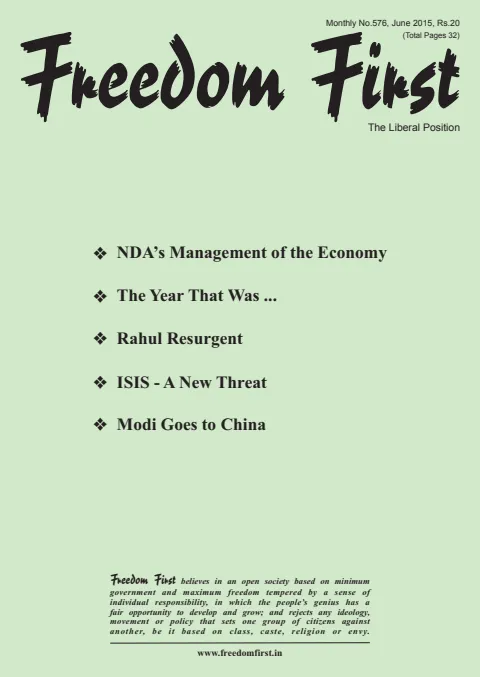
Freedom First
Summary
Freedom First No. 576 (June 2015) is a memorial issue: its long-time editor S. V. Raju had died on 19 May 2015 while this issue was still in preparation, and it opens with tributes (“Remembering Raju”) before moving into the magazine’s regular current-affairs commentary. The issue’s cover-story cluster marks the Modi-led NDA government’s first anniversary, with Ranga Kota auditing its economic record as largely a continuation of UPA-era initiatives, H. R. Bapu Satyanarayana surveying “the year that was” across Kashmir, AAP’s Delhi landslide, the D. K. Ravi death, and the Coalgate/black-money cases, Firoze Hirjikaka charting a newly assertive Rahul Gandhi, and B. Ramesh Babu previewing Modi’s China visit. Other contributions cover the Hindu/Buddhist swastika’s misidentification with Nazism (Nitin G. Raut), a paired debate column on Zaki-ur-Rehman Lakhvi, Salman Khan’s conviction and farmer suicides (Ashok Karnik’s “Point Counter Point”), the ISIS/Daesh phenomenon and a possible Dawood Ibrahim extradition (also Karnik), the second part of Usha Thakkar’s history of the Swatantra Party in Gujarat, Sunil Bhandare on the agrarian crisis and MSP policy, and the concluding eighth part of R. M. Mohan Rao’s series on agriculture and rural indebtedness. The issue closes with further condolence pieces for Raju (from the Guntur Liberal Group and Freedom First readers) and Jehangir Patel’s retrospective, “Nurturing a Tradition,” on Raju and founder-editor Minoo Masani. Across the issue the magazine’s classical-liberal, free-enterprise editorial position is explicit, applied to praise for economic liberalization and scepticism of state planning alongside sharp criticism of the Congress, AAP, and the UPA’s rural and land-acquisition policies.
Essays
Remembering Raju
By Firoze Hirjikaka / Ashok Karnik
Two short tributes to S. V. Raju, Freedom First’s editor since Minoo Masani’s retirement, who died on 19 May 2015 at age 81. Firoze Hirjikaka recalls Raju’s decades-long stewardship of the magazine through chronic underfunding, his refusal to censor contributors he disagreed with, and his role sustaining the Swatantra Party’s legacy. Ashok Karnik’s companion piece describes Raju as an unfailingly liberal editor who published opposing viewpoints without judgment, chaired the Indian Liberal Group, and was hurt but undeterred by accusations of being soft on the government.
- S. V. Raju (24.09.1933 - 19.05.2015) edited Freedom First for decades after succeeding founder-editor Minoo Masani.
- He kept the financially precarious magazine running for roughly half a century without compromising its editorial independence.
- He published contributors’ work regardless of his personal agreement with their views, judging pieces only on logic and freedom from malice.
- He was Chairman of the Indian Liberal Group and remained a committed liberal even as he took criticism for perceived leniency toward the Modi government.
NDA’s Management of the Economy – More of The Same
By Ranga Kota
Ranga Kota argues that the NDA government’s first-year economic “success stories” are largely relabelled continuations of UPA-era initiatives (diesel deregulation, Make in India, Jan Dhan, the GST bill, coal and spectrum auctions, Aadhaar) helped along by falling global oil prices rather than any genuine policy breakthrough. He surveys a slowing stock market, stagnant manufacturing and exports, a struggling IT and financial-services sector, and land-acquisition and environmental-clearance bottlenecks that threaten the government’s infrastructure push, concluding that the promise of “Achhe Din” remains unproven a year in.
- NDA’s claimed successes are mostly tweaks of prior UPA initiatives, judicial mandates (coal/spectrum auctions), or windfalls from falling oil prices and gold imports.
- GDP growth of 7.4% (revised CSO methodology) versus 6.9% under the previous government is presented by the author as a less impressive gain than officially claimed.
- The Sensex’s rise from 22,000 to 29,000 between April 2014 and February 2015 has since lost momentum amid weak corporate earnings.
- Manufacturing and exports remain stagnant around USD 300 bn for three years, hampered by high domestic interest rates and Chinese competition.
- Land acquisition (citing the POSCO and Tata Nano precedents) is flagged as the likely chokepoint for the government’s infrastructure ambitions.
The Year That Was …
By H. R. Bapu Satyanarayana
H. R. Bapu Satyanarayana reviews the NDA government’s first year admiringly, casting Narendra Modi as a decisive statesman in contrast to a supposedly slumbering UPA and a diminished Congress dynasty. He runs through a string of the year’s political events: the delayed BJP-PDP government formation in Jammu & Kashmir and Mufti Mohammad Sayeed’s controversial remarks, General V. K. Singh’s attendance at Pakistan Day functions, J&K floods, AAP’s landslide 2015 Delhi win after its brief 2013 stint, the mysterious death of IAS officer D. K. Ravi in Karnataka, the Prevention of Corruption Act debate around Coalgate and the coal/spectrum auction proceeds, church-attack allegations the author dismisses as manufactured, and Modi’s Swachh Bharat and “Mann Ki Baath” initiatives. The piece (continued from page 9 to page 27) closes noting the Land Acquisition Bill as the government’s first real political setback.
- Frames Modi’s 2014 election as ending Congress’s “dynastic rule” and credits him with a hands-on, statesman-like governing style.
- Covers J&K’s BJP-PDP coalition, the Mufti’s pro-Pakistan remarks, and General V. K. Singh’s Pakistan Day controversy.
- Recounts AAP’s rise, its 49-day 2013 government, and its landslide 67/70 win in the 2015 Delhi assembly election.
- Treats the D. K. Ravi death and the Ashok Khemka transfer as evidence that whistle-blowers remain unprotected in India.
- Cites economist Jagdish Bhagwati’s view that reported attacks on churches are “alarmist” and lack evidence.
- Flags the NDA’s Land Acquisition Bill amendments as its first real political setback, opposed by Congress and other parties.
Rahul Resurgent
By Firoze Hirjikaka
Firoze Hirjikaka charts what he sees as a genuine political transformation in Rahul Gandhi following a mysterious multi-week disappearance in early 2015. Long mocked by the BJP as an inconsequential, gaffe-prone “crown prince,” Rahul returned newly energetic, visible, and focused on concrete issues (farmer suicides, urban housing) rather than personal attacks on Modi, prompting the BJP to respond with senior figures like Arun Jaitley rather than junior spokespersons. The author is cautiously optimistic but stresses that Rahul must sustain the change and “go beyond words” to be a credible alternative to Modi and the BJP.
- Rahul Gandhi’s unexplained sabbatical and subsequent transformation rattled the BJP, which had previously treated him as a disposable target.
- Post-return, Rahul focuses on specific grievances (farmer suicides, housing) and direct constituent contact rather than personal broadsides against Modi.
- The BJP’s escalation to senior spokesmen like Arun Jaitley to counter him is read as evidence of his rising political relevance.
- The author argues dynastic politics is endemic across Indian parties (citing the Shiv Sena, NCP, Lalu-Rabri, and Karunanidhi/Chautala families), not unique to the Congress.
- Concludes that Rahul’s future credibility depends on translating rhetoric into sustained concrete action.
Swastika: Whose Symbol Is It Any Way?
By Nitin G. Raut
Nitin G. Raut responds to a George Washington University controversy in which a Hindu student’s Swastika image was treated as a Nazi hate symbol, arguing this conflates the ancient Hindu and Buddhist Swastika (a symbol of prosperity, luck, and divinity, found across Hindu, Buddhist, Jain, and other Asian traditions, and even in ancient European and Egyptian archaeology) with the geometrically distinct symbol appropriated by the Nazis only in the 1920s. He contends a university ban on the symbol would be both historically ignorant and, if applied in the US, a First Amendment violation.
- A Hindu student’s Swastika image at George Washington University was treated as a potential Nazi hate symbol, risking expulsion.
- The Hindu/Buddhist Swastika is visually distinct (rounded angles, dots, curled ends) from the Nazis’ sharp-angled geometric version adopted only in the 1920s.
- The word ‘Swastika’ derives from Sanskrit, denoting goodwill/being, and represents God, Energy, Wealth, and Liberation in Hindu tradition.
- The symbol appears across Hindu, Buddhist, Jain, and East Asian traditions, and even in ancient European, Egyptian, Celtic, and Native American contexts.
- The author argues a blanket ban would wrongly conflate a religious symbol with a political one and could violate US First Amendment protections.
Point Counter Point
By Ashok Karnik
Ashok Karnik’s recurring “Point Counter Point” column presents opposing viewpoints on three topical issues: the stalled Zaki-ur-Rehman Lakhvi trial and India’s reliance on international pressure over Pakistan versus the argument that only self-reliant action matters in international affairs; the outrage over Salman Khan’s rash-driving conviction and the double standard of wealth-enabled legal remedies versus the view that his celebrity philanthropy cannot excuse the harm caused; and the politics of farmer suicides, contrasting long-neglected structural problems in agriculture with the argument that no government can solve them within a single term.
- On Lakhvi: one view blames Pakistan’s bad faith and India’s naivety in expecting evidence-sharing to work; the counterpoint argues nations act only from self-interest and India must “fight our own battles.”
- On Salman Khan: one side highlights public sympathy and a broken norm around drunk driving; the counterpoint stresses that wealth buys legal remedies unavailable to ordinary citizens.
- On farmer suicides: one side blames decades of neglected structural problems (irrigation, cultivation costs, low prices); the counterpoint argues political parties overpromise because no fix is achievable within an election cycle.
Guntur Remembers Raju
A report on a condolence meeting held by the Guntur chapter of the Liberal Group and a local voluntary organization on 20 May 2015, in memory of S. V. Raju. Speakers recalled Raju’s decades-long friendships with Swatantra Party veterans, his mentorship of youth, his role training N. T. Rama Rao in political management, and his contributions to propagating liberal and economic-reform ideology across Andhra Pradesh.
- The Guntur Liberal Group and Avagahana held a condolence meeting for Raju on 20 May 2015.
- Dr. Y. Sivaji called Raju a link between the old Swatantrites and modern liberals, and “the other Minoo Masani” who trained N. T. Rama Rao.
- V. V. S. Rama Rao recalled Raju’s work organizing agriculture and rural-indebtedness programmes across Andhra Pradesh.
- Multiple speakers, including Ch. Seshayya of the Telugu Desam Party, praised Raju’s lifelong propagation of liberal ideology.
Fond Reminiscences of our dear Editor
By Editorial Team
A compilation of condolence messages from Freedom First readers and associates following S. V. Raju’s death, including Firoze Hirjikaka’s editorial framing note. Contributors including D. N. Patodia, Kunwar Sinha, Dr. L. S. N. Prasad, Dr. B. Ramesh Babu, Sunil S. Bhandare, Meera Sanyal, R. N. Bhaskar, and members of the Matunga unit of the Swatantra Party remember Raju as a true successor to Rajaji and Minoo Masani, a mentor devoted to liberal institutions, and the Swatantra Party’s most loyal “jawan.”
- Numerous readers and colleagues sent condolence messages within hours of Raju’s death.
- Sunil S. Bhandare calls Raju ‘a friend, philosopher and mentor’ whose passing risks leaving the liberal movement ‘orphaned.’
- Meera Sanyal describes Raju as the ‘true successor to Rajaji and Masani’ who archived the liberal movement’s history.
- The Matunga unit of the Swatantra Party calls Raju the party’s most faithful ‘jawan’ since its 1958 inception.
ISIS – A New Threat
By Ashok Karnik
Ashok Karnik argues that ISIS/Daesh should not be dismissed as mere banditry but understood as possessing its own theology and philosophy, rooted in a narrative of a centuries-long civilizational war against the ‘Army of Rome’ (the West). He explains the split between the more pragmatic, network-driven Al Qaeda and the more puritanical, self-financing Daesh, which rejects any accommodation with ‘infidels,’ ‘apostates,’ or fellow Muslims accepting democracy. He assesses ISIS’s military weaknesses (no air force, navy, or missiles) against the West’s reluctance to commit ground troops, and warns that the ideology’s appeal to disaffected Westerners as ‘lone wolves’ makes the threat open-ended.
- ISIS/Daesh is framed as fighting a theological and civilizational war against the ‘Army of Rome’ (the West), not merely engaging in banditry.
- Daesh split from Al Qaeda over ideological purity, rejecting Al Qaeda’s tolerance of Muslim-majority regimes that accepted democracy.
- Daesh’s financial self-sufficiency, unlike Al Qaeda’s past reliance on Osama bin Laden’s fundraising, is presented as a key strategic difference.
- ISIS’s declared statehood makes it vulnerable to conventional attack, but Western publics’ war-weariness after Iraq/Afghanistan limits appetite for ground intervention.
- The article warns that thousands of Western recruits and ‘lone wolf’ terrorism reflect an ideology with an unpredictable end point.
Dawood’s Return?
By Ashok Karnik
Ashok Karnik dissects claims that a 1994 CBI approach to negotiate Dawood Ibrahim’s return from Pakistan was sabotaged by politicians and police fearing exposure. He argues such ‘secret deal’ speculation is naive: no Indian government can legally bargain with a fugitive, negotiating channels are deliberately deniable, and claims that Dawood’s return would have prevented 26/11 ignore that the attack was planned by Lashkar-e-Toiba with ISI support regardless. He is equally sceptical of any near-term extradition, noting Pakistan denies Dawood is even in its territory.
- A former CBI officer’s claim of a 1994 approach to bring Dawood Ibrahim back to India triggered speculation about political sabotage.
- The author argues governments cannot legally ‘bargain with criminals,’ and that untraceable middlemen, not identifiable officials, run such deals.
- He calls it ‘childish’ to claim Dawood’s 1994 return would have prevented 26/11, since Lashkar-e-Toiba and the ISI could have found an alternative plan.
- Dawood’s extradition is called ‘only a pipe dream’ since Pakistan denies knowledge of his presence there.
- The piece draws a parallel to the decade it took the CIA to locate and eliminate Osama bin Laden, urging patience over wishful thinking.
The Swatantra Party in Gujarat: A Shooting Star (Part II)
By Usha Thakkar
The second installment of Usha Thakkar’s three-part history of the Swatantra Party in Gujarat covers the pivotal 1967 elections, in which the party sought to become a genuine alternative to Congress rather than mere opposition, winning 66 of 168 assembly seats (37.5% of the vote) and 12 of 21 Gujarat Lok Sabha seats. She traces how the historic Kshatriya-Patidar caste rivalry resurfaced within the party’s ranks despite leadership efforts (via the Gujarat Kshatriya Sabha and figures like Bhaikaka) to unite the two communities, causing internal defections (notably Narendrasinh Mahida’s departure to Congress) and factional tension that shaped seat allocation and election outcomes across Gujarat’s districts.
- In the 1967 elections the Swatantra Party won 66 of 168 Gujarat assembly seats (37.5% of votes) and 12 of 21 Lok Sabha seats (39.92%), consolidating bipolar contests with Congress.
- The party was strongest in Surendranagar and Sabarkantha and weakest in South Gujarat, with most of its wins coming from rural constituencies.
- Caste politics resurfaced: the historic Kshatriya-Patidar antagonism divided the party despite leadership efforts, including a policy of allocating 33% of seats each to Patidars and Kshatriyas.
- Key defections, including Narendrasinh Mahida’s return to Congress, and losses in Kutch and Anand illustrated the cost of the Kshatriya-Patidar split.
- The party attracted industrialists (Pashabhai Patel, Manubhai Amresey, Viren Shah) and retired bureaucrats (H. M. Patel, C. C. Desai), and won support from several former princely rulers.
Agrarian Crisis – Rural Distress – and All That
By Sunil S. Bhandare
Sunil S. Bhandare argues that the political debate blaming NDA’s 2014-15 minimum support price (MSP) restraint for rural distress is misguided. He shows that UPA-era MSP increases (over 11% annually for rice and wheat) far outpaced productivity growth and mainly benefited medium and large farmers with marketable surplus, while contributing to persistent food inflation; the 75-80% of farmers with under two hectares saw little benefit since they consume most of their own output. He contends the real, unaddressed structural problems are land fragmentation, weak crop insurance, and the absence of a genuine second green revolution, and calls for strategic buffer-stock management rather than indiscriminate MSP hikes or procurement targets.
- UPA-era MSP increases (2004-05 to 2013-14) were in double digits for many crops but productivity growth (e.g., 2.9% annual for wheat) lagged far behind.
- MSP increases mainly benefit medium/large farmers with marketable surplus; 75-80% of farmers, holding under two hectares, gain little since they consume most of their own crop.
- P. Sainath’s July 2014 study found 2,96,438 farmer suicides since 1995, with Maharashtra alone recording 60,750 since 1995 and worsening after 2004.
- Indiscriminate MSP hikes are argued to have created a persistent inflationary ‘ratchet effect,’ hurting rural and urban poor alike.
- The author calls for strategic buffer-stock operations rather than excessive procurement, and for reforms addressing land fragmentation, crop insurance, and crop diversification.
Poor Kishen
By Adi F. Merchant
B. Ramesh Babu previews Modi’s May 2015 visit to China, Mongolia, and South Korea, arguing that India-China relations are poised for major geo-economic growth (trade, investment, nuclear and aviation cooperation, BRICS Bank and AIIB membership) even as the long-unresolved Himalayan border dispute remains the central obstacle. He details China’s continued mixed signals (protesting Modi’s Arunachal Pradesh visit even amid friendly diplomacy), broader Chinese expansionism (South China Sea island-building, the Gwadar port lease, interest in a Djibouti base), and Modi’s departure from India’s earlier ‘deference and diffidence’ China policy toward a more assertive, US-aligned posture, concluding that India has no choice but to pursue simultaneous cooperation and containment.
- Modi’s China/Mongolia/South Korea trip (14-17 May 2015) was his 11th foreign trip covering 16 countries in his first year.
- India and China cooperate via BRICS Bank membership and India’s founding role in the China-led AIIB, even as India remains cautious on Xi’s ‘Belt and Road’ project.
- China lodged formal protests over Modi’s visit to Arunachal Pradesh even as friendly border-dispute talks (Doval-Yang meeting in Munich) proceeded in parallel.
- The article documents Chinese assertiveness beyond India: island-building in the Spratlys, a 40-year Gwadar port lease in Pakistan, and reported interest in a Djibouti base.
- Modi is credited with abandoning India’s historic China policy of ‘deference and diffidence’ for a more ‘muscular,’ US-aligned approach, giving field commanders more latitude on border incidents.
Modi Goes to China: Development at Home and Peace on the Border
By B. Ramesh Babu
In the concluding eighth part of his series, R. M. Mohan Rao lays out policy recommendations on agricultural extension reform, marketing, and rural social-sector investment. He calls for a farming-systems approach to extension that addresses nutrition, risk, and income holistically; warns that profit-driven private extension neglects poor and marginal farmers, requiring continued state involvement; and proposes marketing reforms including farmer freedom to transport and sell produce, toll-free market-price information, price stabilization funds, warehouse-receipt credit for small farmers, and expanded rural road and telecom connectivity. On the social sector, he recommends improved rural primary education and health infrastructure, vocational schooling, educational loans for farmers’ children, group rural health insurance, and higher KCC insurance limits, concluding that public investment in agriculture must continue since private capital will not fill the gap.
- Calls for a holistic ‘farming systems’ approach to agricultural extension covering nutrition, risk, income, and marketing, not just production technique.
- Warns that private-sector and input-dealer extension services neglect poor, marginal, and geographically remote farmers, citing 1997-98 Andhra Pradesh cotton-farmer suicides as a cautionary example.
- Recommends marketing reforms: farmer freedom to transport/sell produce, toll-free market-price intelligence, price stabilization funds, and warehouse-receipt credit parity with traders.
- Notes over half of Indian villages lack all-weather roads and 41% lack telephone connectivity, hampering market access.
- Proposes rural social-sector reforms: better primary education, vocational subjects, educational loans, preventive health care, group rural health insurance, and a KCC insurance limit raised to Rs. 1 lakh.
- Concludes that continued public investment in agriculture is necessary since private capital will not serve small and marginal farmers.
Agriculture and Rural Indebtedness - VIII
By R. M. Mohan Rao
Jehangir Patel’s retrospective contrasts the temperaments of Freedom First’s two editors, the ‘thoughtful, insightful’ Minoo Masani and the ‘restless, energetic’ S. V. Raju, while tracing the magazine’s evolution from a quarterly into a polished monthly. He describes Raju’s staunch pro-liberalization, pro-BJP leanings (tempered by discomfort with Hindutva hardliners and doubts about Modi’s minority outreach) and his allowance of a dissenting anti-Modi column despite his own preferences, and recounts the magazine’s defiant closure during the Emergency, its Bombay High Court challenge (with Soli Sorabjee appearing pro bono), and Raju’s foresight in digitizing its archive before his death.
- Contrasts Minoo Masani’s stubborn, statesman-like editorship with S. V. Raju’s restless, pragmatic style as his successor.
- Raju grew Freedom First from a quarterly into a well-designed monthly while preserving its practice of publishing all viewpoints.
- Raju welcomed the scrapping of the Planning Commission and Modi’s economic liberalization but distanced himself from anti-minority hardliners’ rhetoric.
- He allowed a colleague’s anti-Modi column to run as an article despite personal disagreement, in keeping with the magazine’s editorial tradition.
- During the Emergency, Masani shut the magazine rather than submit to censorship, winning a Bombay High Court challenge (with Soli Sorabjee appearing pro bono) before resuming publication two years later.
- Raju ensured Freedom First’s archives were digitized and made freely available online before his death.
Generated by the v1.5 extraction pipeline. Awaiting editorial review.
Metadata and summary are AI-extracted from the source PDF and reviewed for editorial accuracy. The original work is available via the Read PDF tab above (where present); paragraph-level citation inside the PDF is deferred to a future engagement.