pamphlet
"For God's Sake, Go"
By Minoo Masani
Swatantra Party · 1966
9 pages
Part of Swatantra Party
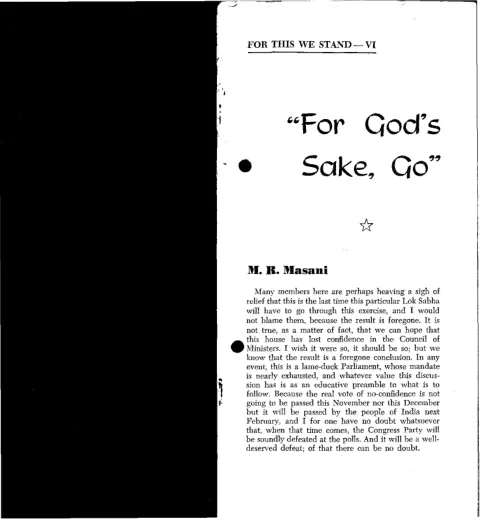
“For God’s Sake, Go”
By M. R. Masani
Summary
“For God’s Sake, Go” is the sixth pamphlet in the Swatantra Party’s “For This We Stand” series, reproducing a speech M. R. Masani delivered in the Lok Sabha on 2 November 1966 during the debate on a No-Confidence Motion against the Congress Government. Masani concedes the motion itself is doomed in a “lame-duck Parliament,” but treats the debate as an “educative preamble” to the real verdict he expects the Indian electorate to deliver in February 1967 — a “well-deserved defeat” for the Congress after nineteen years of what he calls misrule.
The bulk of the speech is a sweeping indictment of Congress governance. On the constitutional front Masani charges that the Constitution has been repeatedly amended — often merely to undo judgments of the Supreme Court — eroding Fundamental Rights, while a permanent state of Emergency and the Defence of India Rules have become a “crutch” for a government ruling a country at peace; he likens the atmosphere to the Rowlatt Act era, quoting Nehru’s own words against repressive government. He decries the fragmentation of national unity through linguistic and territorial disputes, and reserves his sharpest fire for public morality, tying pervasive corruption and “jobbery” to the “permit-licence raj” of statism and controls, and citing the grossly inflated Punjab and Haryana cabinets as proof. He attacks the abdication of law and order (the Bombay bundh, where police stood by while goondas ruled the streets), a foreign policy that has left India isolated and encircled by Communist China, and an economic plight — quoting the London Economist — of shattered self-confidence, failed planning, a botched devaluation, and a “horrible” Fourth Plan he predicts will bring famine and thousands of deaths by the middle of 1967.
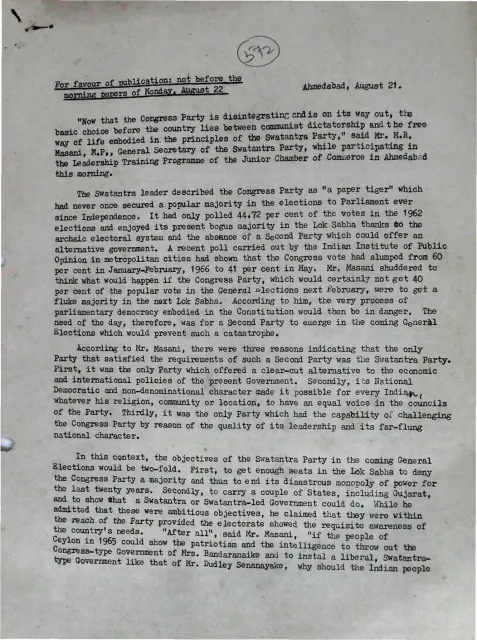
Masani closes by rebutting two “fallacies” that might yet save the Congress. The first, that the party is invincible, he dismisses: the Congress is a “paper tiger” — indeed a shrinking one — that has never won a majority of votes (its highest share 48 per cent, its lowest 44.72 per cent) yet holds some 72 per cent of seats through a fluke of the British first-past-the-post system. His remedy is a “second ballot” on the French model, achieved through pre-poll seat arrangements among opposition parties (already agreed between the Swatantra Party and the Jan Sangh in Gujarat, Rajasthan and Orissa) to give a single democratic candidate a straight fight against Congress. The second fallacy, that stability requires Congress continuity, he calls “complete nonsense,” warning that only a change of government can keep India from drifting toward the fate of Ghana or Indonesia. He ends by pointing to the Congress President’s invitation to the communists and to Indira Gandhi’s “one nation, one team” slogan as evidence of totalitarian and “Fascist” tendencies, insisting that a democracy needs “one nation, two teams” — one in office and one in opposition.
Key points
-
The sixth pamphlet in the Swatantra Party’s “For This We Stand” series, reproducing M. R. Masani’s Lok Sabha speech of 2 November 1966 in the No-Confidence Motion debate.
-
Treats the doomed motion in a “lame-duck Parliament” as a prelude to the real verdict he expects voters to deliver against Congress in February 1967.
-
Indicts constitutional erosion: repeated amendments to undo Supreme Court rulings, whittled Fundamental Rights, and a permanent Emergency used as a governing “crutch.”
-
Ties pervasive corruption and “jobbery” to the “permit-licence raj,” citing bloated Punjab and Haryana cabinets and the abdication of law and order (the Bombay bundh).
-
Attacks a foreign policy that has left India isolated and encircled by Communist China, and an economic crisis of failed planning, botched devaluation, and a doom-laden Fourth Plan he warns will bring famine by mid-1967.
-
Calls the Congress a “paper tiger” that rules on a minority of votes (never above 48%) yet holds ~72% of seats through the distorting British first-past-the-post system.
-
Urges a “second ballot” via pre-poll opposition seat pacts (Swatantra–Jan Sangh agreements in Gujarat, Rajasthan and Orissa) for straight fights against Congress.
-
Rejects the “stability” argument for Congress and reads Indira Gandhi’s “one nation, one team” slogan as a Fascist tendency, insisting democracy needs “one nation, two teams.”
Ingested 2026-07-21 from the CCS source archive. AI-drafted summary awaiting editorial review.
Metadata and summary are AI-extracted from the source PDF and reviewed for editorial accuracy. The original work is available via the Read PDF tab above (where present); paragraph-level citation inside the PDF is deferred to a future engagement.