edited volume · anthology
Friedman on India
Centre for Civil Society · New Delhi · 2000
48 pages
Part of CCS Publications
Summary
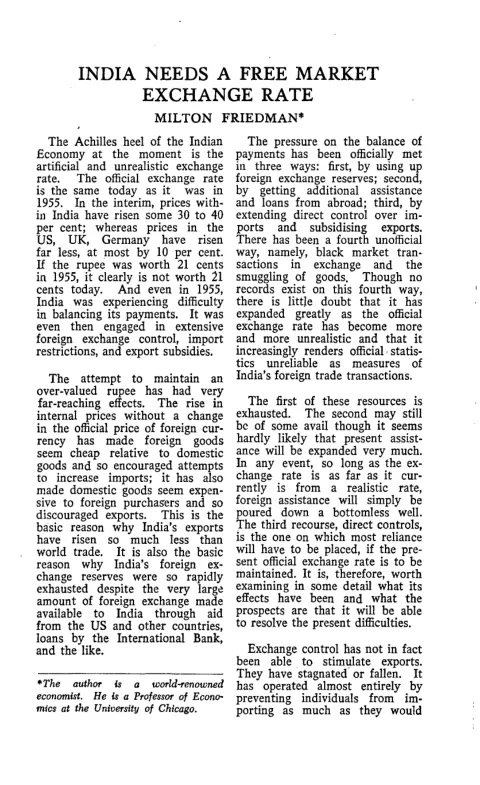
Two pieces Milton Friedman wrote about Indian economic policy, gathered by the Centre for Civil Society forty years after they were written and published with a foreword by Deepak Lal. Friedman came to India in the autumn of 1955 at the invitation of the United States government, which had been asked for help as the Second Five Year Plan was being drafted and saw an opportunity to set two proponents of free markets against the left-wing advice the Indian government was already receiving from Oskar Lange, Michael Kalecki, Nicholas Kaldor and John Strachey. Assigned to advise the finance minister C. D. Deshmukh, Friedman spent a month in Delhi and wrote a memorandum at the end of it. He returned in the early 1960s and wrote a second, longer assessment.
Deepak Lal’s foreword places the two essays in their setting. In the heyday of Indian planning almost every leading economist in the world endorsed the framework of the Second Plan and the licensing system it inaugurated. Lal counts only three notable dissenters: B. R. Shenoy at the University of Gujarat, Peter Bauer at the London School of Economics, and Friedman at Chicago. Friedman’s contribution, he writes, is the least known of the three, and the reason the pamphlet is worth reprinting is that the failures it identified were still unrepaired half a century later.
Friedman’s argument is that planning cannot supply the information a price system supplies. Import licensing has no criterion for deciding what is essential and what is not, because outside a market there is no test; the result is that a family reducing its spending trims a little everywhere while a planning board bans whole categories. He works the point through the Indian car market, where a second-hand American car worth twenty-two dollars was quoting at fifteen hundred to two thousand rupees in Bombay. He argues for a stable monetary rule, warns that deficit financing is a form of taxation and an inefficient one, and presses the case for removing trade and exchange controls in favour of a convertible rupee.
Key points
- The volume collects the memorandum Friedman wrote for the Government of India in 1955 and a longer essay on Indian economic planning from the early 1960s, with editor’s excerpts.
- Friedman visited India in 1955 under the United States International Cooperation Administration and was assigned to advise the finance minister, C. D. Deshmukh.
- Deepak Lal’s foreword names B. R. Shenoy, Peter Bauer and Friedman as the only notable dissenters from the international consensus behind the Second Five Year Plan.
- Friedman argues that import licensing has no workable criterion for distinguishing essential from unessential goods, because that judgement requires a market test.
- He treats the Indian car market as a demonstration, contrasting a second-hand car worth twenty-two dollars in the United States with its Bombay price of several thousand rupees.
- He argues for a stable rate of monetary expansion, holding that no other single area of policy carries a greater risk of damage or a greater possible benefit.
- He treats deficit financing as a form of taxation rather than a separate way of closing a resource gap, and an inefficient and inequitable one.
- Lal’s one recorded disagreement with Friedman is his claim that reverence for the cow is irrational, which Lal argues elsewhere is less uneconomic than it appears.
Metadata and summary are AI-extracted from the source PDF and reviewed for editorial accuracy. The original work is available via the Read PDF tab above (where present); paragraph-level citation inside the PDF is deferred to a future engagement.