periodical issue
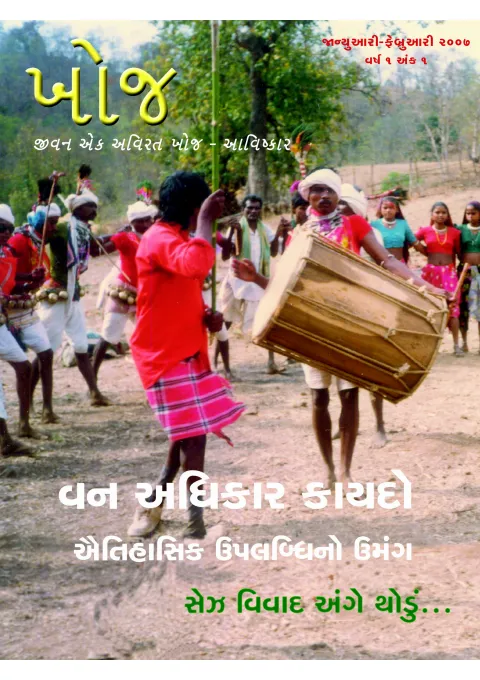
ખોજ
જીવન એક અવિરત ખોજ
ખોજ — જીવન એક અવિરત ખોજ
Khoj — Jivan ek avirat khoj
By Trupti Parekh, Ambrish Mehta, Anil Patel
આર્ય, ઈ-૩૦૨, સામ્રાજ્ય કોમ્પ્લેક્ષ, ફતેગંજ પોસ્ટ ઓફિસ પાસે, ફતેગંજ, વડોદરા - ૩૯૦૦૦૨, ગુજરાત. ફોન : ૦૨૬૫ ૨૭૮૨૨૦૫૩. ઈ-મેઈલ : [email protected]. (Subscriptions via ARCH — Action Research in Community Health and Development) · Vadodara, Gujarat · 2007
48 pages
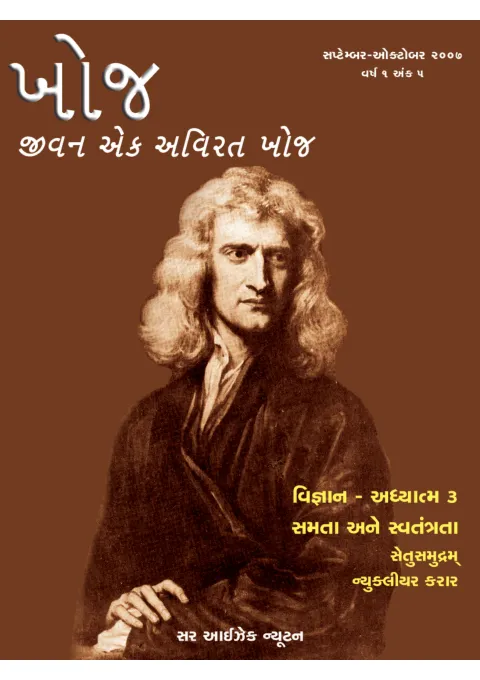
ખોજ
Summary
Khoj (“ખોજ — જીવન એક અવિરત ખોજ”, roughly “Life, an unending quest”) is a Gujarati liberal little-magazine published from Vadodara; this is Year 1, Issue 5 (cover and masthead date September-October 2007, despite the file name). Edited by Ambarish Mehta with an editorial board and a wide advisory committee, the issue opens with bilingual epigraphs (a Rig Veda verse and the Greek sceptic Xenophanes) and an editorial, then runs a substantial letters-and-responses section before its main features. In the rendered pages the issue is dominated by an ongoing debate on “Vigyan-Adhyatma” (science vs. spirituality) and on whether free markets automatically produce prosperity, alongside topical commentary on civil liberties, the India-US nuclear deal, and the Sethusamudram canal project. The magazine prints translated pieces by liberal and libertarian authors (Leonard E. Read’s “I, Pencil”, Sauvik Chakravarti, Fareed Zakaria) and carries explicitly classical-liberal arguments about knowledge, markets and individual freedom.
Key points
-
Jayanti Patel and fellow contributors continue Khoj’s Vigyan-Adhyatma debate, distinguishing science’s public, reproducible verification from spirituality’s inward, person-specific experience and warning against treating subjective claims as objective truth.
-
Kirit Panvala’s essay on Yakub Memon argues that even those accused of the 1993 Mumbai serial blasts deserve a fair trial, scrutinising the TADA court’s verdict and standard of evidence rather than defending the accused.
-
Mukesh Adenwala’s rejoinder to Anil Patel accepts individual liberty as central but disputes that market institutions automatically produce prosperity, arguing capitalism’s European success depended on secularism, rule of law and an independent judiciary.
-
T. S. Gopi Rethinaraj defends the July 2007 India-US civil nuclear agreement as a chance to end India’s nuclear “apartheid,” discussing Nuclear Suppliers Group safeguards while dismissing both left and right objections as ideological.
-
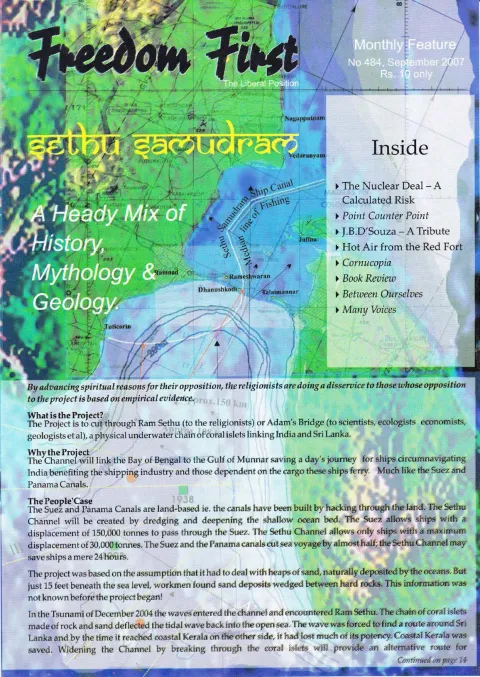
Tripti Parekh’s piece on the Sethusamudram canal sets aside the “Ram Setu” religious controversy to question, on economic and environmental grounds, whether shipping-time savings justify the dredging costs and ecological risk.
-
The issue prints Gujarati translations of libertarian writers, including Leonard E. Read’s “I, Pencil,” alongside pieces by Sauvik Chakravarti and Fareed Zakaria.
-
Edited by Ambarish Mehta with an editorial board and advisory committee, the issue opens with bilingual epigraphs from the Rig Veda and the Greek sceptic Xenophanes before its editorial and letters section.
Essays
વિજ્ઞાન - આધ્યાત્મ
By જ્યંતી પટેલ અને મિત્રો
The “Vigyan-Adhyatma” (science and spirituality) feature collects responses to an earlier essay series in Khoj. In the rendered pages it argues that science and spirituality both pursue truth but by different methods — science through reproducible, public verification, spirituality through inward, person-specific experience — and warns that treating subjective spiritual claims as objective truth produces dogma. It draws a distinction between knowledge that can be tested against history and merely asserted belief, and cautions against religious-spiritual knowledge overstepping its boundaries.
- Frames science and spirituality as two distinct paths to truth, with different epistemic methods.
- Science is characterised by public, reproducible verification; spiritual knowledge as inward and person-specific.
- Warns against converting subjective spiritual experience into claims of objective truth (the root of dogma).
- Part of an ongoing multi-issue debate in Khoj prompted by Jayanti Patel and others.
યાકુબ મેમણ માટે કોણ આંસુ સારશે ?
By કિરીટ પાનવાલા
Kirit Panvala’s “Yakub Memon mate kon aansu sarshe?” (“Who will shed tears for Yakub Memon?”) responds to an earlier Khoj piece on the 1993 Mumbai serial-blasts case. Rather than defending Memon, it makes a due-process and rule-of-law argument: that even those accused of grave terrorist crimes are entitled to a fair trial, that evidence and the courts’ reasoning must be scrutinised, and that the integrity of India’s democratic and judicial system matters more than vengeance. It examines the TADA court verdict and the standards of proof in the case.
- A reply within an ongoing Khoj exchange about the 1993 Mumbai blasts case.
- Centres the rule of law and due process even for those accused of terrorism.
- Scrutinises the TADA court’s reasoning and the standard of evidence.
- Argues the credibility of the judicial system outweighs the impulse to vengeance.
સ્વતંત્રતા - જ્ઞાન અને બજાર
By મુકેશ એદનવાલા
Mukesh Adenwala’s “Svatantrata — Jnan ane Bajar” (“Freedom — Knowledge and the Market”), printed in English, is a careful rejoinder in a debate with Anil Patel over whether establishing a market order automatically yields prosperity. Adenwala accepts the centrality of individual liberty and the idea of free institutions guiding economic agents, citing Adam Smith on markets as a set of institutions, but doubts that market mechanisms automatically and assuredly lead to development irrespective of the institutional and cultural setting. He argues that the historical success of capitalism in 18th-19th century Europe depended on prior conditions — secularism, personal dignity, rule of law, an independent judiciary, enforceable contracts — and that culture and institutions shape developmental outcomes, so there is no single guaranteed path to prosperity.
- Written in English as a response to Anil Patel in a market-and-prosperity debate.
- Accepts individual liberty and free choice but disputes that markets automatically guarantee development.
- Invokes Adam Smith on markets as institutions and the ‘rules of the game’ definition of institutions.
- Argues capitalism’s European success rested on prior conditions: secularism, rule of law, independent judiciary, property rights.
- Concludes culture and institutions condition development; no single sure route to prosperity.
ન્યુક્લીયર કરારના બચાવમાં
By ટી. એસ. ગોપી રેથીનારજ
T. S. Gopi Rethinaraj’s “Nuclear kararna bachavma” (“In Defence of the Nuclear Deal”) argues that the July 2007 India-US civil nuclear agreement should not be obstructed for narrow political reasons. It frames the deal as a chance to end India’s nuclear ‘apartheid’ and isolation, discusses the NSG and international safeguards, and criticises both left and right opponents whose objections it reads as ideological and anti-American rather than grounded in India’s strategic interests.
- Defends the July 2007 India-US civil nuclear agreement.
- Casts the deal as ending India’s nuclear ‘apartheid’ and international isolation.
- Discusses the NSG and safeguards arrangements.
- Criticises both left and right opposition as ideological rather than strategic.
સેતુસમુદ્રમ્ પ્રોજેક્ટ જરૂરી છે ખરો ?
By તૃપ્તિ પારેખ
Tripti Parekh’s “Setusamudram project jaruri chhe kharo?” (“Is the Sethusamudram project really necessary?”) examines the controversial shipping-canal project through the Palk Strait. It sets aside the religious ‘Ram Setu’ politics to ask whether the project is justified on economic, environmental and strategic-security grounds, and from an economic viewpoint questions whether the time and cost savings to shipping justify the ecological damage and expense, noting that the dredged channel may silt up and that larger vessels could not use it.
- Assesses the Sethusamudram Palk Strait canal project on economic, environmental and security grounds.
- Deliberately brackets the ‘Ram Setu’ religious-political controversy.
- Questions whether shipping time/cost savings justify ecological damage and cost.
- Notes risks of silting and that larger ships could not use the channel.
Generated by the v1.5 extraction pipeline. Awaiting editorial review.
Metadata and summary are AI-extracted from the source PDF and reviewed for editorial accuracy. The original work is available via the Read PDF tab above (where present); paragraph-level citation inside the PDF is deferred to a future engagement.