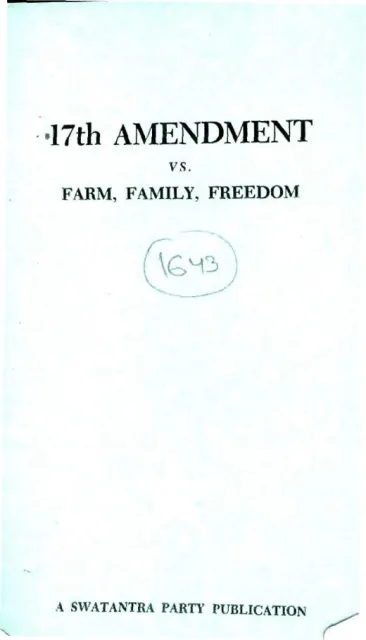
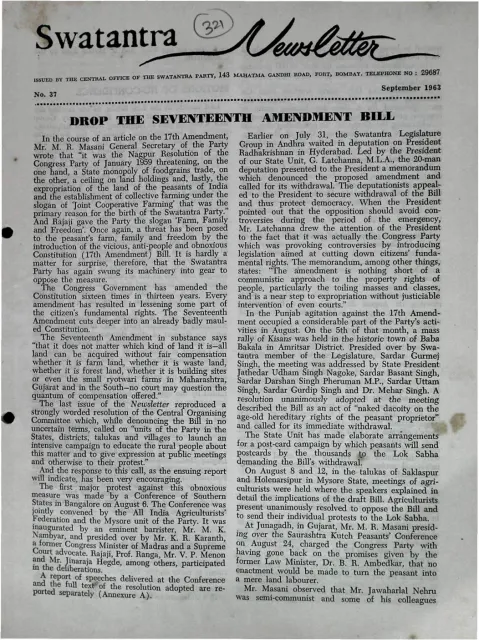
edited volume
Lawless Legislation
Why Swatantra Opposes the 17th Amendment?
Swatantra Party Parliamentary Office, New Delhi · New Delhi · 1963
42 pages
Part of Swatantra Party
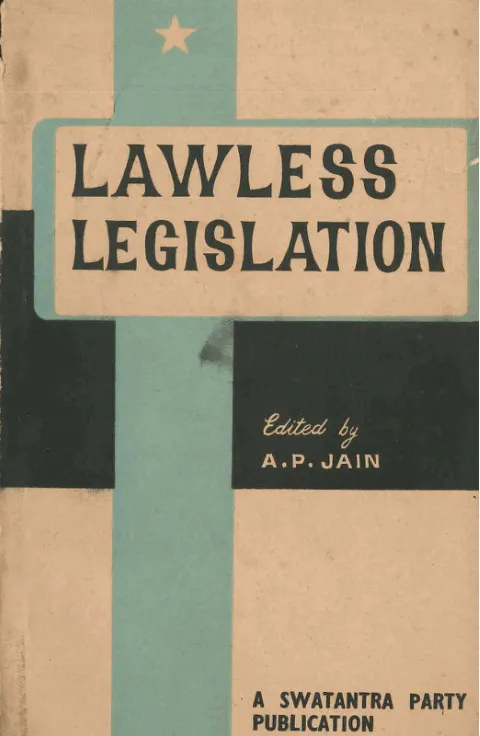
Lawless Legislation
A Swatantra Party publication, edited by A. P. Jain
Summary
Lawless Legislation is a 1963 Swatantra Party pamphlet, edited by A. P. Jain and issued by the party’s Parliamentary Office in New Delhi, gathering the party’s case against the Constitution (Seventeenth Amendment) Bill of 1963. Its subtitle asks “Why Swatantra opposes the 17th Amendment?” The collection opens with a foreword and a title essay by C. Rajagopalachari (Rajaji), whose phrase “lawless legislation” gives the booklet its name: he argues that laws contrary to the fundamental principles embodied in the Constitution are “lawless laws,” and that the climax of lawlessness is reached when a government, rebuffed by the Supreme Court, simply amends the Constitution to nullify the judgment.
The pamphlet traces the history of land-reform amendments — the First Amendment (1951), which inserted Article 31-A and the Ninth Schedule to shield the Zamindari-abolition Acts from Fundamental Rights challenges, and the Fourth Amendment (1955), which made the adequacy of compensation non-justiciable. Its central alarm is the Seventeenth Amendment’s redefinition of “estate” in Article 31-A to sweep in ryotwari holdings and virtually all agricultural land, house sites and kitchen gardens. Drawing on Sir Thomas Munro and Arthur Young (“the magic of ownership would turn sand into gold”), the contributors insist that the ryotwari cultivator is an owner-proprietor in direct relation with the State, not a rent-collecting intermediary like a zamindar; to reclassify him as the holder of an “estate,” they argue, is “a gigantic falsehood” that revives the exploded doctrine that all land in India belongs to the Government.
The consequence, the writers contend, is that peasant land could be compulsorily acquired for a nominal, non-justiciable compensation and handed to cooperative farms — the machinery, they say, for carrying out the Congress’s 1959 Nagpur Resolution on joint cooperative farming and, ultimately, Soviet- and Chinese-style collectivisation. Speeches by Prof. N. G. Ranga (“Monstrous Legislation”), Krishnapal Singh (“The Socialist Pattern”), Lokanath Misra (“Liquidation of Peasantry”) and Dahyabhai Patel (“Road to Communism”) frame the Bill as an emergency-time assault on some 65 million peasant families and on the Fundamental Right to Property, backed by roughly 72,000 protest petitions to the Lok Sabha. K. M. Munshi’s chapter reads the amendment as part of a drift toward a “New Despotism” that subordinates the judiciary and the Rule of Law to the will of the ruling party.
Throughout, the Swatantra Party’s position is that the Supreme Court had objected only to the manner of implementing ceilings and to inadequate compensation — not to ceilings or to the abolition of intermediaries as such — so the proper course was for the States to amend their land Acts to fit the Constitution, not to amend the Constitution to validate scores of defective Acts (123, later put at 144) by lodging them in the Ninth Schedule. The party accordingly refused to join the Joint Select Committee and demanded that the Bill be circulated for public opinion, presenting itself as the defender of self-employed peasant proprietors, freedom and constitutional guarantees against collectivisation.
Key points
-
A 1963 Swatantra Party pamphlet, edited by A. P. Jain and issued by the party’s Parliamentary Office, New Delhi, arguing against the Constitution (Seventeenth Amendment) Bill of 1963.
-
Takes its title from C. Rajagopalachari’s essay: laws that contradict the Constitution’s fundamental-rights guarantees are “lawless laws,” and amending the Constitution to overturn adverse Supreme Court rulings is the “climax of lawlessness.”
-
Objects chiefly to the Amendment’s redefinition of “estate” in Article 31-A to include ryotwari holdings and nearly all agricultural land, house sites and gardens.
-
Distinguishes the ryotwari peasant-proprietor (an owner in direct relation with the State, per Munro and Arthur Young) from rent-collecting zamindari intermediaries, calling the reclassification “a gigantic falsehood.”
-
Recalls the First Amendment (1951: Article 31-A and the Ninth Schedule) and the Fourth Amendment (1955: compensation made non-justiciable) as the precedents now being extended.
-
Warns the Bill would allow compulsory acquisition of peasant land at nominal, non-justiciable compensation to force cooperative and collective farming under the 1959 Nagpur Resolution — the “road to Communism.”
-
Collects parliamentary speeches by N. G. Ranga, Krishnapal Singh, Lokanath Misra and Dahyabhai Patel, plus a chapter by K. M. Munshi warning of a “New Despotism” subordinating the judiciary.
-
Swatantra’s remedy: States should amend their land Acts to fit the Constitution rather than shield scores of Acts in the Ninth Schedule; the party refused the Joint Select Committee and demanded the Bill be circulated for public opinion.
Ingested 2026-07-21 from the CCS source archive. AI-drafted summary awaiting editorial review.
Metadata and summary are AI-extracted from the source PDF and reviewed for editorial accuracy. The original work is available via the Read PDF tab above (where present); paragraph-level citation inside the PDF is deferred to a future engagement.