edited volume · festschrift
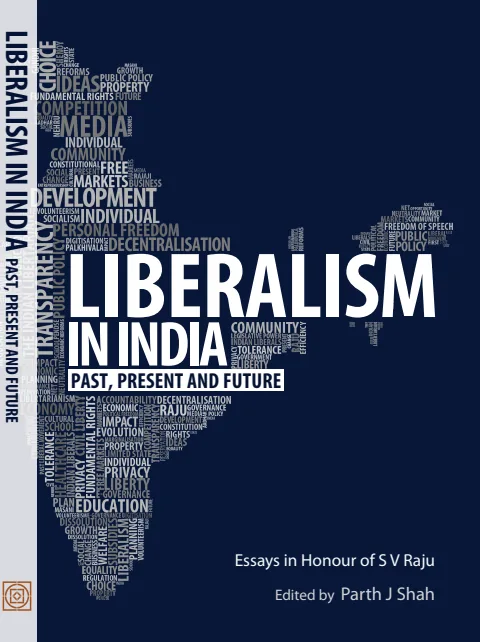
Liberalism in India: Past, Present and Future
Essays in Honour of S V Raju
Edited by Parth J. Shah
Centre for Civil Society · New Delhi · 2016
254 pages
Part of CCS Publications
Summary
Parth J Shah’s introduction presents the book as the S V Raju Festschrift and describes S V Raju as a ‘convening force’ for Indian liberals. After the closure of the Swatantra Party, Raju helped sustain the Maharashtra chapter and the Indian Liberal Group as a forum where liberals could continue to meet, debate and develop ideas. The volume brings together liberals, libertarians and conservatives, as well as politicians, public intellectuals, authors, columnists, activists and organisations.
The essays examine what Shah calls the ‘liberty conflicts’ and ‘liberty implications’ of liberalism. The conflicts include liberty versus equality, security, the welfare state, democracy, reservations, and India’s history of liberty. The implications include liberal constitutionalism, decentralisation of governance, and religious and cultural freedom. The contributors apply these questions to India’s political, economic and social circumstances.
Key points
- Parth J Shah presents liberty as the fundamental political value that makes a political association liberal.
- Parth J Shah identifies equality, fraternity, security and social justice as values that can come into tension with liberty.
- Hindol Sengupta traces the development of liberal thought in India and discusses figures and movements that contributed to the Indian liberal tradition.
- Atanu Dey argues for constitutional changes that would better protect individual economic and political freedom.
- Laveesh Bhandari examines the contrasting approaches of Gandhiji and Nehruji to India’s development and political future.
- Nirvikar Singh examines how digital technology is changing economic activity, social interaction and government, while also creating new questions concerning freedom and security.
- Surjit S Bhalla examines reservations and affirmative action in relation to equality of opportunity.
- Gurcharan Das examines the relationship between liberty, opportunity and inequality.
- R Jagannathan examines religious and cultural freedom through contemporary Indian examples involving expression, religion and state intervention.
- Ashok V Desai examines the relationship between political and economic freedom, while Jayaprakash Narayan examines the relationship between liberty and the location of political power.
Essays
Introduction
By Parth J Shah
Parth J Shah’s introduction explains the purpose of the S V Raju Festschrift and identifies the central questions addressed by its contributors. Shah describes liberty as the fundamental political value of liberalism and groups the essays into ‘liberty conflicts’ and ‘liberty implications’. He identifies conflicts between liberty and equality, security, the welfare state, democracy, reservations, and India’s history of liberty, while identifying liberal constitutionalism, decentralisation and religious and cultural freedom as institutional implications of liberty. Shah also presents William John Boetcker’s ‘Ten Cannots’ as principles that can guide a good society, a liberal constitution and sound public policy.
- Shah describes S V Raju as a convening force who kept liberal discussion alive through the Indian Liberal Group.
- Shah distinguishes between conflicts involving liberty and institutional arrangements that can enhance liberty.
- Shah classifies Gurcharan Das under liberty versus equality and Nitin Pai under liberty versus security.
- Shah classifies Atanu Dey, Jayaprakash Narayan and R. Jagannathan under liberal constitution, decentralisation and religious and cultural freedom respectively.
The Mind of the Indian Liberal: Liberal thought in India
By HINDOL SENGUPTA
Hindol Sengupta’s chapter traces the development of liberal thought in India through figures and movements associated with India’s social and political transformation. Sengupta discusses the Bengal Renaissance, Raja Rammohun Roy, Swami Vivekananda, the Indian National Congress, the constitutional tradition and the later political failure of explicitly liberal parties. He argues that despite the political setbacks of liberalism, the opening of India’s economy after 1991 strengthened the importance of the individual.
- Sengupta discusses Raja Rammohun Roy and the Bengal Renaissance as important parts of India’s liberal intellectual history.
- Sengupta examines Swami Vivekananda’s contribution to ideas of social justice and reform.
- Sengupta discusses the decline of the Swatantra Party and the political difficulties faced by Indian liberals.
- Sengupta argues that India’s post-1991 economic opening demonstrated the continuing importance of the individual.
Why India Needs a New Constitution
By ATANU DEY
Atanu Dey’s chapter argues that India’s institutional and economic problems are structural rather than simply the result of individual policies or personalities. Dey argues that the rules established by the Constitution shape subsequent policies and outcomes, and therefore calls for a new constitutional framework suited to a large, complex modern economy. He proposes constitutional protection for economic freedom, equality before the law, freedom of speech and the press, and a limitation on government involvement in activities that properly belong to the private sector.
- Dey argues that India’s poor outcomes are rooted in its institutional rules.
- Dey argues that changing constitutional rules would change the policies derived from them.
- Dey calls for constitutional guarantees of economic freedom.
- Dey argues that government should be restricted from entering businesses that properly belong to the private sector.
Gandhiji’s Dharma vs Nehruji’s Vikas
By LAVEESH BHANDARI
Laveesh Bhandari’s chapter compares Gandhiji’s and Nehruji’s approaches to India’s development. Bhandari examines the intellectual and political appeal of Nehru’s vision of modernity and socialism and contrasts it with Gandhi’s approach. The chapter discusses how socialism became deeply embedded in Indian political thinking and how the promise of state-led modernisation shaped India’s post-independence development.
- Bhandari compares Gandhi’s and Nehru’s ideas of India’s development.
- Bhandari examines the relationship between Nehru’s conception of modernity and socialism.
- Bhandari discusses the continuing influence of socialist ideas in India.
- Bhandari considers how political ideas shaped India’s post-independence development path.
Freedom and Digital India
By NIRVIKAR SINGH
Nirvikar Singh’s chapter examines the impact of digital technology on freedom, economic activity, social interaction and government. Singh highlights the substantial reduction in transaction costs enabled by digital technology and considers its potential contribution to development. At the same time, he discusses the new security and governance challenges created by digital networks, including cybercrime and the misuse of digital platforms.
- Singh argues that digital technology is changing how people work, shop, interact and engage with government.
- Singh highlights the reduction in transaction costs as an important economic benefit of digital technology.
- Singh connects digital technology with the management of energy use and greenhouse gas emissions.
- Singh also examines cyber-security challenges arising from increasingly networked societies.
Caste Reservations: Half Pregnant Constitution, Half Pregnant State
By SURJIT S BHALLA
Surjit S Bhalla’s chapter examines reservations and affirmative action in relation to equality of opportunity. Bhalla distinguishes reservations from broader forms of affirmative action and discusses the role of state support in expanding educational opportunities. He compares the logic of affirmative action with India’s shift from industrial licensing and quotas towards an incentive-based price system after the economic reforms of 1991.
- Bhalla distinguishes reservations from affirmative action.
- Bhalla argues that affirmative action should address unequal opportunities.
- Bhalla identifies education as a major area in which disadvantaged individuals require support.
- Bhalla uses India’s shift away from industrial licensing and quotas as an analogy for moving towards incentive-based systems.
Worry about Opportunity, Not about Inequality
By GURCHARAN DAS
Gurcharan Das’s chapter examines inequality through the lens of opportunity. The chapter is concerned with the tension between liberty and equality and asks whether public policy should focus primarily on differences in outcomes or on ensuring that individuals have meaningful opportunities to improve their circumstances.
- Das focuses on opportunity rather than inequality as the central concern.
- Das examines the relationship between equality and liberty.
- Das considers the implications of inequality for a liberal society.
Religious and Cultural Freedom in India: Both too little and too much
By R Jagannathan
R Jagannathan’s chapter examines religious and cultural freedom through a series of contemporary Indian cases. The chapter considers questions involving freedom of expression, threats by organised groups, state intervention in religious institutions, minority status and restrictions on films and speech. Its central concern is whether the state adequately protects individual freedom while maintaining equal treatment across religious and cultural groups.
- Jagannathan examines the case of writer Perumal Murugan and the pressure placed on his freedom of expression.
- Jagannathan examines the state’s response to violent protests following offensive speech.
- Jagannathan discusses the Ramakrishna Mission’s dispute over minority status and state intervention.
- Jagannathan uses these cases to question the protection of religious and cultural freedom in India.
Political and Economic Freedom: Are they compatible?
By ASHOK V DESAI
Ashok V Desai’s chapter examines the relationship between political and economic freedom. Desai considers how markets can influence social and political relations, including relations between majority and minority communities. He argues that competitive markets can reduce the importance of social prejudice in economic exchange because firms have incentives to minimise costs and respond to economic opportunities.
- Desai examines whether political and economic freedom reinforce or conflict with one another.
- Desai considers the effects of markets on minority participation in economic activity.
- Desai argues that competitive pressures can reduce the economic significance of prejudice.
Liberty and Locus of Power
By JAYAPRAKASH NARAYAN
Jayaprakash Narayan’s chapter examines the location of political power and the importance of decentralisation. The chapter considers how political institutions can become distorted by vote buying, competitive populism, corruption and sectarian mobilisation. It also examines the functioning of local governance and the limitations of the 73rd and 74th Constitutional Amendments.
- Narayan examines the relationship between liberty and the concentration of political power.
- Narayan discusses vote buying and competitive populism as problems in electoral politics.
- Narayan examines sectarian polarisation as a method of political mobilisation.
- Narayan discusses corruption and weaknesses in local governance.
Liberty and Security in Radically Networked Societies: A challenge for every generation
By PRANAY KOTASTHANE & NITIN PAI
Pranay Kotastahne and Nitin Pai’s chapter examines the tension between liberty and security in a society transformed by digital networks. The authors use contemporary cases of online mobilisation, misinformation, communal tensions and government restrictions to examine how networked communication can create both new freedoms and new security risks. The chapter asks how societies can preserve individual liberty while responding to the security problems created by rapidly spreading digital information.
- Kotastahne and Pai examine the security implications of radically networked societies.
- The authors discuss the role of social media in political and social mobilisation.
- The authors examine cases in which online activity contributed to real-world conflict.
- The chapter considers the difficult balance between security measures and individual liberty.
Securing Safety Net: Sustenance, Self-Help and Selfhood
By PARTH J SHAH
Parth J Shah’s chapter examines the welfare state and proposes a different approach to social protection. Shah argues that a state-dominated welfare system can create dependency and treat citizens primarily as recipients rather than active participants. He distinguishes rights from welfare entitlements and develops models intended to provide both basic sustenance and support for self-reliance and selfhood. Shah proposes a greater role for civil society organisations and greater citizen participation in the allocation of tax revenues.
- Shah distinguishes rights from government-provided welfare entitlements.
- Shah argues that a state-dominated welfare system can become dehumanising and financially unsustainable.
- Shah proposes combining sustenance support with support for self-reliance and selfhood.
- Shah argues that civil society organisations should play a larger role in welfare provision.
- Shah proposes giving citizens a greater role in deciding how tax revenues are allocated.
Liberalism for Whom? Confessions of an Incorrigible Liberal
By BARUN S MITRA
Barun S Mitra’s chapter questions the constituency and political appeal of liberalism. It examines the relationship between liberal ideas and democratic politics and considers why liberal political positions can struggle to attract broad political support.
- Mitra questions who liberalism is intended to serve.
- Mitra examines the relationship between liberalism and democratic politics.
- Mitra reflects on the political difficulties faced by liberals.
The Problem with Liberal Parties
By JAITHIRTH RAO
Jaithirth Rao’s chapter examines why liberal political parties have struggled to establish themselves as successful political forces. Rao considers political competition, identity, class, religion and electoral mobilisation, including the experience of British political parties. He examines how political parties organise support around competing social and cultural identities and considers the difficulties this creates for explicitly liberal parties.
- Rao examines the difficulties faced by liberal political parties.
- Rao considers the importance of identity alongside class in political mobilisation.
- Rao discusses how religious and cultural identities influence party support.
- Rao uses British political experience to examine the broader problem of building liberal political coalitions.
S V Raju: Keeping the Flame of Liberalism Alive
By JOHN, LORD ALDERDICE
John, Lord Alderdice’s chapter remembers S V Raju and his contribution to sustaining liberalism in India. The chapter forms part of the volume’s tribute to Raju and reflects on his role in bringing liberals together and maintaining a space for liberal discussion.
- Alderdice focuses on S V Raju’s contribution to liberalism.
- Alderdice presents Raju as an important figure in sustaining liberal activity.
- The chapter contributes to the volume’s broader tribute to Raju.
Last Man Standing: A Tribute to S V Raju
By SEETHA
Seetha’s chapter is a tribute to S V Raju and reflects on his life and work. Parth J Shah’s introduction specifically identifies Seetha’s contribution as a summary of Raju’s life and work and connects the volume’s open discussion and convening of liberals with the role Raju played during his lifetime.
- Seetha pays tribute to S V Raju.
- Seetha reflects on Raju’s life and work.
- The chapter connects Raju’s legacy with the continuation of liberal discussion and debate.
Annexure: The Guardian of Liberty
By NADIR GODREJ
Nadir Godrej contributes the annexure titled ‘The Guardian of Liberty’. It appears towards the end of the volume, after the two pieces remembering S V Raju and before the section on contributors.
- Godrej contributes an annexure titled ‘The Guardian of Liberty’.
- The annexure appears near the conclusion of the volume.
Metadata and summary are AI-extracted from the source PDF and reviewed for editorial accuracy. The original work is available via the Read PDF tab above (where present); paragraph-level citation inside the PDF is deferred to a future engagement.