edited volume · anthology
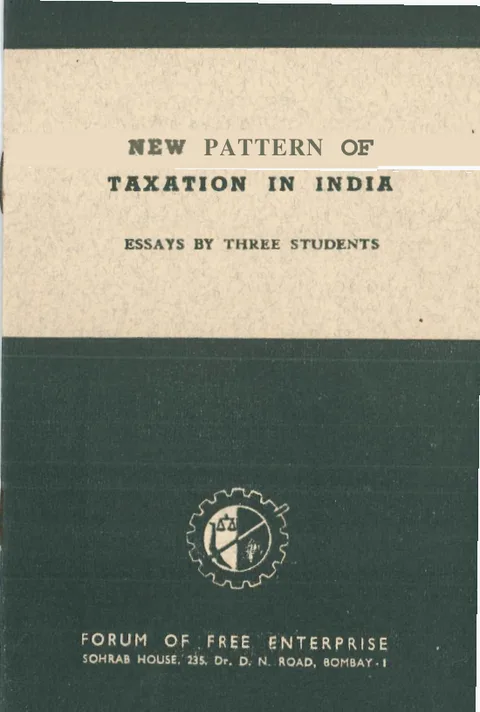
NEW PATTERN OF TAXATION IN INDIA
Essays by Three Students
By R. S. Sivaramakrishnan, E. S. Ganesh, M. V. Nadkarni
FORUM OF FREE ENTERPRISE, SOHRAB HOUSE, 235, Dr. D. N. ROAD, BOMBAY-1 · Bombay · 1959
14 pages
NEW PATTERN OF TAXATION IN INDIA
Summary
This Forum of Free Enterprise booklet (series 8/D/59, December 1959) collects the three prize-winning essays from the FFE’s 1958 student essay competition on ‘The New Pattern of Taxation in India’. An unsigned editorial introduction frames the competition, names the panel of judges — Dr. D. T. Lakdavala (University of Bombay), Mr. R. V. Murthy and Prof. R. J. Taraporevala — and prints a marginal note from Eugene Black of the World Bank arguing that people must come to accept private enterprise ‘not as a necessary evil, but as an affirmative good’. The three essays — by R. S. Sivaramakrishnan (Christian College, Madras), E. S. Ganesh (Jamshedpur Co-operative College) and M. V. Nadkarni (Karnatak College, Dharwar) — converge on a shared critique. Each writer accepts that the Second Five-Year Plan demands more revenue but argues that the post-Kaldor structure of Income-tax, Super-tax, Surcharge, Wealth Tax, Expenditure Tax, Gift Tax, Capital Gains Tax and Estate Duty has stacked complementary levies on the same narrow base of high-income individuals and companies, dampening private saving, capital formation and the appetite to invest. The volume closes with the FFE’s customary disclaimer and A. D. Shroff’s motto on the back inner cover. The full 20-page booklet was rendered for this pass.
Key points
-
The booklet collects the three prize-winning essays from the Forum of Free Enterprise’s 1958 student essay competition on ‘The New Pattern of Taxation in India’, judged by Dr. D. T. Lakdavala, Mr. R. V. Murthy, and Prof. R. J. Taraporevala.
-
R. S. Sivaramakrishnan reads the New Pattern as a Kaldor-driven attempt to graft Wealth, Expenditure, Capital Gains, Annual Capital, and Gift taxes onto an already heavy direct-tax base carried by a narrow group of taxpayers.
-
Sivaramakrishnan argues the cumulative incidence on a small minority of taxpayers reaches marginal rates of 84 per cent and is administratively unenforceable in practice.
-
Sivaramakrishnan treats the Capital Gains Tax and Estate Duty as direct disincentives to risk-capital formation at a time when industry is starved of equity finance.
-
E. S. Ganesh defines sound tax policy by the twin tests of greater production and better distribution, arguing lowered income-tax rates were offset by the Wealth and Expenditure taxes sealing off both saving and spending.
-
Ganesh catalogues contradictions in company taxation, including the Excess Dividends Tax penalising distributed profits and Section 23A penalising retained profits, and calls the Wealth Tax on companies a case of double taxation.
-
Ganesh closes on Chief Justice Marshall’s dictum that the power to tax is the power to destroy, endorsing C. D. Deshmukh’s call for taxation that is ‘less repugnant and more voluntary’.
-
M. V. Nadkarni evaluates the New Pattern against four stated objectives, namely meeting the Plan’s revenue needs, promoting savings, minimising evasion, and making taxes broad-based and progressive, while conceding it is comprehensive.
Essays
I
By R. S. SIVARAMAKRISHNAN
Sivaramakrishnan opens with the Government’s ‘insatiable demand’ for development revenue and credits Prof. Kaldor’s Indian Tax Reform report and the Taxation Enquiry Commission with paving the way for the new pattern. He reads the package — heavy progressive personal taxation, broadened company taxation and a battery of structural levies on Wealth, Expenditure, Capital Gains, Annual Capital and Gifts — as an attempt to graft an ‘integrated’ tax structure on top of an already heavy base of direct taxation. The essay argues that, despite the formal logic of broadening checks and balance, the cumulative incidence on a ‘minority of the total population’ is administratively burdensome and confiscatory, with marginal rates running to 84 per cent and Wealth Tax stacked on top of Income-tax, Super-tax and Surcharge.
The second half catalogues specific damage: Capital Gains and Estate Duty depress the climate for risk capital just when industry is starved of equity finance; Excess Dividends Tax, the Section 23A penalty rate and the Bonus Tax pull companies into a ‘peculiar conflict in principle’; rationalised Excise on cloth, sugar and vegetable products offends the principle of automatic increase in revenue with national income; and the rise of corporate taxation has measurably depressed corporate savings and foreign investment. The author closes with four remedies — fair rates, an investment-friendly structure, simplification through abolition of prohibition and reform of land revenue, and constitutional accommodation of the Expenditure and Wealth taxes recommended by Kaldor.
- Reads the New Pattern as a Kaldor-driven attempt to weld Wealth, Expenditure, Capital Gains, Annual Capital and Gift taxes onto an already heavy direct-tax base.
- Argues the cumulative incidence on a ‘very small minority’ of taxpayers reaches 84 per cent and is administratively unenforceable in practice.
- Treats Capital Gains Tax and Estate Duty as direct disincentives to risk-capital formation at a time of capital scarcity.
- Diagnoses Section 23A, Excess Dividends Tax and the Bonus Tax as contradictory company-tax penalties that cramp new ventures.
- Recommends fair rates, rationalisation, abolition of prohibition, reform of land revenue, and a comprehensive structure on sound economic principles.
II
By E. S. GANESH
Ganesh frames a sound tax policy as one that simultaneously raises revenue, advances social justice and protects economic stability, and identifies ‘greater production and better distribution’ as its twin tests. He reads the New Pattern as an essentially welcome response to the disequilibrium of the over-ambitious Second Plan but warns that the reduction of income-tax rates for high earners has been offset by Wealth Tax and Expenditure Tax in a way that seals the only outlets — saving and spending — through which an individual can respond to incentives.
On company taxation he piles up the contradictions: the Excess Dividends Tax punishes well-managed companies for distributing profits, while Section 23A punishes them for retaining profits; the Wealth Tax on companies operates on accruals rather than ability to pay; and the inclusion of companies within the Wealth Tax produces ‘a clear case of double taxation’. He closes by invoking Chief Justice Marshall’s dictum that the power to tax is the power to destroy, endorsing C. D. Deshmukh’s call to find forms of taxation that are ‘less repugnant and more voluntary’, and arguing that Indian tradition’s recognition of personal initiative is the deepest available incentive to efficiency.
- Defines a sound tax policy by its twin tests of greater production and better distribution.
- Argues that reductions in marginal income-tax rates have been neutralised by Wealth Tax and Expenditure Tax sealing off both saving and consumption.
- Catalogues the contradictions of company taxation, including Section 23A, the Excess Dividends Tax and the Wealth Tax on companies as double taxation.
- Calls for a ‘Simple Tax Structure’, invoking Kaldor’s suggested single uniform rate of seven annas in the rupee as worthy of consideration.
- Closes on Marshall’s ‘power to tax is the power to destroy’ and Deshmukh’s plea for taxation that is ‘less repugnant and more voluntary’.
III
By M. V. NADKARNI
Nadkarni reads the New Pattern through four stated objectives — meeting the Plan’s revenue needs, promoting savings and checking inflation, minimising evasion, and making taxes broad-based, progressive and equitable. He concedes that the pattern is ‘integrated and comprehensive’ but argues that, judged by capital formation and investment incentive, it has not improved on its predecessor. The regressive character of indirect taxation persists, the poorest sections receive no relief, and the structure’s sheer complexity raises tax-collection costs, multiplies legal formalities for the taxpayer and converts the ‘vicious circle’ of high rates and high evasion into a permanent feature. Frequent, short-sighted experimentation, he argues, has replaced the ‘coherent, continuous, planned policy’ the system needs for healthy growth.
The second half audits the individual taxes. Income-tax rate cuts have privileged unearned over earned income; the new structure has hit lower-middle-class households without giving them the social-security backing such cuts presuppose elsewhere; the Expenditure Tax is conceptually sound but its exemptions blunt its purpose; the Wealth Tax on new companies risks expropriation by being levied on accruals; the welcome of concessions for fresh capital is undercut by the psychological effect of the surrounding tax structure. Sales Tax, Excise on textiles and indirect levies on necessities all need rationalisation. The essay closes with five concrete recommendations — minimising State expenditure, ruthless punishment of evasion conditioned on removing assessment defects, heavier taxes on luxury industries with little employment potential, systematic tapping of higher slabs of agricultural income across all States, and greater reliance on State borrowing and savings mobilisation.
- Reads the New Pattern as ‘integrated and comprehensive’ in form but unimproved on capital formation, investment and relief to the poorest.
- Identifies frequent, short-sighted experimentation as the enemy of a ‘coherent, continuous, planned policy’ for economic growth.
- Argues that lower marginal rates have privileged unearned over earned income and squeezed the lower middle class without compensating social-security infrastructure.
- Treats the Wealth Tax on new companies as an expropriation in principle because it is levied on accruals rather than ability to pay.
- Recommends five reforms: minimised State expenditure, ruthless punishment of evasion paired with removal of assessment defects, heavier taxes on low-employment luxury industries, taxation of higher agricultural-income slabs in all States, and reliance on State borrowing and savings mobilisation.
Generated by the v1.5 extraction pipeline. Awaiting editorial review.
Metadata and summary are AI-extracted from the source PDF and reviewed for editorial accuracy. The original work is available via the Read PDF tab above (where present); paragraph-level citation inside the PDF is deferred to a future engagement.