edited volume · anthology
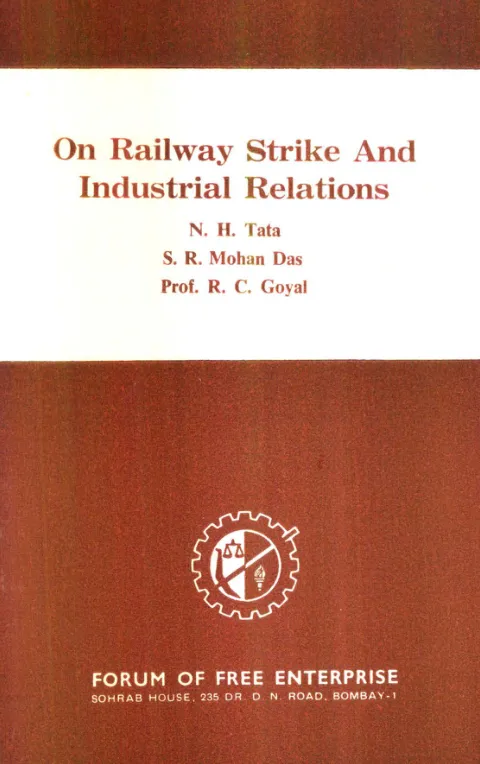
On Railway Strike And Industrial Relations
By naval-h-tata, s-r-mohan-das, Prof. R. C. Goyal
FORUM OF FREE ENTERPRISE, SOHRAB HOUSE, 235 DR. D. N. ROAD, BOMBAY-1 · Bombay · 1974
32 pages
On Railway Strike And Industrial Relations
Summary
This 1974 Forum of Free Enterprise booklet collects three pieces — a reprinted Financial Express article by N. H. Tata, a Bombay lecture by S. R. Mohan Das, and the A. D. Shroff Memorial Lecture delivered in New Delhi by Prof. R. C. Goyal — all responding to the nation-wide Indian railway strike of 1974 and the broader crisis of industrial relations under a mixed economy. The contributors, though writing from different vantage points (employer body, industrial-relations commentator, public-administration academic), converge on a common diagnosis: a wage and bonus structure detached from profit or productivity, a regulatory framework that treats workers as wards of the state while excluding them from genuine collective bargaining, and a Government that simultaneously promotes trade unionism and undercuts it by acting as both legislator and largest employer.
Key points
-
N. H. Tata, writing for the Employers’ Federation of India, blames the Bonus Act of 1965 for fixing a minimum bonus unrelated to profit or productivity, converting bonus into a disguised wage increase.
-
Tata notes the Government’s pre-election move in 1974 to raise the minimum bonus from four to 8.33 percent created a windfall for organised industry while more than 85 million unorganised workers received no bonus or job security at all.
-
Tata argues the right to strike is not a fundamental right but derives from a Human Rights Convention, and must be balanced against an employer’s right to lock-out and restricted by Parliament in essential services.
-
S. R. Mohan Das traces the strike to civil-service attitudes inherited from British Charter Companies that stop the Railway Board from behaving like industrial management, calling it a “cultural block.”
-
Mohan Das describes the Government fragmenting railway unions by backing the INTUC-sponsored National Federation of Indian Railwaymen against Jayaprakash Narayan’s All-India Railwaymen’s Federation, then arresting leaders on 2 May.
-
Mohan Das estimates a settlement of about Rs. 140 crores would have cost less than the damage the strike inflicted on steel production and the resulting black-market price spike.
-
Prof. R. C. Goyal’s A. D. Shroff Memorial Lecture frames Indian industrial relations against a Western liberal-democratic model, asking how autonomous unions and collective bargaining fit a mixed economy where the state is both largest employer and rule-maker.
-
Goyal shows registered trade unions grew from 4,623 with an average membership of 781 in 1951-52 to 15,314 unions averaging just 546 members by 1965, evidence of fragmentation despite official calls for healthy trade unionism.
Essays
BASIC ISSUES BEHIND THE RAILWAY STRIKE
By N. H. Tata
N. H. Tata, writing as President of the Employers’ Federation of India in a Financial Express article reprinted here, treats the 1974 railway strike as a symptom of two structural blunders in Indian industrial-relations policy: the Bonus Act of 1965, which fixed a 4 per cent minimum bonus unrelated to profit or productivity and thereby converted bonus into a deferred wage; and the unwillingness to anchor wages in either productivity or comparative justice across the organised and unorganised sectors. He argues that the railwaymen’s claim of parity with other public-sector workers, however emotionally justified, measures itself against a ‘mythical yardstick’ while more than 85 million unorganised non-industrial workers receive no bonus, no dearness allowance and no job security.
- The Bonus Act of 1965 wrongly enshrined a minimum bonus unrelated to profit or productivity, turning bonus into a disguised wage boost.
- The Government’s 1974 pre-election raising of minimum bonus from 4 to 8.33 per cent (inclusive of D.A.) created a windfall for organised industry and a grievance for excluded service workers.
- Wage parity claims by railwaymen ignore the absence of any scientific national wage structure linking pay to productivity.
- More than 85 million unorganised rural and urban workers enjoy none of the social-security benefits — Provident Fund, gratuity, sickness insurance, D.A., bonus or job security — that organised labour secured.
- The right to strike is not a fundamental right but flows from a Human Rights Convention; it must be balanced by an employer’s right to lock-out and, in essential services, restricted by Parliament.
- Suspension of the Payment of Wages Act and use of D.I.R. and M.I.S.A. are extreme measures with ‘no legitimate place’ in normal industrial relations and should not be used as strike-breaking tools.
BASIC FACTORS BEHIND THE RAILWAY STRIKE
By S. R. Mohan Das
S. R. Mohan Das, in a lecture at the Forum of Free Enterprise on 6 June 1974, traces the railway strike to inherited paternalistic and civil-service attitudes that prevent the Railway Board from behaving like industrial management. The Government, he argues, did not bargain over the Miabhoy Tribunal Award or the bonus demand; instead it fragmented unions (sponsoring the INTUC-backed National Federation of Indian Railwaymen against Jayaprakash Narayan’s All-India Railwaymen’s Federation), arrested leaders on 2 May, suspended the Payment of Wages Act and treated the railwaymen as agents of an ‘anti-nationalist’ agitation rather than as workers asking why public-sector wages elsewhere outpaced theirs. He estimates that a settlement at roughly Rs. 140 crores would have cost less than the damage to steel and other production caused by the strike.
- India responds to strikes ‘through a judgment based on emotional reactions’ rather than positive analysis of an industrial conflict.
- Civil-service rules inherited from the British Charter Companies prevent the Railway Board from accepting industrial accountability and produce a ‘cultural block’ to industrial behaviour.
- Government-sponsored fragmentation of railway unions — INTUC’s National Federation set up against AIRF, with Jayaprakash Narayan as AIRF president — undermined any institutional employee voice.
- The strike’s real grievance was a simple industrial-job claim — ‘Why can’t we get wages like any other public sector organisation?’ — not a leader-driven political revolt.
- Government used suspension of the Payment of Wages Act and non-implementation of the Miabhoy Tribunal Award as power-play rather than negotiation tools.
- A negotiated settlement of about Rs. 140 crores would have been cheaper than the strike damage to steel production and the black-market price spike.
INDUSTRIAL RELATIONS IN A MIXED ECONOMY
By Prof. R. C. Goyal
Prof. R. C. Goyal’s A. D. Shroff Memorial Lecture (27 October 1973), of which the rendered pages cover the opening through the discussion of National Commission on Labour recommendations, frames industrial relations as a historical product of Western liberal-democratic capitalism — the joint outcome of autonomous trade unions, collective bargaining and a regulating state — and asks how this construct fits the Indian ‘mixed economy’, where the state has become both the largest employer and the dominant rule-maker. Goyal argues that successive Five-Year Plans proclaimed voluntary collective bargaining, healthy trade unionism and rising productivity as policy objectives, but the legal framework (especially the Indian Trade Union Act of 1926 and the Industrial Disputes Act) and Government’s discretionary powers of compulsory adjudication have instead fragmented unions — from two All-India federations in 1947 to eight by 1972, and from 4,623 registered unions with an average membership of 781 in 1951-52 to 15,314 unions with an average of 546 in 1965 — while industrial disputes and man-days lost have mounted sharply (1,357 disputes in 1961 against 2,889 in 1970; man-days lost rising from 4.9 million to 20.6 million).
- Industrial relations is historically a Western liberal-democratic invention — capitalist industry, autonomous unions and collective bargaining — now grafted onto India’s mixed economy.
- Because the Government is India’s single largest employer (with banks, insurance and joint-sector ventures like Oil India, Indian Explosives and Gujarat State Fertilizer added to the state’s sphere), it carries the bulk of responsibility for productive employee relations.
- Five-Year Plan statements consistently proclaimed voluntary collective bargaining, a healthy trade-union movement and rising productivity as objectives, but never spelt out how to reach them.
- Legal incentives — discretionary compulsory adjudication, Industrial Disputes Act machinery, and the Trade Union Act’s seven-worker threshold — encourage parties to abandon bargaining and have fragmented unions both inter- and intra-establishment.
- Quantitative evidence of policy failure: All-India federations rose from two (pre-1947) to eight (1972); registered unions from 4,623 (1951-52) to 15,314 (1967), with average membership falling from 781 to 546.
- Industrial disputes nearly doubled (1,357 in 1961 to 2,889 in 1970) while man-days lost more than quadrupled (4.9 million to 20.6 million), exposing a ‘curious hotch-potch’ of regulatory technique.
- The 1969 National Commission on Labour proposed statutory recognition of a sole bargaining agent, a permanent Industrial Relations Commission at the Centre and in each State, and union-based Works Committees — most of which were not implemented.
Generated by the v1.5 extraction pipeline. Awaiting editorial review.
Metadata and summary are AI-extracted from the source PDF and reviewed for editorial accuracy. The original work is available via the Read PDF tab above (where present); paragraph-level citation inside the PDF is deferred to a future engagement.