
book
Our India
By Minoo Masani
published by C. H. Lewis, Oxford University Press, Calcutta 700013 (title page: CALCUTTA / OXFORD UNIVERSITY PRESS / DELHI BOMBAY MADRAS) · Calcutta · 1975
181 pages
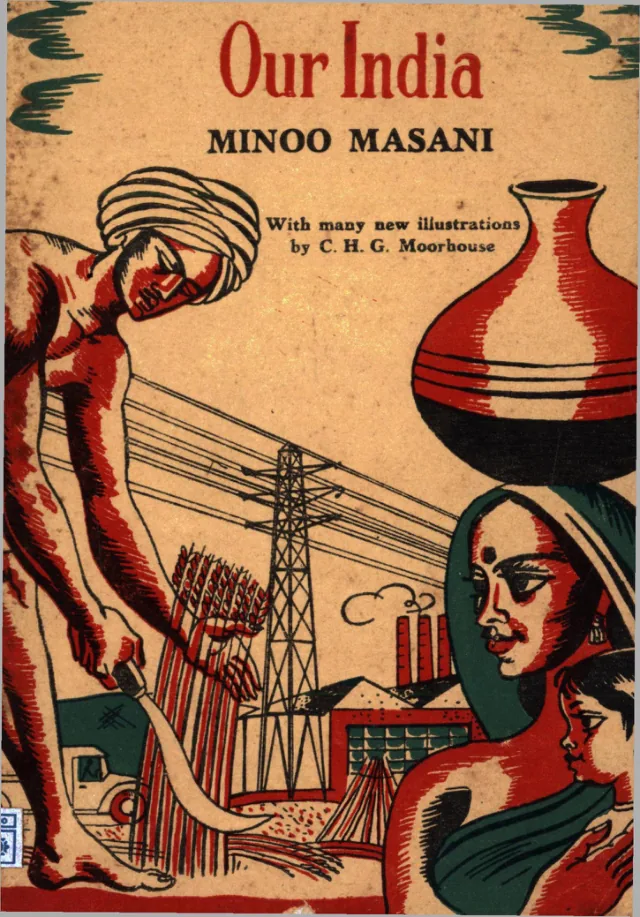
Our India
Summary
Our India is Minoo Masani’s illustrated primer on the Indian economy for schoolchildren, first published in October 1940 and sold in more than half a million copies. This is the eighth impression (1975, Oxford University Press, Calcutta) of the cheap edition of the revised text, Our India-1953, and the book prints both his September 1940 preface and his August 1953 preface. The 1953 preface says the original was mainly about the future, while the revised book shows that the present has to a certain extent caught up with it. The India described is therefore the early planning-era republic: figures come from the 1951 Census and the First Five-Year Plan, the population is given as 365 million, and Partition, the loss of the Burmese and Attock oilfields, zamindari abolition, Community Development Projects and Point Four aid are treated as current events. The 1975 impression carries these figures unrevised.
The book is built as a puzzle. Chapter 1 (One in Seven) establishes India’s size, geography, climate and human variety. Chapter 2 (Can You Eat the Sun?) is a catalogue of natural wealth: people, land, cattle, sun, monsoon, mountains, rivers, wind, coal, iron ore, manganese. Chapter 3 (A Puzzle) sets the paradox of poverty in the midst of plenty, with infant mortality, a life expectancy of about 27 to 30 years, and an average income of Rs 190 a year. Chapters 4 to 7 diagnose agriculture, where about 70 in 100 Indians live off the land. Output per acre is a fraction of English or French yields, and the book blames exhausted soil, cowdung burnt as fuel instead of used as manure, lost forests and erosion, monsoon dependence and thin irrigation, primitive tools, starved and surplus cattle, and holdings fragmented by inheritance. The peasant Rama, a recurring device, is shown that he needs credit, trees for fuel, water, seed, and a farm of about 20 acres worked co-operatively. Chapter 7 closes with five big jobs: consolidate and pool holdings, extend irrigation, plant fuel forests, teach better seed and implements, and reduce the number of useless cattle.
Chapters 8 to 11 turn to industry. They cover cotton textiles (India’s oldest and biggest industry, with 440 mills and a long history of Lancashire displacing Indian handloom cloth), buried minerals (coal, iron, manganese, mica, sulphur, petroleum, the rare earths of Travancore-Cochin and monazite), power (steam, oil, hydro-electricity and the grid, India’s very low horse-power per head, and speculation about wind, tide, solar and atomic energy), and steel and machinery (Jamshedji Tata and Jamshedpur, the need for machine tools and many independent engineering workshops). Masani repeatedly argues that India exports raw ores and imports finished goods and machinery at great cost, and that the missing inputs are machinery and power rather than markets, raw materials or labour. Throughout he looks to the state, the Planning Commission, the Five-Year Plan, multi-purpose river projects such as Bhakra Nangal, Hirakud and the Damodar Valley, and the National Extension Organization, with help from World Bank loans, the Ford Foundation and the American Point Four programme.
Chapter 12 (Hindostan Hamara) states the thesis. Government is slow and lazy unless citizens press it, and every nation gets the government it deserves, so planning must decide what kind of society it wants. Masani stages a dialogue between a Modernist and a Back-to-the-Village man, citing Gandhi’s remark that he objects to the craze for machinery, not machinery as such, and concludes that a machine is neutral. Since about 70 in 100 Indians work on the land and large industry can absorb only a small fraction of a growing population, he argues for maximum employment, maximum production and equitable distribution. That means scattered village and cottage industries supplied with capital, skill, markets, tools and cheap electricity from big plants. The chapter then argues for a mixed economy of government factories alongside private factories for profit, with the state checking price-fixing by owners, and co-operative societies for artisans and farmers. The book ends on Iqbal’s song, printed in Devanagari with an English gloss. Readers should note that the prose uses period terms, pre-decimal rupee-anna-pie figures and Rs 3-8-0 a day budgets, and that the many pictorial statistics (country comparisons of wheat, rice, coal, infant mortality, horse-power, national income per head) appear in the OCR only as fragmentary captions and were not treated as prose.
Notable passages
"Statistics of Indian life are so scanty and scrappy that reliance on them is bound to endanger one's conclusions."
"The original book was mainly about the future; the new book shows that the present has to a certain extent caught up with the future."
"One man in every seven is an Indian."
"Now, size or bigness is not in itself much good. It is what one makes of one's bigness that matters."
"Just think how lucky a country like India is—and how rich it ought to be—which has all types of men, all sorts of land and all kinds of climate!"
Metadata and summary are AI-extracted from the source PDF and reviewed for editorial accuracy. The original work is available via the Read PDF tab above (where present); paragraph-level citation inside the PDF is deferred to a future engagement.