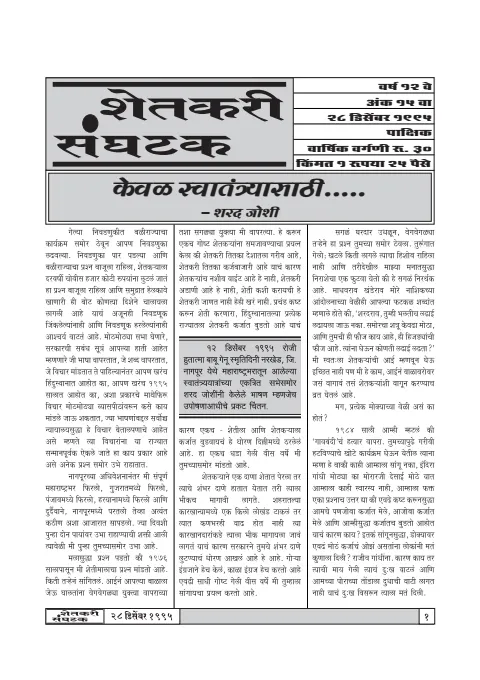
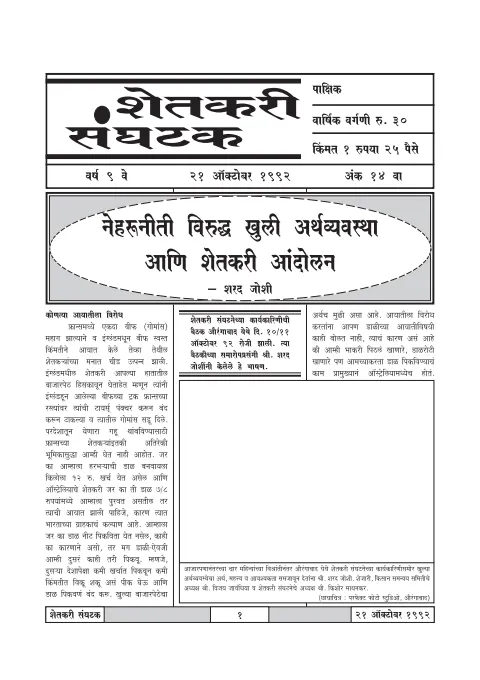
periodical issue
Shetkari Sanghatak
शेतकरी संघटक
Śetkarī Saṅghaṭak
By शरद जोशी
संपादक, मुद्रक, प्रकाशक सुरेशचंद्र म्हात्रे; मालक — मोहन विठारीलाल परदेशी, मुद्रण स्थळ — गणेश प्रिंटर्स, ५९३, बुधवार पेठ, पुणे - २ · Pune · 1995
12 pages
Shetkari Sanghatak
Summary
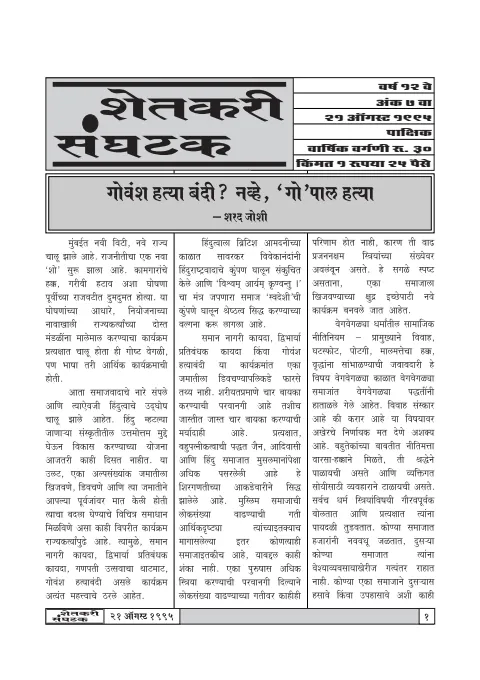
This is the 21 August 1995 issue (Year 12, Issue 7) of the Marathi fortnightly शेतकरी संघटक (Shetkari Sanghatak), the organ of Sharad Joshi’s farmers’ movement Shetkari Sanghatana. In the rendered pages the issue is dominated by two long signed pieces by Sharad Joshi: a front-page polemic against the cow-slaughter ban, reframing it as ‘गोपाल हत्या’ (the killing of cattle-keepers), and a heartfelt obituary-tribute, ‘शंकरराव गेले’, remembering the activist Shankarrao. Around them sit movement correspondence and notices — a Kolhapur district report demanding a halt to coercive recovery of enhanced land revenue (शेतसारा), a poem ‘अंधारदूत’ by Subhash Naktode, and condolence notices for movement members. The issue’s argumentative centre, in the rendered pages, is an agrarian-liberal economics of livestock: Joshi argues that cattle have value to farmers only as productive, tradeable assets, and that a religiously-motivated slaughter ban, by stripping aged cattle of market value, harms the very farmers and animals it claims to protect.
Key points
-
This 21 August 1995 issue (Year 12, No. 7) of the Marathi fortnightly Shetkari Sanghatak is dominated by two long signed pieces by Sharad Joshi, founder of the Shetkari Sanghatana farmers’ movement.
-
Joshi’s front-page essay reframes a cattle-slaughter ban as ‘गोपाल हत्या’ — the killing of cattle-keepers — arguing that aged cattle become a pure economic burden once they can no longer be sold.
-
He marshals comparative figures on milk yields and herd-keeping costs across India, Pakistan, Ethiopia, Tanzania and Kenya to argue that market incentives, not sentiment, sustain healthy livestock.
-
Joshi distinguishes religious reverence for the cow from rational animal husbandry, invoking Gandhi and Radhakrishnan, and casts the ban as urban, upper-caste sentiment imposed on farmers.
-
His second essay, ‘शंकरराव गेले’, is an obituary-tribute to Sanghatana activist Shankarrao, who died of lung cancer on 7 August 1995.
-
It recalls Shankarrao’s agitational work across Maharashtra, Punjab, Gujarat and Chandigarh, including jail terms, and his association with the weekly ‘Warkari’.
-
Around these two pieces, the issue also carries a Kolhapur district report demanding a halt to the coercive recovery of enhanced land revenue (शेतसारा) and a poem, ‘अंधारदूत’, by Subhash Naktode.
Essays
गोवंश हत्या बंदी? नव्हे, ‘गो’पाल हत्या
By शरद जोशी
Sharad Joshi’s front-page lead essay, ‘गोवंश हत्या बंदी? नव्हे, गोपाल हत्या’ (A ban on cattle slaughter? No — the killing of cattle-keepers), argues against a proposed/renewed ban on cow and cattle slaughter. Written in Marathi, it contends that the value of cattle to a farmer is economic: an animal that can no longer work or yield milk becomes a pure burden unless it can be sold. Joshi marshals comparative data — milk yields, the cost of keeping unproductive cattle, and contrasts with Bharat, Pakistan, Ethiopia, Tanzania and Kenya — to claim that ‘Servival [survival] technology’ and market incentives, not sentiment, sustain healthy herds. He distinguishes reverence for the cow from sound husbandry, invokes Gandhi and Radhakrishnan on the question, and frames the ban as urban, upper-caste sentiment imposed on farmers, hurting cattle-keepers (गोपाल) most. The piece runs across the front pages of the issue in the rendered set.
- Reframes a cattle-slaughter ban as ‘गोपाल हत्या’ — harm to cattle-keepers rather than protection of cattle.
- Argues cattle have value to the farmer only as productive, tradeable assets; an unsaleable aged animal is a net burden.
- Uses comparative figures across India, Pakistan, Ethiopia, Tanzania and Kenya and invokes ‘survival technology’ to argue markets sustain herds.
- Distinguishes religious reverence for the cow from rational animal husbandry.
- Casts the ban as urban, upper-caste sentiment imposed on farmers.
Essay 2
‘शंकरराव गेले’ (Shankarrao has gone) is Sharad Joshi’s obituary-tribute to the activist Shankarrao, who died of lung cancer on 7 August 1995 while a Shetkari Sanghatana programme was under way. Joshi recalls Shankarrao as a fearless, tireless organiser who threw himself into the movement’s agitations across Maharashtra, Punjab, Gujarat and Chandigarh — including jail terms — and was associated with the weekly ‘Warkari’. The piece weaves personal memory with the movement’s history, naming local co-workers (Madhavrao More, Prahlad Patil Karad) and the advocate Ram Jethmalani in connection with the activists’ legal battles, and closes on Shankarrao’s loyalty to the farmers’ cause to the very end.
- Tribute to the Sanghatana activist Shankarrao, who died of lung cancer on 7 August 1995.
- Recalls his role in agitations across Maharashtra, Punjab, Gujarat and Chandigarh, including imprisonment.
- Connects him with the weekly ‘Warkari’ and the movement’s organising work.
- Blends personal reminiscence with the broader history of Shetkari Sanghatana.
Generated by the v1.5 extraction pipeline. Awaiting editorial review.
Metadata and summary are AI-extracted from the source PDF and reviewed for editorial accuracy. The original work is available via the Read PDF tab above (where present); paragraph-level citation inside the PDF is deferred to a future engagement.