periodical issue
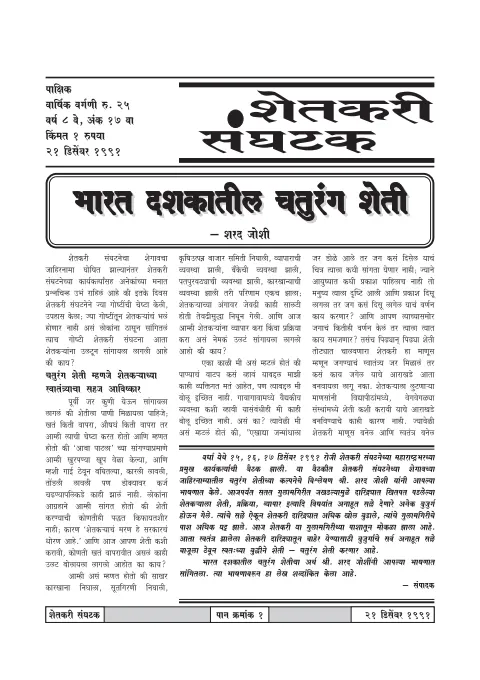
Shetkari Sanghatak
शेतकरी संघटक
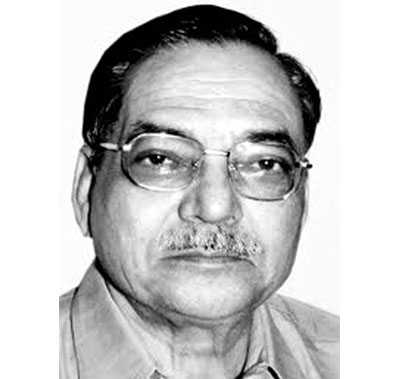
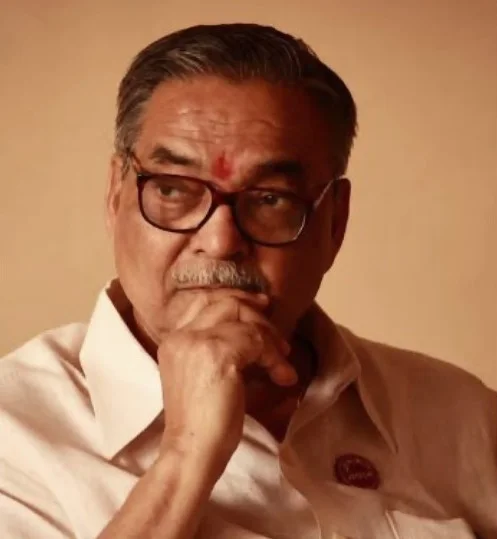
By सौ. सुमन अग्रवाल, sharad-joshi, Katrine A. Saito
पाक्षिक शेतकरी संघटक — मालक: मोहन विठारीलाल परदेशी; मुद्रण स्थळ: चाकण प्रिंटिंग प्रेस, चाकण; संपादक, मुद्रक, प्रकाशक: सुरेशचंद्र म्हात्रे; प्रकाशन स्थळ व पत्रव्यवहाराचा पत्ता: ११४७/५६ शिवाजीनगर, पुणे ४११ ००५ · Pune · 1992
8 pages
Shetkari Sanghatak
Summary
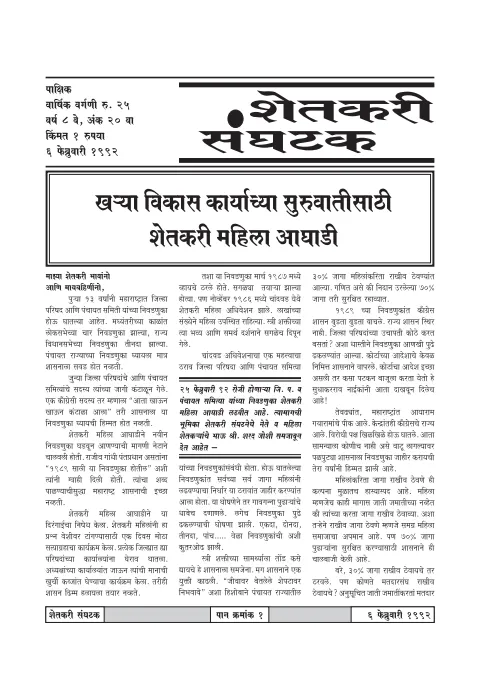
This is the 6 February 1992 fortnightly issue of Shetkari Sanghatak (शेतकरी संघटक), Year 8, Issue 20, the Marathi-language organ of the Shetkari Sanghatana, the farmers’ organisation led by Sharad Joshi. Across the rendered pages the issue threads together two organising priorities for the movement: mobilising rural women through the Shetkari Mahila Aghadi for the Zilla Parishad and Panchayat Samiti elections scheduled for 25 February 1992, and preparing cadres for a state-wide Rasta Roko (road-blockade) agitation on 8 February 1992 against the Centre’s handling of the new liberalisation programme. The lead pieces argue that the 30% reservation for women in local bodies is meaningless without organised women candidates, while a centre-page programmatic note explains why farmers, despite welcoming the broad move toward economic openness, are mobilising against the residual licence-permit controls on agricultural processing, domestic trade and exports. A translated extract from a World Bank-affiliated paper on women in LDC agriculture, and a closing position note by Sharad Joshi himself on the demands placed before Finance Minister Manmohan Singh, round out the issue.
Key points
-
The lead essay argues the Shetkari Mahila Aghadi, the women’s front of the Shetkari Sanghatana, must field organised women candidates or the new 30 per cent panchayat reservation will be captured by relatives of male politicians.
-
It credits sustained pressure from Sharad Joshi’s organisation for placing the panchayat women’s quota on the political agenda and details the Aghadi’s ‘Sita Sheti’ and ‘Mauj Sheti’ women-led farming initiatives.
-
An unsigned ‘Bhumika’ note sets out the rationale for the state-wide Rasta Roko agitation on 8 February 1992, arguing the licence-permit raj on agricultural processing, trade and exports survives the government’s liberalisation rhetoric.
-
It traces the Sanghatana’s escalating meetings at Sevagram on 10 November 1991, at Sitamau, and in Delhi with the Kisan Samvay Samiti on 18-19 January 1992 leading to direct action.
-
The note demands removal of restrictions on processing, exporting and inter-state trading of agricultural produce, and on farmers’ freedom to choose whether to enter those activities themselves.
-
Sushma Agrawal, President of the Shetkari Mahila Aghadi, announces roughly 400 women candidates for the 25 February 1992 Zilla Parishad and Panchayat Samiti elections, backed by about 400 male Sanghatana candidates.
-
She logs preparatory meetings at Aurangabad on 24 January chaired by Sudhakar Naik and at Akkalkuva on 26 January chaired by Saroj Kashikar, plus a planned 5 February meeting with the Chief Minister.
Essays
खऱ्या विकास कार्याच्या सुरुवातीसाठी शेतकरी महिला आघाडी
The lead front-page essay argues that the Shetkari Mahila Aghadi, the women’s front of the Shetkari Sanghatana, is the vehicle through which the 30% reservation for women in Maharashtra’s Zilla Parishad and Panchayat Samiti elections (slated for 25 February 1992) can be turned from a paper concession into real political representation. The piece recalls how, eleven years earlier, the very idea of a panchayat-level women’s quota was considered impossible, and credits sustained pressure from Sharad Joshi’s organisation for forcing the issue onto the agenda. It maintains that without organised women candidates the reservation will be captured by relatives of male politicians, and details the Aghadi’s parallel programmes of ‘Sita Sheti’ and ‘Mauj Sheti’ (women-led farming experiments), drinking-water rights, and a women-centred development agenda invoked as the true Gandhian path of social-economic reform.
- Frames the upcoming 25 February 1992 Zilla Parishad / Panchayat Samiti elections as a test case for whether the 30% women’s reservation in Maharashtra panchayats will yield genuine representation.
- Credits the Shetkari Sanghatana’s earlier agitations, led by Sharad Joshi, for placing women’s panchayat reservation on the political agenda.
- Warns that without organised candidates the reserved seats will be filled by proxies for sitting male leaders.
- Introduces ‘Sita Sheti’ and ‘Mauj Sheti’ as women’s farming initiatives and frames water, fuel, education and employment as the Aghadi’s policy axis.
- Positions the Aghadi’s project as a continuation of Mahatma Gandhi’s economic-social vision applied to rural women.
शेतकरी संघटनेचे आठ फेब्रुवारीचे रास्ता रोको आंदोलन — भूमिका
An unsigned ‘Bhumika’ (background note) from the Sanghatana’s central office sets out the rationale for the state-wide Rasta Roko (road-blockade) agitation called for 8 February 1992. It argues that India’s external-debt crisis has forced the government to adopt the rhetoric of a ‘new open economic policy’ that ought to benefit farmers, but that the bureaucracy has in practice retained the licence-permit controls on agricultural processing, domestic agricultural trade and exports. The note traces the Sanghatana’s escalating decisions — at meetings in Sevagram (10 November 1991), Sitamau, and Delhi (18-19 January 1992 with the Kisan Samvay Samiti) — toward direct action, and presents four concrete demands: removal of all restrictions on the processing of agricultural produce, on agricultural exports, on inter-state domestic agricultural trade, and on farmers’ freedom to choose whether or not to enter processing, trade and export themselves.
- Diagnoses the Centre’s liberalisation rhetoric as a response to the external-debt crisis rather than a principled embrace of farmers’ freedom.
- Argues the new policy will benefit farmers only if the licence-permit raj over agriculture is actually dismantled.
- Lists the Sanghatana’s preparatory meetings at Sevagram (10 Nov 1991), Sitamau, and Delhi (18-19 Jan 1992) leading to the 8 Feb Rasta Roko.
- Names four demands: lifting restrictions on (i) processing of farm produce, (ii) agricultural exports, (iii) domestic inter-state trade in agricultural produce, (iv) farmers’ right to choose whether to enter processing/trade/export.
- Frames the agitation as protecting the spirit of liberalisation from being killed by the surviving regulatory state.
शेतकरी महिला आघाडी पंचायत राज्य निवडणुकांसाठी सज्ज
By सौ. सुमन अग्रवाल, अध्यक्ष, शेतकरी महिला आघाडी
A signed notice by Sushma Agrawal, President of the Shetkari Mahila Aghadi, reports that the Aghadi will field roughly 400 women candidates for the Zilla Parishad and Panchayat Samiti elections on 25 February 1992, with another 400-odd men of the Shetkari Sanghatana standing in support. The note traces the build-up — a 24 January meeting at Aurangabad chaired by Sudhakar Naik, a 26 January meeting at Akkalkuva chaired by Saroj Kashikar — and announces a Mumbai meeting with the Chief Minister on 5 February 1992 to press the Aghadi’s electoral demands. It closes by listing the Aghadi’s campaign coordinators for Nanded, Vidarbha and West Maharashtra.
- Announces roughly 400 women candidates from the Shetkari Mahila Aghadi for the 25 Feb 1992 ZP / Panchayat Samiti elections, with ~400 male Sanghatana candidates in supporting seats.
- Logs the preparatory meetings at Aurangabad (24 Jan, with Sudhakar Naik) and Akkalkuva (26 Jan, with Saroj Kashikar).
- Announces a 5 February 1992 meeting with the Maharashtra Chief Minister in Mumbai.
- Names regional coordinators for Nanded, Vidarbha and West Maharashtra.
- Positions the campaign as the operational arm of the Aghadi’s broader social-political programme.
कृषिप्रशिक्षण व सुविधा महिला शेतकऱ्यांपर्यंत पोहोचायला हव्या
By मूळ लेख: Extending Help to Women Farmers in LDCs — Katrine A. Saito (Finance and Development, December 1989); मराठी सारांश: श्री. गोपकुमार परांजपे, पुणे
A Marathi rendering, by Gopalrao Paranjpe of Pune, of Katrine A. Saito’s article ‘Extending Help to Women Farmers in LDCs’ (Finance and Development, December 1989). The piece argues that in most developing countries women perform a disproportionate share of agricultural labour while receiving a fraction of agricultural training, extension services, credit and inputs. It documents the chain of disadvantages — illiteracy, social and religious restrictions on movement, household labour burden, and the assumption among male-dominated extension bureaucracies that the ‘farmer’ is male — and proposes that targeted training, female extension officers, and credit and input-delivery systems designed for women are essential if the productivity gap is to close. The translator presents the analysis as directly relevant to Maharashtra’s women farmers and to the Shetkari Mahila Aghadi’s programme.
- Documents that in most LDCs women supply the majority of agricultural labour but receive a small fraction of training, credit and inputs.
- Identifies illiteracy, household-labour burden, religious-social restrictions on women’s mobility, and a male-coded extension bureaucracy as compounding causes.
- Argues for explicitly targeted training programmes, female extension agents, and women-designed credit and input delivery.
- Notes that ignoring women’s role in agriculture suppresses national productivity in developing economies.
- Frames the World Bank-side analysis as directly useful to the Shetkari Mahila Aghadi’s policy agenda in Maharashtra.
शेतकऱ्यांना उद्योगस्वातंत्र्य हवे
By शरद जोशी
Sharad Joshi’s closing position note, derived from a presentation to a Kisan Samvay Samiti meeting with Finance Minister Manmohan Singh on 23 January 1992, presses a single argument: that farmers want udyogswatantrya — freedom of enterprise — and not just relief. Joshi rehearses four operative demands the Sanghatana has placed before the Centre: removal of all restrictions on processing of farm produce; abolition of restrictions on agricultural exports; lifting of restrictions on inter-state domestic agricultural trade; and protection of the farmer’s right to choose whether or not to enter processing, trade and export. Joshi argues that India’s adverse terms of trade against farmers — what he calls the long-running anti-farmer bias of policy — cannot be cured by subsidies or selective price interventions and must be addressed by lifting the regulatory cordon around agriculture itself.
- Restates the Sanghatana’s case to Finance Minister Manmohan Singh that farmers’ core demand is freedom of enterprise, not subsidy.
- Lists four operative demands: end restrictions on farm-produce processing, exports, domestic inter-state trade, and on the farmer’s right to choose participation in these activities.
- Argues that the long-standing adverse terms of trade against agriculture are policy-engineered and cannot be reversed by price tinkering.
- Locates the new economic policy as an opportunity that will be wasted if the residual licence-permit raj over agriculture is left intact.
- Frames udyogswatantrya — freedom of enterprise — as the precondition for any genuine rural prosperity.
Generated by the v1.5 extraction pipeline. Awaiting editorial review.
Metadata and summary are AI-extracted from the source PDF and reviewed for editorial accuracy. The original work is available via the Read PDF tab above (where present); paragraph-level citation inside the PDF is deferred to a future engagement.