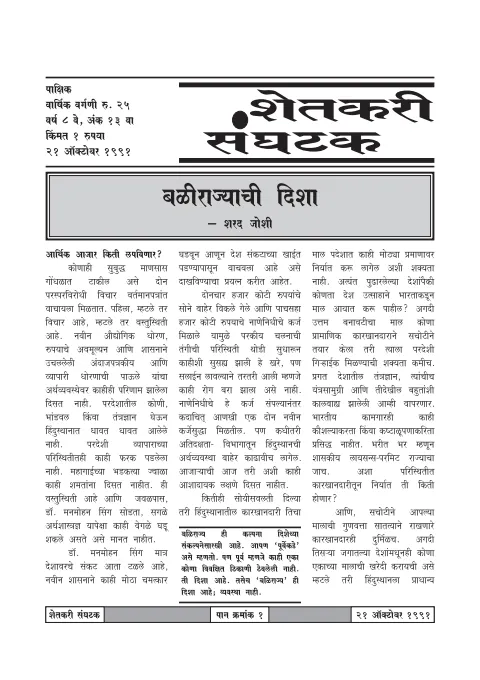
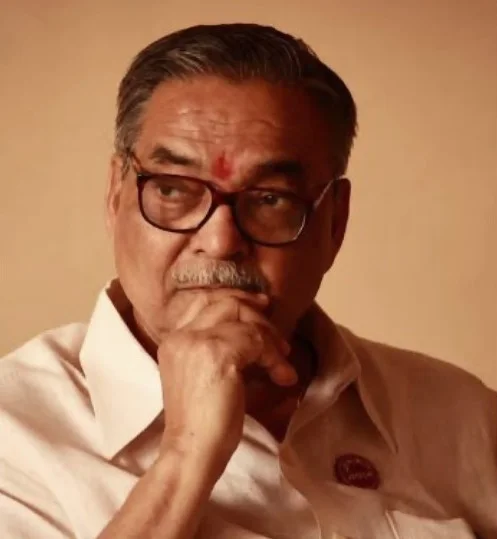
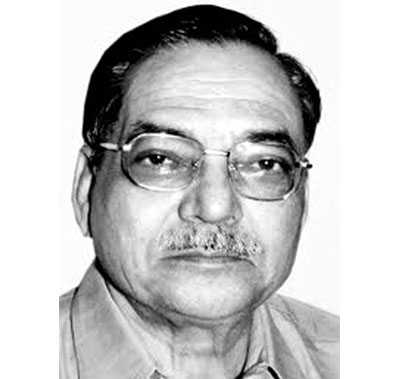
periodical issue
Shetkari Sanghatak
Year 10, No. 20 — 6 February 1994
शेतकरी संघटक
By sharad-joshi, मो. वि. टेमुर्डे, मो. वि. टेमुर्डे, कोंडाबाई सावंत
संपादक, मुद्रक, प्रकाशक: सुरेशचंद्र पांडुरंग म्हात्रे, राष्ट्रीयत्व - भारतीय, पत्ता - अंगारमळा, मु. पो. आंबेठाण, ता. खेड, जि. पुणे. वृत्तपत्राचे मालक: श्री. मोहन विहारीलाल परदेशी, मु. पो. चाकण, ता. खेड, जि. पुणे. मुद्रण स्थळ: गणेश प्रिंटर्स, ६९२, बुधवार पेठ, पुणे - २. · Ambethan, Khed, Pune · 1994
8 pages
Shetkari Sanghatak
Summary
This 6 February 1994 issue of the Marathi fortnightly Shetkari Sanghatak (Year 10, Issue 20) — the house organ of Sharad Joshi’s Shetkari Sanghatana — is dominated by two argumentative threads. The opening polemic by Sharad Joshi (“मध्यममार्गी पंतप्रधान”) skewers Prime Minister P. V. Narasimha Rao as a ‘middle-path’ leader who praises open-market reform in speeches while clinging to the Nehru–Mahalanobis subsidy-and-quota apparatus, arguing that half-hearted liberalisation is bleeding the exchequer without delivering relief to farmers or consumers. The second thread is on-the-ground reportage from the Akola–Amravati–Buldhana cotton-belt agitation (“बळीराज्य अवतरले” and a sidebar by Mo. Vi. Tembhurni in both Marathi and Hindi), documenting the Shetkari Sanghatana’s ‘Kapus Seemapaar’ (cotton-across-the-border) campaign against the Centre’s cotton-export ban, the police lathi-charge of women farmers near Buldhana on 23 January 1994, and the arrest of agitation chief Prakash Pohare. Shorter items announce the rescheduling of the Shetkari Mahila Aghadi training shibir and a forthcoming ‘Baliraj Andolan Visheshank’ (21 March 1994), and carry an obituary of Sarjerao Patil of Kurdu (Solapur) — a long-time activist who joined Sharad Joshi’s Madha-taluka cycle yatra in 1981/82.
Key points
-
Sharad Joshi’s lead essay ‘Madhyamamargi Pantpradhan’ casts Prime Minister P. V. Narasimha Rao as a middle-path leader who praises open-market reform in speeches while his budgets still reproduce Nehru-Mahalanobis subsidy and quota controls.
-
Joshi cites government subsidies of about Rupees thirty-eight thousand crores and administrative expenditure of about Rupees twenty-one thousand crores as evidence that no real fiscal correction has accompanied the reform rhetoric.
-
He treats the cotton-export ban as the decisive test of the Prime Minister’s sincerity, holding up Indonesia, Thailand, South Korea and Hong Kong as small economies that advanced through genuinely open systems.
-
An unsigned dispatch, ‘Baliraj Awatarle,’ chronicles the Shetkari Sanghatana’s ‘Kapus Seemapaar’ cross-border cotton campaign against the Centre’s export ban across Akola, Amravati and Buldhana districts from November 1993 to January 1994.
-
It reports the 23 January 1994 police lathi-charge of women farmers from Vaghini village, marching under the slogan ‘our cotton, we are the owners,’ and names Prakash Pohare as the agitation leader who was arrested.
-
A sidebar announces the postponement of the Shetkari Mahila Aghadi training camp and Lakshmi-Mukti mahamelava, originally set for 9 to 11 February 1994 at Yeval, citing unavoidable reasons.
-
A column by Mo. Vi. Tembhurni, Vice-President of the Maharashtra Vidhan Sabha, argues the cotton-export ban is anti-farmer, suppressing domestic prices and denying farmers the international price the WTO trade regime would otherwise allow.
-
The issue closes with an obituary for Sarjerao Patil of Kurdu, Solapur, a longtime activist who had joined Sharad Joshi’s Madha-taluka cycle yatra in 1981-82.
Essays
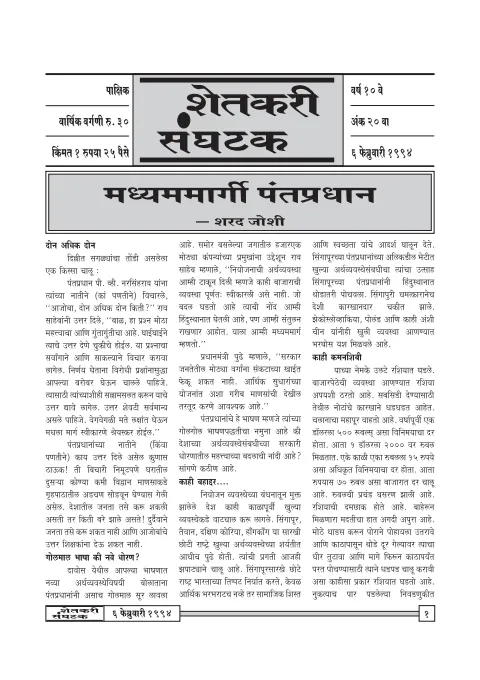
मध्यममार्गी पंतप्रधान
By शरद जोशी
Sharad Joshi’s lead essay frames Prime Minister P. V. Narasimha Rao as a ‘मध्यममार्गी’ — a middle-path leader whose rhetoric endorses open-market reform but whose budgets reproduce the old Nehru–Mahalanobis controls. Joshi opens with a Marathi anecdote about Pandit Pant being asked ‘two plus two equals?’ and replying ‘four — though it could be a little more or a little less’ — a parable for the PM’s evasive style. He notes that even Dr. Manmohan Singh’s reformist line is yoked to a cabinet, party and bureaucracy still wedded to subsidy politics; that government expenditure has ballooned from ₹15,400 crore in the early reform years to ₹38,000 crore on subsidies and ₹21,000 crore on administration, with no tightening visible. The essay closes by arguing that the only honest test of the PM’s commitment is whether export bans on cotton and other farm produce — the regulatory residue of the Nehru-era licence-permit raj — are actually lifted, not merely deplored in speeches.
- Casts P. V. Narasimha Rao as a ‘middle-path PM’ who praises liberalisation but refuses to dismantle the controls underpinning it.
- Reads Manmohan Singh’s reform programme as captive to a Congress establishment still loyal to the Nehru–Mahalanobis model.
- Cites government subsidies of ~₹38,000 crore and administrative expenditure of ~₹21,000 crore as evidence that no real fiscal correction has occurred.
- Holds up Indonesia, Thailand, South Korea and Hong Kong as small economies that pulled ahead through genuinely open systems.
- Treats the cotton-export ban as the decisive litmus test of whether the PM’s open-market rhetoric is sincere.
बळीराज्य अवतरले — अकोला-अमरावती-बुलढाणा
An unsigned dispatch from the Akola–Amravati–Buldhana cotton belt reports the Shetkari Sanghatana’s escalating ‘Kapus Seemapaar’ (cross-border cotton) agitation against the Centre’s cotton-export ban during November 1993–January 1994. It chronicles a sequence of rallies — the 11 November Karanja taluka office gherao, the 19 November Hiwarkhed roadblock where ~₹500 worth of cotton was sold openly, the entry into Madhya Pradesh on 1 December — culminating in a third-phase action on 23 January 1994 in which women farmers from Vāghiṇī village marched with bullock-carts under the slogan ‘कापूस आमचा, मालक आम्ही’ (‘our cotton, we are the owners’) and were lathi-charged by police near Buldhana. The article details the beating of women activists, the snatching of journalists’ cameras, and includes a censored/blacked-out photograph captioned as proof of ‘गुंडगिरी’ (thuggery) by uniformed police, framing the state’s response as evidence that the Sanghatana’s farmer-republic (‘बळीराज्य’) has in fact arrived. A short supporting verse by Konḍubai Sawant of Vāghoḷī is printed alongside; agitation leader Prakash Pohare’s arrest is reported.
- Documents the ‘Kapus Seemapaar’ export-ban defiance campaign across Akola, Amravati and Buldhana districts (Nov 1993–Jan 1994).
- Reports the 23 January 1994 police lathi-charge of women farmers led by the Shetkari Mahila Aghadi near Buldhana.
- Names Prakash Pohare as the arrested agitation chief and prints supporting verse by Konḍubai Sawant of Vāghoḷī.
- Reads the state’s violent response as proving — rather than refuting — that the Sanghatana’s ‘Baliraj’ (farmers’ kingdom) has arrived.
- Carries a deliberately blacked-out photograph as visual evidence of ‘goonda-ism in government uniform’.
शेतकरी महिला आघाडी शिबीर पुढे ढकलले
By शेतकरी महिला आघाडी
A short sidebar announces that the Shetkari Mahila Aghadi training shibir and Lakshmi-Mukti mahamelava — originally scheduled for 9, 10 and 11 February at Yeval following the executive meeting of 6 January 1994 — have been postponed due to unavoidable reasons; revised dates will be announced separately. Signed by the Shetkari Mahila Aghadi.
- Postpones the Shetkari Mahila Aghadi training shibir and Lakshmi-Mukti mahamelava planned for 9–11 February 1994 at Yeval.
- Cites ‘unavoidable reasons’ and promises revised dates separately.
बळीराज्य आंदोलन विशेषांक
By संपादक
A signed column by Mo. Vi. Tembhurni — identified as Vice-President of the Maharashtra Vidhan Sabha — argues that the Central Government’s cotton-export ban is anti-farmer at its core. He notes that a recent meeting in Delhi rejected even token relaxations, refusing to issue new export permits or release the pending consignment quotas, on the pretext of supplying Nehruvian-era textile mills cheaply. Tembhurni contends that the ban suppresses domestic cotton prices, denies the farmer the international price that the WTO trade regime would otherwise guarantee, and exists solely to subsidise mill owners at the cultivator’s expense. He calls for full deregulation of cotton exports and pledges support to the Shetkari Sanghatana’s national agitation.
- Frames the Centre’s cotton-export ban as anti-farmer at its core, not merely a technical trade measure.
- Argues the ban exists to keep textile-mill input prices artificially low, transferring value from cultivator to mill owner.
- Calls for complete removal of export curbs so farmers can access international prices.
- Pledges the writer’s support to the Shetkari Sanghatana’s escalating agitation.
कापूस निर्यातबंदी शेतकरीविरोधी
By मो. वि. टेमुर्डे, उपाध्यक्ष, महाराष्ट्र विधान सभा, मुंबई
A Hindi companion-piece by Mo. Vi. Tembhurni, addressed as an open letter to Prime Minister P. V. Narasimha Rao under the title ‘प्रधानमंत्री जी आप के मन में क्या है?’ (‘Prime Minister, what is on your mind?’). Tembhurni asks why the government has cleared exports of a dozen essential commodities — wheat, rice, sugar, edible oils, pulses — while singling out cotton for re-imposed export curbs through a Cabinet sub-committee; he reads this as a betrayal of farmers in the name of protecting urban consumers and textile interests. He invokes the Nehruvian patron–client legacy as the source of the bias and demands the PM either honour his liberalisation rhetoric by lifting the cotton ban or admit the reform programme is hollow.
- Open letter in Hindi to PM Narasimha Rao asking why cotton alone among farm commodities faces re-imposed export curbs.
- Reads the export-ban decision as a Nehruvian-era reflex protecting mill owners and urban consumers at the farmer’s cost.
- Demands the PM choose between liberalisation rhetoric and continued protectionist controls.
प्रधानमंत्री जी आपके मन में क्या है?
By मो. वि. टेमुर्डे, उपाध्यक्ष, महाराष्ट्र विधान सभा, मुंबई
An obituary, ‘कुर्डूच्या सर्जेराव पाटीलांचे निधन’, mourns Sarjerao Patil of Kurdu (Madha taluka, Solapur district), a devoted Shetkari Sanghatana activist who died of a heart attack on 11 January 1994. The notice recalls that Patil joined Sharad Joshi in 1981/82 when Joshi cycled through drought-prone Madha taluka to mobilise farmers, that Patil painted Sanghatana slogans on his village walls — a legacy still visible in Kurdu — and that he participated in every Sanghatana agitation from the Parbhani convention onwards despite acute financial hardship at home. The Shetkari Sanghatak pays tribute on behalf of the organisation.
- Records the death on 11 January 1994 of Sarjerao Patil of Kurdu (Madha taluka, Solapur) from a heart attack.
- Recalls his recruitment during Sharad Joshi’s 1981/82 cycle yatra through drought-hit Madha taluka.
- Notes that village walls in Kurdu still carry the Sanghatana slogans he painted.
Generated by the v1.5 extraction pipeline. Awaiting editorial review.
Metadata and summary are AI-extracted from the source PDF and reviewed for editorial accuracy. The original work is available via the Read PDF tab above (where present); paragraph-level citation inside the PDF is deferred to a future engagement.