periodical issue
Shetkari Sanghatak
शेतकरी संघटक
By sharad-joshi
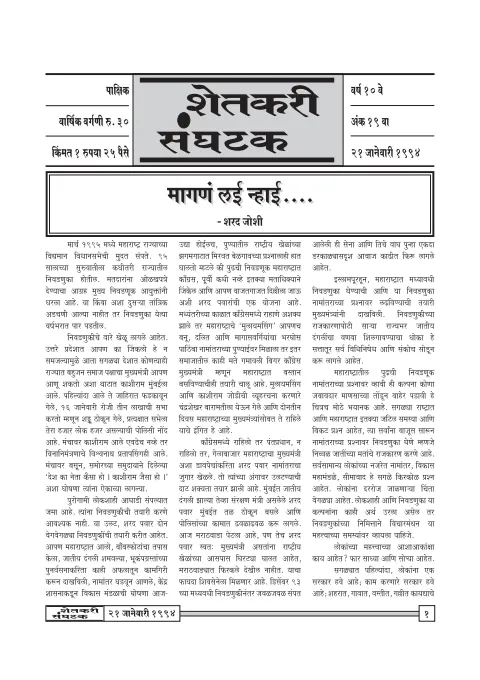
पाक्षिक शेतकरी संघटक — मालक: मोहन विहारीलाल पादेशी; संपादक, मुद्रक, प्रकाशक: सुरेशचंद्र म्हात्रे; मुद्रण स्थळ: गणेश प्रिंटर्स, ६९३, बुधवार पेठ, पुणे - २; प्रकाशन स्थळ व पत्रव्यवहाराचा पत्ता: अंगारमळा, मु. पो. आंबेठाण (४१० ५०२), ता. खेड, जि. पुणे · Pune · 1994
8 pages
Shetkari Sanghatak
Summary
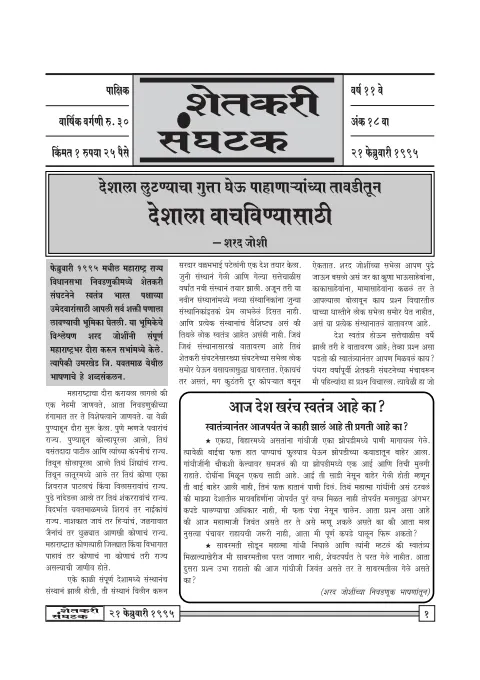
This January 21, 1994 issue of Shetkari Sanghatak, the Marathi fortnightly of the Shetkari Sanghatana, is built around two argumentative spines. The front-page editorial ‘मागणं लई न्हाई…’ by Sharad Joshi takes the upcoming end of the Maharashtra Legislative Assembly term in March 1995 as a pretext to read the electoral landscape: Congress is jockeying internally, regional and caste-bloc players like Sharad Pawar and Mulayam Singh are recalibrating, and the established parties — already worn down by communal arithmetic and a collapsing rural base — are visibly nervous about a Shetkari Sanghatana-allied alternative. Joshi argues that the existing parties cannot construct a coherent farmers’ programme because the very state architecture they defend is the architecture choking the countryside.
Pages 3–6 carry an unsigned visual feature titled ‘१९७१ ते १९९५’ that telescopes a twenty-one-year retrospective into a single satirical chain: 1947 brought independence, 1950 brought ‘development plans for prosperity,’ and 1971 brought poverty — because the ‘socialist Nehru-state’ systematically dismantled the freedoms to produce, to earn, to save and to be generous, replacing them with a layered cascade of taxes (excise, customs, sales tax, income tax, wealth tax, gift tax, capital gains, estate duty) so dense that, in the feature’s closing joke, even a journey to heaven requires filling out various forms. The spread closes on a clean Swatantra Paksha credo: a welfarist (not despotic-socialist) society, social justice, opposition to absolute state power, and freedom for farmers, industry, trade, and religion, anchored in the fundamental right to property earned through labour and savings.
The back pages report two organisational items the Sanghatana wants its base to act on. Page 7 covers a Supreme Court ruling fixing sugarcane purchase prices at Rs 600+140 in a Pune Pohilchavl matter, and announces an aggressive new posture by the Shetkari Mahila Aghadi (the Farmers’ Women’s Front), with meetings on 6 February 1994 and demands targeting the women’s-empowerment (‘Lakshmi Mukti’) programme, liquor-shop closures, and the local sugar market. Page 8’s main piece, ‘तर मदतीसाठी पुढे याल?’, lays out a programmatic reform menu spanning law and policing, the financial sector, the sugar industry, education, public-sector reform, women’s safety, and bureaucratic audit — framed explicitly as the work the Sanghatana wants any aspiring political ally to underwrite. The issue is in Marathi throughout; key terms recur in ‘स्वातंत्र्य’ (freedom) and ‘समाजवादी नेहरूराज्य’ (the socialist Nehru-state).
Key points
-
Front-page editorial by Sharad Joshi reads the run-up to the 1995 Maharashtra Assembly elections as a moment when existing parties (Congress, Pawar’s camp, Mulayam Singh’s allies) are visibly anxious about a Shetkari Sanghatana-aligned alternative.
-
A four-page visual feature, ‘१९७१ ते १९९५’, stages a twenty-one-year indictment of Nehruvian planning, charging that the ‘socialist Nehru-state’ replaced the freedoms to produce, earn and save with a layered tax cascade.
-
The taxation chain is itemised through the spread: excise, customs, sales tax, income tax, wealth tax, gift tax, capital gains and estate duty are each shown as a separate confiscation of citizen autonomy.
-
Closing panel articulates the Swatantra Paksha credo: a welfarist society opposed to absolutist socialism, defending freedoms of farmers, industry, trade and religion, and the fundamental right to property earned through labour and savings.
-
Page 7 reports a Supreme Court ruling fixing sugarcane prices at Rs 600+140 in a Pune-area sugar factories dispute, framed as a farmer-favourable judicial intervention.
-
Page 7 announces an aggressive new phase for the Shetkari Mahila Aghadi (Farmers’ Women’s Front), with a meeting on 6 February 1994 and resolutions tying women’s empowerment to closure of village liquor shops and reform of the local sugar market.
-
Page 8’s ‘तर मदतीसाठी पुढे याल?’ compiles a multi-sector reform menu — law and policing, financial system, sugar industry, education, public-sector reform, women’s safety and audit — as conditions any political ally must meet.
-
Boxed editorial on page 2 invokes Rajaji’s warning, written soon after independence, that Nehru’s centralised socialist machinery could not be reconciled with democratic life, to underwrite the Sanghatana’s anti-statist line.
Generated by the v1.5 extraction pipeline. Awaiting editorial review.
Metadata and summary are AI-extracted from the source PDF and reviewed for editorial accuracy. The original work is available via the Read PDF tab above (where present); paragraph-level citation inside the PDF is deferred to a future engagement.