periodical issue
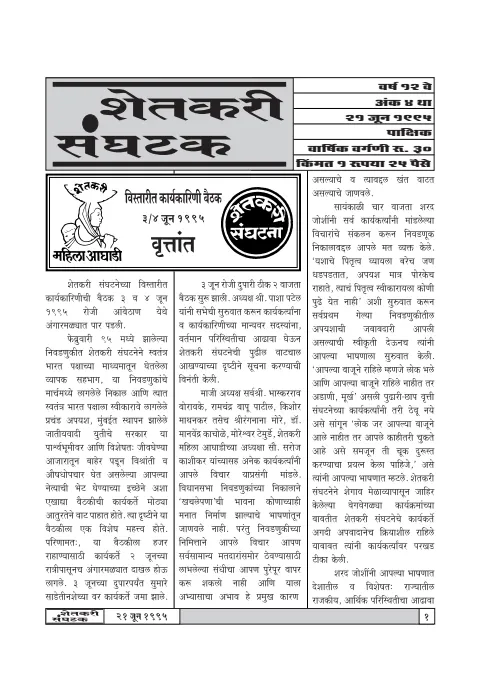
Shetkari Sanghatak
Marathi Fortnightly
शेतकरी संघटक
By एस. शंकर मेनन, नाबार्ड अधिकारी, कृषिअर्थतज्ञ, सौ. सरोज काशीकर, वर्धा
SHETKARI SANGHATAK (Marathi Fortnightly), Regd. No. 39926/83. संपादक, मुद्रक, प्रकाशक: सुरेशचंद्र म्हात्रे. मालक — सौ. मोहना वि. परदेशी, मुद्रण स्थळ — गणेश प्रिंटर्स, ५९३, बुधवार पेठ, पुणे - २. प्रकाशन स्थळ व पत्रव्यवहाराचा पत्ता: अंगणस्थळ, मु. पो. आदेगांव (४१० ५०१), ता. खेड, जि. पुणे. · Pune · 1995
4 pages
Shetkari Sanghatak
Summary
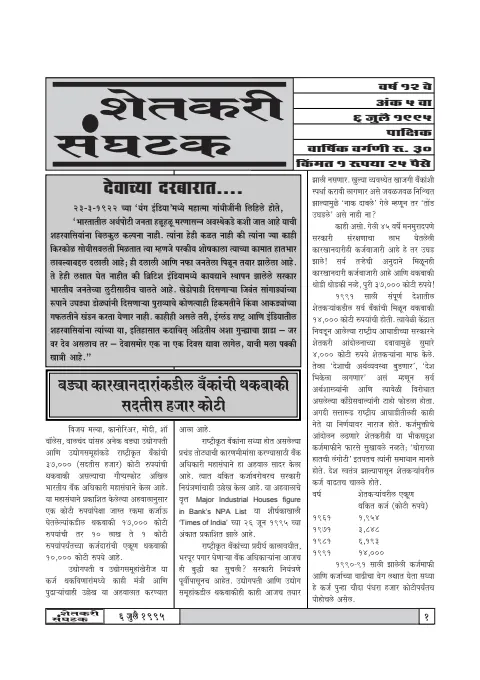
This is the 6 July 1995 number (Year 12, Issue 5) of Shetkari Sanghatak, the Marathi fortnightly of Sharad Joshi’s Shetkari Sanghatana. The lead editorial ‘देवाच्या दरबारात…’ (‘In God’s Court…’) opens by quoting Mahatma Gandhi’s 23 January 1932 Young India piece on the gulf between urban Indians and the half-fed, dying peasantry, and argues that India’s celebration of freedom rings hollow as long as the village population remains unfree — that the urban-industrial order continues colonial-era extraction from the countryside.
The second front-page report, ‘बङ्या कारखानदारांकडील बँकांची थकबाकी सदतीस हजार कोटी’ (‘Bank dues from big industrialists run to thirty-seven thousand crore’), draws on a 26 June 1995 Times of India ‘Major Industrial Houses figure in Bank’s NPA List’ to argue that elite houses — Mallya, Modi, Singhania, Khaitan and others — have left over ₹37,000 crore unpaid to public banks, dwarfing aggregate farmer loan dues. The piece uses this contrast to attack the political framing that treats farm-loan waivers as fiscally irresponsible while industrial defaults are quietly rolled over since the Indira Gandhi-era bank nationalisation.
Inside pages carry two interview-format pieces: ‘शरद जोशींच्या अर्थशास्त्रात तथ्य आहे’, in which NABARD officer S. Shankar Menon endorses Joshi’s farm economics after a visit to Ambethan, and ‘निर्यातीवरील सर्व बंधने उठवावीत’, in which agricultural economists Dr. Ashok Gulati and Dr. C. Hanumantha Rao call for the removal of all restrictions on agricultural exports. The issue also announces a three-day Krishi Arth Prabodhini training course (18–20 June 1995) held jointly with the Shetkari Mahila Aghadi, with a curriculum covering economic-era theory, market behaviour, ideological currents, evolution, organisation and consolidation.
The back half of the issue prints the July–August 1995 district tour calendar of the Sanghatana’s newly elected state president Shri Babasaheb Deshmukh (based at the divisional office in Kalmanthi-Bunzari, Nanded) alongside a parallel tour by the new Mahila Aghadi president Mrs. Indira Patil; outgoing Mahila Aghadi president Saroj Kakodikar’s farewell address from Wardha to the women’s farmer movement; and an obituary for Prof. Ramesh Shipurkar, the paper’s Aurangabad correspondent for fourteen years and a long-time Sanghatana volunteer, who died on 8 May 1995.
Key points
-
Lead editorial ‘देवाच्या दरबारात…’ opens with Mahatma Gandhi’s 23 January 1932 ‘Young India’ indictment of urban India’s blindness to dying peasants, and argues that Indian freedom is incomplete while villages remain unfree.
-
Front-page report uses a Times of India NPA list (26 June 1995) to argue that big industrial houses owe public banks more than ₹37,000 crore, dwarfing aggregate farmer loan dues — a polemical counter to the standard objection to farm-loan waivers.
-
Interview slug ‘शरद जोशींच्या अर्थशास्त्रात तथ्य आहे’ reports NABARD officer S. Shankar Menon’s visit to Sharad Joshi at Ambethan and his stated agreement with Joshi’s farm-economics framework.
-
Agricultural economists Dr. Ashok Gulati and Dr. C. Hanumantha Rao are reported as calling for all restrictions on agricultural exports to be lifted.
-
The Shetkari Sanghatana announces a three-day Krishi Arth Prabodhini training course (18–20 June 1995), run jointly with the Shetkari Mahila Aghadi, with a six-module curriculum covering economic-era theory, market behaviour, ideological currents, evolution, organisation and consolidation.
-
Tour schedule of the newly elected state president Shri Babasaheb Deshmukh (Nanded office) covers districts across Maharashtra in July–August 1995, paired with a parallel tour by new Mahila Aghadi president Mrs. Indira Patil.
-
Outgoing Mahila Aghadi president Saroj Kakodikar (Wardha) signs off with a reflection on rural women’s economic self-organisation.
-
The issue closes with an obituary for Prof. Ramesh Shipurkar, the paper’s Aurangabad correspondent for fourteen years, who died on 8 May 1995.
Generated by the v1.5 extraction pipeline. Awaiting editorial review.
Metadata and summary are AI-extracted from the source PDF and reviewed for editorial accuracy. The original work is available via the Read PDF tab above (where present); paragraph-level citation inside the PDF is deferred to a future engagement.