periodical issue
Shetkari Sanghatak
शेतकरी संघटक
By शंकर धोंडगे, सौ. इंदिराबाई भानुदास पाटील, बाबुलाल जैन
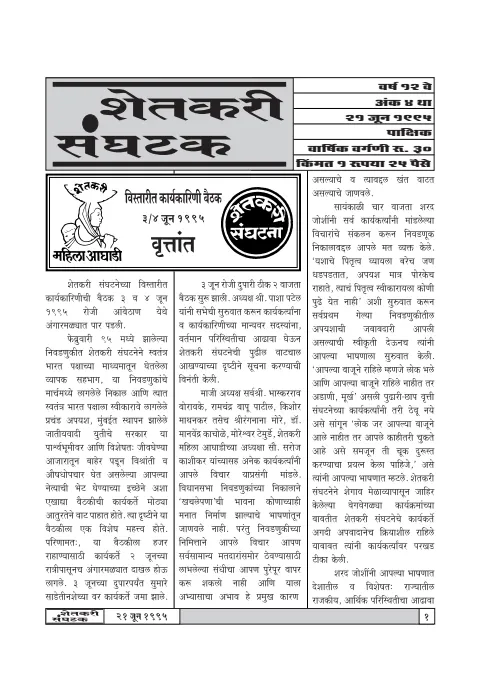
SHETKARI SANGHATAK (Marathi Fortnightly), Regd. No. 39926/83, June 21, 1995. संपादक, मुद्रक, प्रकाशक: सुरेशचंद्र म्हात्रे. मालक — मोहन विहारीलाल परदेशी. मुख्य पत्ता: गणेश प्रिंटर्स, ५९३, बुधवार पेठ, पुणे - २. · Pune · 1995
4 pages
Shetkari Sanghatak
Summary
This is Issue 4, Year 12 (21 June 1995) of Shetkari Sanghatak (शेतकरी संघटक), the Marathi fortnightly bulletin of the Shetkari Sanghatana farmers’ movement, edited by Sureshchandra Mhatre and printed at 6, Budhwar Peth, Pune. The rendered pages carry a full report (वृत्तांत) of the extended working-committee meeting held at Ambethan on 3-4 June 1995, profile sketches of the newly elected office-bearers Shankar Dhondge (organisation president) and Indirabai Bhanudas Patil (Mahila Aghadi president), an opinion piece (मनोगत) by Balubhau Jain from Alibag arguing that meetings have shifted from being kāryakartā-driven to functionary-driven, and a programmatic statement by Indirabai Patil setting out the Mahila Aghadi’s four-fold agenda — Lakshmimukti (women’s land rights), prohibition, maternity leave, and women’s participation in decision-making. A back-page notice announces enrolment for the September 1995 Krishi Arth Prabodhini training camp at Ambethan.
The central political question taken up at the Ambethan meeting is how the Sanghatana should read its support for the BJP-Shiv Sena alliance that ousted Congress in the February 1995 Maharashtra assembly elections — Sharad Joshi’s framing rejects the view that the rural movement was ‘broken’ by the result, insists that ‘the people are with us’ must remain the working presumption of any kāryakartā, and points to the new non-Congress government as continuity with the Sanghatana’s long anti-Congress orientation. The volume is in Marathi throughout; the key organisational terms recurring across the issue are विस्तारीत कार्यकारिणी (extended working committee), जोतीबा गाव (a model-village award named for Jyotiba Phule), and लक्ष्मीमुक्ती (the campaign to register agricultural land in women’s names).
Key points
-
Issue 4, Year 12 (21 June 1995) of the Marathi fortnightly Shetkari Sanghatak, edited by Sureshchandra Mhatre and printed in Pune, reports on the Shetkari Sanghatana’s extended working-committee meeting held at Ambethan on 3-4 June 1995.
-
The committee read the February 1995 Maharashtra assembly result, which toppled Congress and installed the state’s first non-Congress government, as a vindication of the Sanghatana’s long political direction rather than a setback.
-
Newly elected office-bearers named in the report are Ram Newale, Saroj Kashikar, Raghunathrao Patil, Shankar Dhondge and Purushottam Lahoti, succeeding an outgoing committee that included Bhaskarrao Borade and Kishore Madhavkar.
-
Sharad Joshi’s closing remarks argue that a karyakarta must presume the people are with the movement, treating any apparent gap in support as the movement’s own failing to correct rather than the people’s fault.
-
A profile of Shankar Dhondge, elected president for a second time, traces his career from his first term in 1986 through the Nanded district committee and notes he fielded six candidates in the recent Maharashtra assembly elections.
-
Balubhau Jain of Alibag contributes an opinion piece arguing that Sanghatana meetings have shifted from being driven by ordinary karyakartas to being dominated by office-bearers and functionaries.
-
Indirabai Bhanudas Patil, elected president of the Shetkari Mahila Aghadi, sets out a four-point agenda covering Lakshmimukti land rights for women, prohibition, maternity leave and greater female participation in decision-making.
-
A back-page notice announces enrolment for the Krishi Arth Prabodhini training camp scheduled to be held at Ambethan in September 1995.
Essays
विस्तारीत कार्यकारिणी बैठक ३/४ जून १९९५ — वृत्तांत / अध्यक्ष शंकर धोंडगे
An unsigned editorial report on the Shetkari Sanghatana’s two-day extended working committee meeting held at Ambethan on 3-4 June 1995, the first such gathering after the February 1995 Maharashtra assembly elections. The piece sets out the agenda — taking stock of the post-election political situation, deciding the movement’s next steps, and electing new office-bearers — and records that ‘the prevailing view’ in the committee was that the result should not be read as a setback for the Sanghatana, since the toppling of Congress and the formation of the first non-Congress government in Maharashtra was itself a vindication of the Sanghatana’s long political direction. The report names the past committee — Bhaskarrao Borade, Ramchandra Bapu Patil, Kishore Madhavkar, Shrirangnana More, Dr. Manavendra Kachole and Moreshwar Temurde — and the Mahila Aghadi outgoing president Saroj Kashikar, before listing the newly elected office-bearers: Ram Newale, Saroj Kashikar, Raghunathrao Patil, Shankar Dhondge and Purushottam Lahoti. It closes with Sharad Joshi’s response that those who hold ‘whoever is with us is the people; whoever is not is ignorant and foolish’ have the wrong leader-mentality and that the kāryakartā must instead start from the presumption that the people are with the movement and that any gap is the movement’s own fault to correct.
- The extended working committee meeting was held at Ambethan on 3-4 June 1995, the first since the February 1995 Maharashtra assembly elections.
- The committee took the view that the February 1995 result, by toppling Congress and installing the first non-Congress government in Maharashtra, was a vindication rather than a defeat of the Sanghatana’s political line.
- The outgoing past committee included Bhaskarrao Borade, Ramchandra Bapu Patil, Kishore Madhavkar, Shrirangnana More, Dr. Manavendra Kachole and Moreshwar Temurde, with Saroj Kashikar as the outgoing Mahila Aghadi president.
- Newly elected office-bearers named are Ram Newale, Saroj Kashikar, Raghunathrao Patil, Shankar Dhondge and Purushottam Lahoti.
- Sharad Joshi argued in his closing remarks that the kāryakartā must work from the presumption that the people are with the movement, treating any gap as the movement’s own failing to correct.
अध्यक्षा सौ. इंदिराबाई भानुदास पाटील (शेतकरी महिला आघाडी)
By सौ. इंदिरा भानुदास पाटील
A short profile of Shankar Dhondge, elected president of the Shetkari Sanghatana at the Ambethan meeting for the second time. The piece opens with Sharad Joshi’s congratulatory line — that being president for a second time means Shankar is, in effect, a kāryakartā for the first time — and reads Dhondge’s career in that light: he was first elected president in 1986 in the period of the Sanghatana’s first president, lost the position later, but stayed within the movement through the Nanded district committee and the 1996 [period] internal organisational restructuring under Sharad Joshi. The sketch positions him as a Maratha ordinary farmer rooted in his samaj rather than a career office-bearer, contrasts him with leader-types who use position for personal benefit, and notes that in the last year and a half it was Dhondge who stood for the Sanghatana in some Nanded-area villages without backing down. The closing paragraph reports that in the Maharashtra assembly elections he led the Sanghatana’s electoral effort and put six candidates into the field — work undertaken with characteristic stubbornness and at personal sacrifice.
- Shankar Dhondge was elected president of the Shetkari Sanghatana for the second time at the 3-4 June 1995 Ambethan meeting.
- He was first elected president in 1986 and remained active in the Nanded district committee through subsequent organisational changes.
- The profile frames him as a Maratha ordinary farmer rooted in his samaj rather than a position-seeking leader.
- In the recent Maharashtra assembly elections he led the Sanghatana’s electoral effort and fielded six candidates.
मनोगत — पूर्वीच्या बैठका ‘कार्यकर्त्यां’च्या असायच्या
By बाबुलाल जैन, अलियाबाद, जि. रायगड
Profile of Indirabai Bhanudas Patil, elected president of the Shetkari Mahila Aghadi at the Ambethan meeting. The piece centres her organising work in Hingoli on the Lakshmimukti campaign — the registration of agricultural land in women’s names — which it locates within the Phule-Ambedkar tradition of social thought as a practical extension of that lineage. It records that Indirabai’s villages took up the ‘Jotiba Gaon’ award (an honour given to villages that meet a set of social criteria), and announces that she intends, as president, to broaden the Lakshmimukti programme and continue the ‘Jotiba Gaon’ award scheme.
- Indirabai Bhanudas Patil, from Pankanagar, Chopda taluka, Jalgaon district, was elected president of the Shetkari Mahila Aghadi.
- Her organising base is the Lakshmimukti campaign in Hingoli, which registers agricultural land in women’s names.
- The profile situates the Lakshmimukti work in the Phule-Ambedkar tradition of social thought.
- Her villages have taken up the ‘Jotiba Gaon’ award scheme, which she intends to continue and expand as president.
कृषि अर्थ प्रबोधिनी प्रशिक्षणाची नोंदणी (notice / box item)
By कृषि अर्थ प्रबोधिनी, अंगारमळा, आंबेठाण
An opinion column (मनोगत) by Balubhau Jain of Alibag, Raigad district, complaining that the Ambethan meeting felt unlike earlier Shetkari Sanghatana gatherings. He argues that previous meetings were truly meetings ‘of the kāryakartās’ — open, argumentative, dominated by working organisers — whereas this one was effectively pre-cooked by an inner functionary core, with the discussion of the February 1995 election result and other items narrowed to ratifying conclusions already reached. He cites parallels in newspapers like Samana, observes that organisational meetings have lately settled into a pattern of formal speeches rather than working sessions, and closes by warning that without restoring the older kāryakartā-driven style of meeting the Sanghatana risks losing the qualities that made it distinctive.
- The author Balubhau Jain (Alibag, Raigad district) frames the Ambethan meeting against the older format of Shetkari Sanghatana gatherings.
- He argues that earlier meetings were genuinely ‘of the kāryakartās’ while recent ones have become functionary-driven and pre-cooked.
- He references the press coverage in Samana as illustrating how political discussion has narrowed.
- He warns that without recovering the kāryakartā-driven style of meeting the Sanghatana risks losing what made it distinctive.
Essay 5
A programmatic statement by the newly elected Mahila Aghadi president Indirabai Bhanudas Patil setting out four working priorities. (1) Lakshmimukti: the registration of agricultural land in women’s names, which she identifies as the priority that has built the Mahila Aghadi’s reach and which she means to scale up; the piece notes that ‘Shivar’ supermarkets selling women-produced goods are now opening, with the aim of giving women’s labour a market presence under the ‘Shivar’ brand. (2) Daru-bandi (prohibition): the Mahila Aghadi will continue its anti-liquor agitation, which is described as a long-standing women-led movement. (3) Matritva-raja (maternity leave): securing maternity leave for women working in the rural unorganised sector. (4) Nirnay-sahabhag (decision participation): expanding women’s substantive role in decision-making within the Sanghatana’s own structures and beyond. The piece signs off with thanks to outgoing office-bearers and a call for solidarity. The same page carries a notice for the September 1995 Krishi Arth Prabodhini training course at Ambethan.
- Indirabai Bhanudas Patil sets out four working priorities for the Shetkari Mahila Aghadi.
- Priority 1 — Lakshmimukti: registration of agricultural land in women’s names, the campaign that built the Aghadi’s reach.
- Priority 2 — Prohibition: continuation of the women-led anti-liquor agitation.
- Priority 3 — Maternity leave for women working in the rural unorganised sector.
- Priority 4 — Women’s substantive participation in decision-making.
- The ‘Shivar’ brand of supermarkets for women-produced goods is announced as a vehicle for giving women’s labour a market presence.
Generated by the v1.5 extraction pipeline. Awaiting editorial review.
Metadata and summary are AI-extracted from the source PDF and reviewed for editorial accuracy. The original work is available via the Read PDF tab above (where present); paragraph-level citation inside the PDF is deferred to a future engagement.