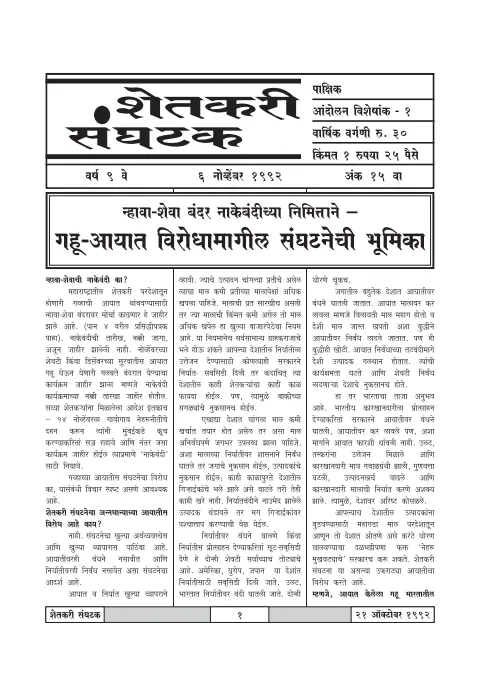
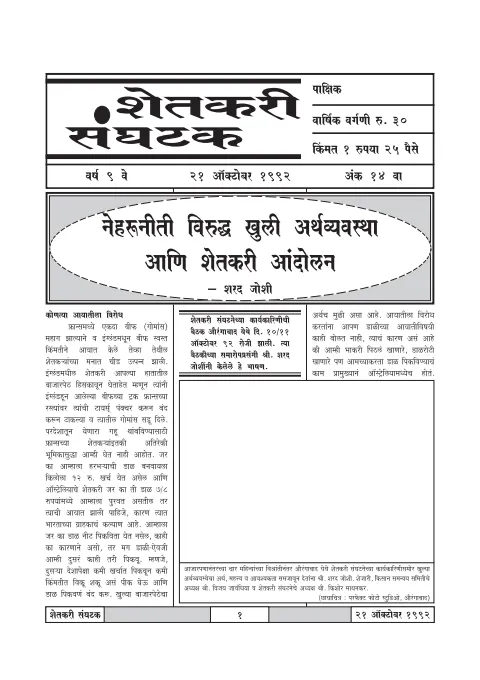
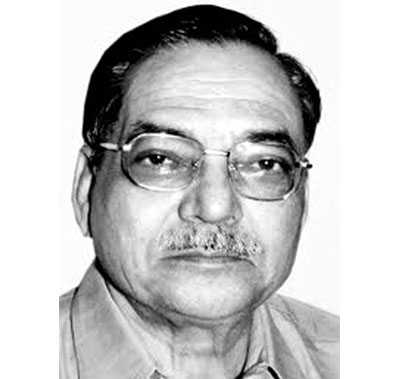
periodical issue
Shetkari Sanghatak
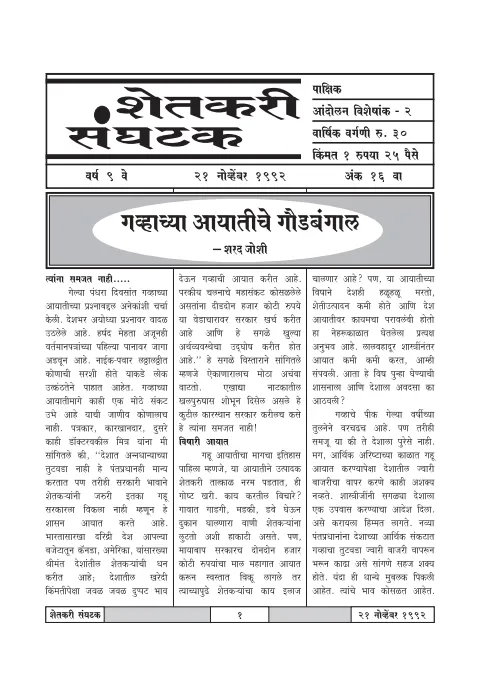
Andolan Visheshank - 2 (Movement Special Issue 2); Varsha 9, Ank 16, 21 November 1992
शेतकरी संघटक
By sharad-joshi, अ. जमील अ. खलील
पाक्षिक शेतकरी संघटक — मालक: मोहन विहारीलाल परदेशी; संपादक, मुद्रक, प्रकाशक: सुरेशचंद्र म्हात्रे; मुद्रण स्थळ: गणेश प्रिंटर्स, ६९३, बुधवार पेठ, पुणे - २; प्रकाशन स्थळ व पत्रव्यवहाराचा पत्ता: अंगारमळा, मु. पो. आंबेठाण (४१० ५०१), ता. खेड, जि. पुणे. (Posted at Market Yard, PSO, Pune 37 on 21st November 1992; Regd. No. 39926/83; PNCW 281; Licence to post without prepayment No. 87) · Ambethan, Tal. Khed, Dist. Pune · 1992
12 pages
Shetkari Sanghatak
Summary
This is the 21 November 1992 issue of Shetkari Sanghatak (शेतकरी संघटक), the Marathi-language fortnightly of the Shetkari Sanghatana, Year 9, Issue 16 — billed on its masthead as ‘आंदोलन विशेषांक — २’ (Movement Special — 2). The cover-to-page-4 lead essay, ‘गव्हाच्या आयातीचे गौडबंगाल’ (The Mystery of the Wheat Imports), is signed by Sharad Joshi and constructs an extended polemic against the P. V. Narasimha Rao government’s announcement that it will import wheat from the United States, Canada, Australia and Argentina at a cost Joshi pegs at thousands of crores in scarce foreign exchange. His core charge in the rendered pages is that procurement prices paid to Indian farmers (he cites figures around Rs. 280, Rs. 350 and Rs. 550 a quintal) were deliberately kept below the cost of production, that the resulting shortfall in government godowns is being used to manufacture a pretext for imports, and that a poor country is in effect taxing its own peasantry to subsidise rich-country growers — a transfer he ridicules as the opposite of a free market and likens, on questions of secrecy and procedure, to the Bofors scandal still on the front pages.
The issue then widens out from the lead essay into a thematic dossier. A boxed report on page 5, ‘कुठे गेला विलायती गहू? बिहारमध्ये भुकेने ५० जण मेले’, juxtaposes the proposed imports with fifty hunger deaths in Manihari, Bihar, and reprints a Karmik Times production table for 1991–92 vs 1992–93 to argue that aggregate output has actually risen. A reprinted Loksatta editorial of 17/11/1992 on page 6 (‘शेतीला दिलासा / लोकसत्तेतील संपादकीय’) debates whether the government’s new farm policy and the V. P. Singh advisory committee mark a genuine break from the Nehruvian model or merely tactical relief. A Pune district report on page 7 covers a public ‘burning of Nehru-policy’ (नेहरूनीतीचे दहन) ceremony led by activists Nandkumar Lokhande and Sanjay Chavhan. Page 8 carries a finance feature reprinted from Sakal, Pune (17/11/92), ‘परदेशी कर्जांचा वाढता बोजा’, which assembles warnings from Krishnachandra Pant, Dr. Manmohan Singh and others about the external-debt trap.
The remainder of the issue functions as an organisational call-sheet. Page 9 reports a national Kisan Coordination Committee meeting at Yavatmal — attended by Bhupinder Singh Maan, Ghasiramji Nain, Premsingh Dahiya, Vipinbhai Desai, Vijaybhai Patel, N. P. Shankar Reddy, Ajay Anmol, Dr. Ramnathkrishna Gandhi and Vijay Javandhia — that resolves to cut Punjab’s wheat acreage by 25 per cent in protest, and launches a ‘गावबंदी’ (village-ban) campaign barring ministers from rural Maharashtra from 10 November onward. Page 10 prints a sample interrogation sheet of ten questions for visiting politicians and Sharad Joshi’s full Maharashtra tour schedule (21 November–8 December). Page 11 announces the centrepiece of the movement: from 9 December, a blockade (‘नाकेबंदी’) of Jawaharlal Nehru Port at Nhava Sheva and a symbolic ceremony on 12 December (Babu Genu martyrdom day) to rename the port ‘Sarkhel Kanhoji Angre’, alongside a poem of farmer lament, ‘व्यथा’, by A. Jamil A. Khalil of Akola. The back cover carries the campaign slogan ‘बंदर न्हेऊ गद्दार गहूं रोकेंगे!’ and the publication imprint (Editor: Sureshchandra Mhatre; Owner: Mohan Viharilal Pardeshi; printed at Ganesh Printers, Budhwar Peth, Pune).
Key points
-
Lead essay by Sharad Joshi attacks the Narasimha Rao government’s plan to import wheat from the US, Canada, Australia and Argentina while paying domestic farmers below cost of production.
-
Joshi frames the import deal as a Bofors-style opaque transaction in which a poor country uses scarce foreign exchange to subsidise rich-country growers.
-
A page-5 box pairs the import news with a Dinamalar report of 50 hunger deaths at Manihari, Bihar, and a production table showing 1992–93 foodgrain output has risen, not fallen.
-
A reprinted Loksatta editorial (17/11/1992) debates whether the new farm policy and V. P. Singh advisory committee genuinely break with Nehruvian planning.
-
A Sakal Pune feature warns, citing Krishnachandra Pant and Dr. Manmohan Singh, that foreign borrowings of $250–300 million per fortnight are creating a debt trap.
-
A national Kisan Coordination Committee meeting at Yavatmal — with delegates from Punjab, Haryana, Gujarat, UP, Andhra and Maharashtra — resolves to cut Punjab wheat acreage by 25 per cent and launch a ‘गावबंदी’ barring ministers from villages.
-
The Shetkari Sanghatana announces a 9 December blockade of Jawaharlal Nehru Port at Nhava Sheva and a 12 December ceremony to rename it Sarkhel Kanhoji Angre Port, timed to Babu Genu’s martyrdom day.
-
The issue’s rhetoric is uniformly anti-‘Nehrunīti’ — page 7 reports a public burning of Nehru-policy in Pune district, and the back cover slogan ‘बंदर न्हेऊ गद्दार गहूं रोकेंगे’ fuses port-blockade and import-protest into a single campaign.
Generated by the v1.5 extraction pipeline. Awaiting editorial review.
Metadata and summary are AI-extracted from the source PDF and reviewed for editorial accuracy. The original work is available via the Read PDF tab above (where present); paragraph-level citation inside the PDF is deferred to a future engagement.