periodical issue
शेतकरी संघटक
Shetkari Sanghatak
By sharad-joshi, विजय जावंधिया, वायफड (वर्धा)
पाक्षिक शेतकरी संघटक — मालक: मोहन बिहारीलाल परदेशी; मुद्रण स्थळ: चाकण प्रिंटिंग प्रेस, चाकण; संपादक, मुद्रक, प्रकाशक: सुरेशचंद्र म्हात्रे; प्रकाशन स्थळ व पत्रव्यवहाराचा पत्ता: ११८७/६६ शिवाजीनगर, पुणे ४११ ००५ · Pune · 1991
8 pages
शेतकरी संघटक
Summary
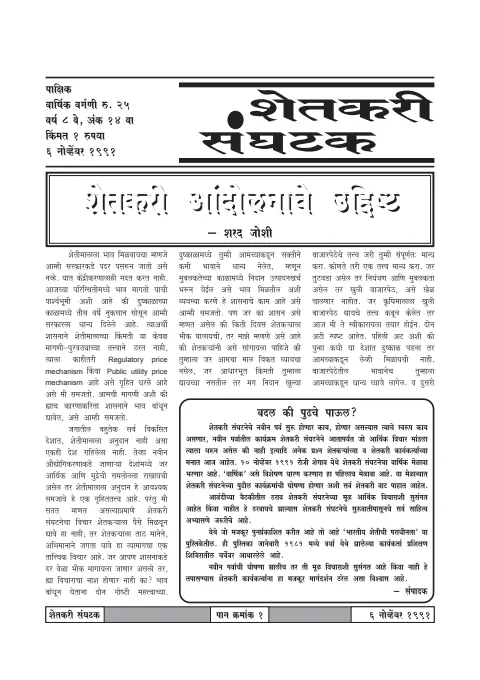
This is the 6 November 1991 fortnightly issue (Year 8, Issue 14) of Shetkari Sanghatak (शेतकरी संघटक), the Marathi-language organ of Sharad Joshi’s Shetkari Sanghatana, published from Pune. The issue is built around four substantive items: a lead essay by Sharad Joshi titled ‘शेतकरी आंदोलनाचे उद्दिष्ट’ (The objective of the farmers’ movement) that argues the movement’s aim is not to seek subsidies from the state but to secure remunerative prices through a genuinely open market for agricultural produce; an unsigned editorial ‘बदल की पुढचे पाऊल?’ (Change or the next step?) reflecting on the Sanghatana’s direction on the eve of its annual gathering and the re-issue of ‘भारतीय शेतीची प्यादेविरू’; Vijay Jawandhia’s polemical piece ‘नाव बुनकरांचे, नफा नसली वाडीयांचा!!’ rebutting Indian Cotton Mill Federation president Nusli Wadia’s call to dissolve the Maharashtra cotton monopoly procurement scheme (एकाधिकार) and the central Cotton Corporation of India (CCI) — Jawandhia argues their abolition would benefit Wadia’s mills rather than handloom weavers; and an interview by Baburao Hadole and the Chamale sarpanch with Latur cultivator Bhimrao Tondre titled ‘राष्ट्रीय संपत्ती संभाळणारा शेतकरी’, condemning chemical fertilisers and pesticides as a curse rather than a boon. The remaining pages carry news of Sharad Joshi’s 19-23 October Vidarbha ‘Lakshmimukti / Gramgaurav Samarambh’ tour granting land in cultivators’ wives’ names with public honour, president Kishor Mhadhakar’s Nashik-Jalgaon-Dhule district tour, an announcement of a processing-technology training camp jointly with Shetkari Mahila Aghadi, the standard Sanghatana pledge (‘प्रतिज्ञा’), a fresh list of life subscribers registered the previous month, and a back-cover call for the annual gathering at Shegaon (Buldhana) on 10 November 1991 where the Marathi edition of Joshi’s ‘राष्ट्रीय कृषिनीती’ (National Agricultural Policy) will be released.
Key points
-
Sharad Joshi’s lead essay, ‘Shetkari Andolanache Uddishta’, argues the farmers’ movement seeks remunerative prices through a genuinely open market, not subsidies sought in supplication from the state.
-
Joshi rejects both the ‘Regulatory price mechanism’ and the ‘Public utility price mechanism’, laying out three paths for the agricultural surplus and endorsing organised collective market entry, conditional on genuine openness at home and abroad.
-
He invokes the colonial-era ‘Imperial preference’ as a warning against false market openness and calls for a ‘Safety-fuse-mechanism’ to guard against price shocks.
-
An unsigned editorial, ‘Badal Ki Pudhache Paul?’, reflects on the Sanghatana’s direction ahead of its annual gathering and the forthcoming re-issue of ‘Bharatiya Shetichi Pyadeviru’.
-
Vijay Jawandhia rebuts Indian Cotton Mill Federation president Nusli Wadia’s call to dissolve Maharashtra’s cotton monopoly procurement scheme and the Cotton Corporation of India, arguing abolition would benefit mill owners rather than handloom weavers.
-
Jawandhia marshals cotton price, procurement, and export data from 1985-86 through 1991-92 and traces the scheme’s political history from its introduction under Indira Gandhi through the tenures of Ramnivas Mirdha, Ashok Gehlot, Ajit Yadav, and Sharad Pawar.
-
An interview with Latur cultivator Bhimrao Tondre, titled ‘Rashtriya Sampatti Sambhalnara Shetkari’, condemns chemical fertilisers and pesticides as a curse rather than a boon for farming.
-
Other pages report Sharad Joshi’s October 1991 Vidarbha tour granting land in cultivators’ wives’ names under the Lakshmimukti/Gramgaurav Samarambh campaign and announce the annual gathering at Shegaon, where the Marathi edition of his agricultural policy work was to be released.
Essays
शेतकरी आंदोलनाचे उद्दिष्ट
By शरद जोशी
Sharad Joshi opens the issue by clarifying what the farmers’ movement is and is not asking for. Securing prices for agricultural produce, he writes, does not mean spreading the pallu before government in supplication; the movement does not aid centralisation. Surveying current agitations over onion, cotton, sugar and groundnut prices, he rejects both the ‘Regulatory price mechanism’ and the ‘Public utility price mechanism’ as adequate solutions. He lays out three possible paths for the agricultural surplus: a Mahatma Gandhi-style retreat to village self-sufficiency and barter; abandoning farming altogether; or preparing large marketable surpluses and pushing them onto markets through farmer collective action. Joshi endorses the third — but only on the strict condition that the market be genuinely open, both within India and internationally. He invokes the colonial-era ‘Imperial preference’ as a cautionary example of false openness, demands a working ‘Safety-fuse-mechanism’ against market shocks, and warns that without a truly open market the cultivator cannot escape his subordinate status.
- Reframes the movement’s demand as fair prices via open markets, not state handouts.
- Rejects ‘Regulatory price mechanism’ and ‘Public utility price mechanism’ as inadequate.
- Lays out three options for the agricultural surplus: Gandhian self-sufficiency, exit from farming, or organised surplus-pushed market entry.
- Endorses the third option, conditional on a genuinely open domestic and international market.
- Calls for a ‘Safety-fuse-mechanism’ as a guardrail against market shocks; warns against the false openness of ‘Imperial preference’-style regimes.
बदल की पुढचे पाऊल?
By संपादक
The unsigned editorial ‘बदल की पुढचे पाऊल?’ (Change or the next step?) on the cover reflects on the role of Shetkari Sanghatak as the Sanghatana enters a new phase of its movement. It notes that the fortnightly has long been the chief vehicle for organisational news, ideological debate and economic argument, and frames the forthcoming annual gathering and the imminent re-publication of ‘भारतीय शेतीची प्यादेविरू’ as occasions for renewed clarity about the movement’s basic economic ideas. The piece signs off simply as ‘संपादक’ (editor).
- Reaffirms the fortnightly’s role as the Sanghatana’s organ for ideological and organisational communication.
- Treats the upcoming annual gathering and the re-issue of ‘भारतीय शेतीची प्यादेविरू’ as moments to revisit the movement’s economic core.
- Signed by the editor — no named byline.
शेतकरी संघटकचे आजीव वर्गणीदार — गेल्या महिन्याभरात नोंदविलेले
Vijay Jawandhia (Wifad, Wardha) takes on Indian Cotton Mill Federation president Nusli Wadia, who has demanded that the Maharashtra state cotton monopoly procurement scheme (एकाधिकार खरेदी) and the central Cotton Corporation of India (CCI) be wound up. Jawandhia argues that the scheme has shielded Maharashtra growers from the price collapses suffered by cotton cultivators in Madhya Pradesh, Punjab, Haryana, Rajasthan, Karnataka, Tamil Nadu and Gujarat, and that its abolition would not free the grower but transfer market power to mill-owners like Wadia. The piece marshals year-by-year cotton price, procurement and export data running from 1985-86 through 1991-92, recounts the political history of the scheme — including its introduction under Indira Gandhi and its continuation through the tenures of Ramnivas Mirdha, Ashok Gehlot, Ajit Yadav and Sharad Pawar — and rebuts the export-licensing case for liberalisation by pointing to international price differentials and the ‘Import against Export Under O.G.L.’ regime. The conclusion: the monopoly procurement system, far from being anti-grower, functions as a protective price floor; Wadia’s demand to dissolve it reads as a mill-lobby move to capture cheaper raw cotton.
- Maharashtra’s cotton ekadhikar scheme has insulated growers from the price falls seen in other states.
- CCI procurement and the ekadhikar function as a price floor rather than a constraint on the grower.
- Detailed cotton price, procurement and export tables for 1985-86 through 1991-92 anchor the empirical argument.
- Political history of the scheme is traced from Indira Gandhi onward through a succession of Union ministers.
- Wadia’s call to wind up the schemes is read as serving mill-owners and importers, not weavers.
नाव बुनकरांचे, नफा नसली वाडीयांचा!!
By विजय जावंधिया, वायफड (वर्धा)
Baburao Hadole and the Chamale sarpanch interview Bhimrao Hawgireev Tondre of Dehrjan (Tal. Udgir, Dist. Latur) on 25 September 1991 under the title ‘राष्ट्रीय संपत्ती संभाळणारा शेतकरी’ (The farmer who safeguards national wealth). Tondre, around seventy, describes managing a one-acre rainfed plot for a twelve-member household after his younger brother left for the railways. He contrasts pre-1947 cultivation — when seeds were saved, bullocks and farmyard manure managed the rotation, and soils stayed alive — with the current pattern in which government chemical fertilisers and pesticides are pushed onto cultivators through subsidies and credit. He has stopped using chemical fertilisers entirely and reports better yields, healthier soils and lower household costs. The interview’s banner line states his verdict bluntly: chemical fertilisers and pesticides are not a boon for the country but a curse.
- Tondre is a roughly seventy-year-old smallholder from Dehrjan (Udgir taluka, Latur) supporting a twelve-member household on one acre.
- Contrasts the pre-Independence seed-saving and farmyard-manure cycle with current chemical-input dependence.
- Reports better yields and lower household costs after abandoning chemical fertilisers.
- Frames chemical inputs as a national-level harm, not just a household one.
अध्यक्षांचा दौरा संपन्न
A news report records Sharad Joshi’s Vidarbha tour from 19-23 October 1991, conducted jointly with Shetkari Mahila Aghadi under the ‘Lakshmimukti / Gramgaurav Samarambh’ programme, in which cultivators publicly register land in their wives’ names and the village honours the participating households. The piece carries a district-wise table of villages and the number of women whose names were so entered on landholdings — spanning villages in Wardha, Yavatmal and Nashik districts among others. It is followed on the same page by short notices on president Kishor Mhadhakar’s Nashik-Jalgaon-Dhule district tour, an upcoming processing-technology (प्रक्रियातंत्र) training camp run with Shetkari Mahila Aghadi, and the standard Sanghatana pledge (‘प्रतिज्ञा’) closing with a salute to farmer-martyrs.
- Joshi’s 19-23 October 1991 Vidarbha tour was conducted jointly with Shetkari Mahila Aghadi.
- Under Lakshmimukti, land titles are entered in wives’ names with public village honour.
- A district-wise count of women whose names were so registered is given for villages in Wardha, Yavatmal and Nashik districts.
- Pairs with notices on president Kishor Mhadhakar’s tour, a processing-technology training camp and the Sanghatana pledge.
Generated by the v1.5 extraction pipeline. Awaiting editorial review.
Metadata and summary are AI-extracted from the source PDF and reviewed for editorial accuracy. The original work is available via the Read PDF tab above (where present); paragraph-level citation inside the PDF is deferred to a future engagement.