periodical issue
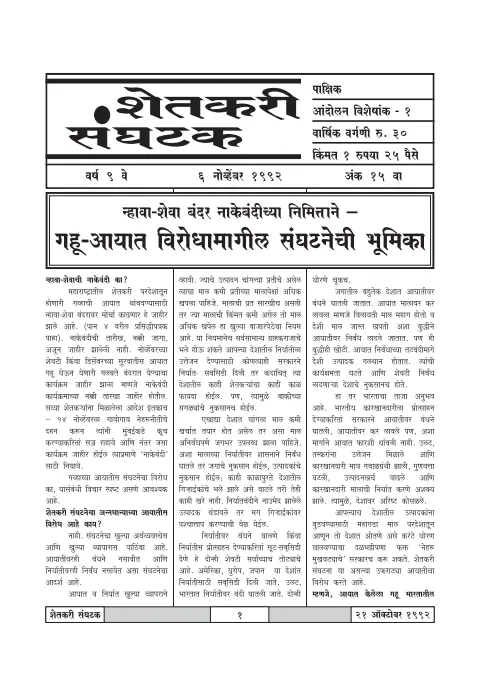
Shetkari Sanghatak
Andolan Visheshank - 1
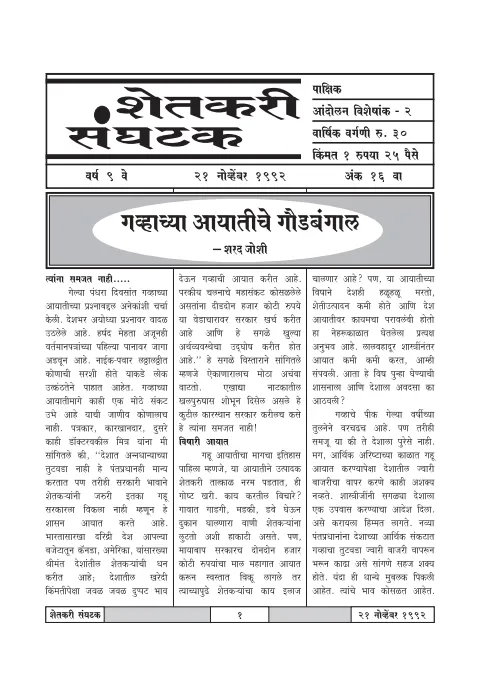
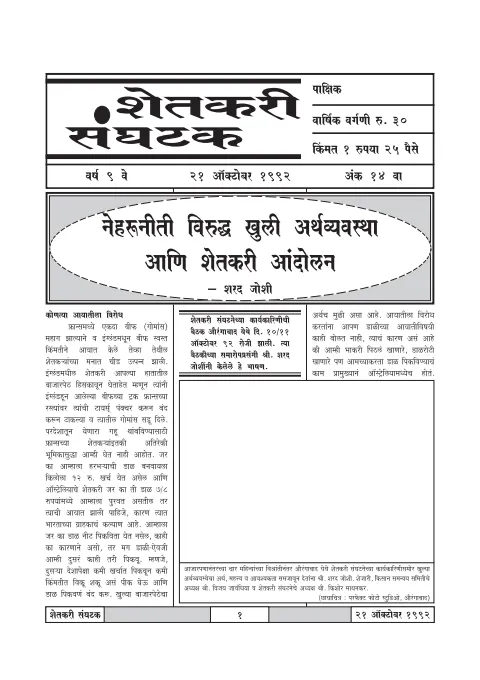
शेतकरी संघटक — आंदोलन विशेषांक - १
Shetkari Sanghatak — Andolan Visheshank - 1
पाक्षिक शेतकरी संघटक — मालक: मोहन विठाराम धारडेजी; संपादक, मुद्रक, प्रकाशक: सुरेशचंद्र म्हात्रे; मुद्रण स्थळ: गणेश प्रिंटर्स, ५९३, बुधवार पेठ, पुणे - २; प्रकाशन स्थळ व पत्रव्यवहाराचा पत्ता: अंगणवाडी, मु. पो. आंबेठाण (४१० ५०१), ता. खेड, जि. पुणे. Regd. No. 39926/83. Posted at Market Yard, PSO, Pune 37 on 6th, November 1992. PNCW 281, Licence to post without prepayment No. 87. · Ambethan, Tal. Khed, Dist. Pune · 1992
6 pages
Shetkari Sanghatak
Summary
This special issue (Andolan Vishishank-1) of the Marathi fortnightly Shetkari Sanghatak, dated 6 November 1992, is given over almost entirely to building the Shetkari Sanghatana’s case for blockading Jawaharlal Nehru Port (Nhava-Sheva) to halt the central government’s wheat imports. The front-page Q&A confronts the obvious counter-argument head-on: does opposing imports mean opposing the open economy? No, the editorial answers — the Sanghatana’s stated ideal is an open economy with no restrictions on either imports or exports. What it opposes is the specific manoeuvre of the Narasimha Rao government, which is paying domestic farmers far less per quintal than the landed cost of imported wheat, deliberately suppressing the home price under cover of consumer subsidy.
The issue frames the wheat-import policy as the unbroken continuation of Nehru-era controls — what the paper calls ‘Nehru-niti’ (नेहरूनीती), summed up in a boxed declaration as ‘the pomp of industrialism, the entrenched privilege of bureaucracy, and the death of the farmer’. The 14 November observance of Nehru-niti Dahan (the ritual burning of Nehru-policy effigies) is scheduled village-by-village to coincide with Nehru’s birth anniversary, and farmers are instructed to march out of their homes that day to demand the renaming of Jawaharlal Nehru Port. The connected campaign of mantri-gaon-bandi — ministers barred from entering villages starting 10 November, the new Shetkari Hutatma Din (Farmer Martyrs’ Day) — is launched alongside.
A second front announces that farmers from south Gujarat (Surat, Valsad, Dang, Bhadochi districts), mobilised at a 29 October rally on Sardar Vallabhbhai Patel’s 113th birth anniversary addressed by Sharad Joshi and Punjab leader Bhupendra Singh Mann, will travel to Nhava-Sheva to join the action. Sharad Joshi’s published Maharashtra tour schedule (15 November–6 December), covering Solapur, Kolhapur, Sangli, Nashik, Aurangabad, Akola, Amravati, Yavatmal, Chandrapur, Nagpur and dozens of intermediate halts, occupies most of page 4. The back-page essay invokes the Pune farmer’s son Babu Genu — crushed on 12 December 1930 by a British-driven truck of foreign cloth at Bombay’s Mulji Jetha Market while satyagrahically blocking its passage — and reads the impending wheat blockade as the same act of protest against foreign goods displacing domestic produce, only now with the Indian state, not a colonial one, doing the displacing. A box of nine sample questions for village campaigners (page 5) gives organisers ready-made talking points pitting consumer-price logic against farmer-price logic.
Key points
-
The Sanghatana defends its anti-import stance by clarifying it supports an open economy with no restrictions on imports or exports — what it opposes is the government’s selective use of imports to crush domestic farm-gate prices while paying lavishly for foreign wheat.
-
The doctrinal target is identified by name as ‘Nehru-niti’: the editorial argues the Narasimha Rao government is merely the latest carrier of a half-century-old state-pricing regime that subsidises industry and bureaucracy at the farmer’s expense.
-
14 November (Nehru’s birth anniversary) is reframed as ‘Nehru-niti Dahan Din’ — village-level burning of Nehru-policy effigies — paired with the demand that Jawaharlal Nehru Port (Nhava-Sheva) itself be renamed.
-
10 November is declared Shetkari Hutatma Din (Farmer Martyrs’ Day) and launches a mantri-gaon-bandi: a sustained ban on ministers entering villages until the import policy is reversed.
-
Sharad Joshi conducts a three-week Maharashtra tour (15 November–6 December 1992) to seed the Nhava-Sheva action across Solapur, Kolhapur, Sangli, Nashik, Aurangabad, Akola, Amravati, Yavatmal, Chandrapur and Nagpur districts, with district kisan-coordination meetings at every halt.
-
South Gujarat farmers, mobilised on Sardar Patel’s birth anniversary at a Surat-area meeting addressed by Sharad Joshi and Bhupendra Singh Mann, commit to travelling to Nhava-Sheva to physically reinforce the blockade.
-
The back-page essay constructs a direct lineage from Babu Genu’s 1930 self-sacrifice against foreign cloth imports to the planned 1992 wheat blockade — inverting the colonial frame so that the Indian state, not the British, is now the foreign agent against domestic produce.
-
A nine-question script for village campaigners turns the consumer-subsidy argument back on the government: if it can pay double the domestic price to import wheat, why not pay farmers that price directly?
Generated by the v1.5 extraction pipeline. Awaiting editorial review.
Metadata and summary are AI-extracted from the source PDF and reviewed for editorial accuracy. The original work is available via the Read PDF tab above (where present); paragraph-level citation inside the PDF is deferred to a future engagement.