periodical issue
Shetkari Sanghatak
Marathi Fortnightly — Year 8, Issue 13
शेतकरी संघटक
By sharad-joshi, सौ. आशा यादव (आशा श्रीरंगराव मोरे), आ. डॉ. वसंत बोंडे, सौ. लि. ना. आंबोरे
पाक्षिक शेतकरी संघटक — मालक: मोहन बिहारीलाल परदेशी; संपादक, मुद्रक, प्रकाशक: सुरेशचंद्र म्हात्रे; मुद्रण स्थळ: चाकण प्रिंटिंग प्रेस, चाकण; प्रकाशन स्थळ व पत्रव्यवहाराचा पत्ता: ११८७/६६ शिवाजीनगर, पुणे ४११ ००५ · Pune · 1991
12 pages
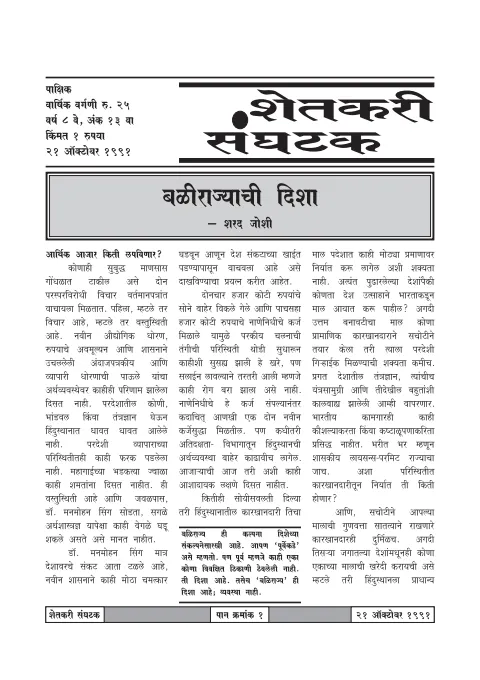
Shetkari Sanghatak
Summary
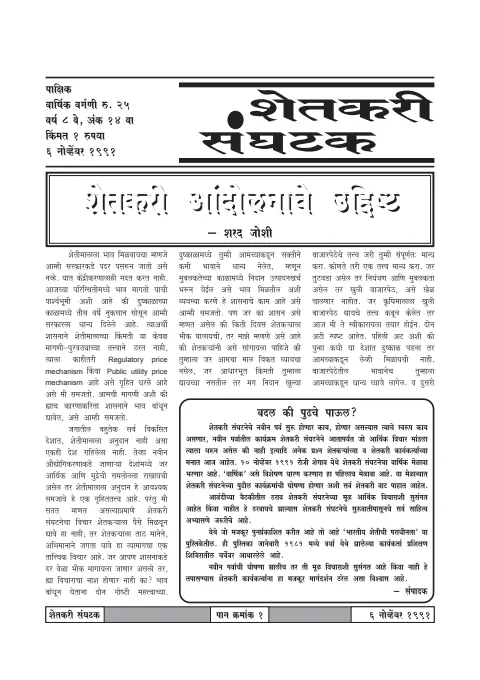
This is the 21 October 1991 fortnightly issue (Year 8, Issue 13) of Shetkari Sanghatak, the Marathi-language organ of Sharad Joshi’s Shetkari Sanghatana, published from Shivajinagar, Pune, with Sureshchandra Mhatre as editor-printer-publisher. The issue is dominated by Sharad Joshi’s long lead essay ‘Baliraj-yachi disha’ (The direction of Baliraj), which reads the just-announced Manmohan Singh liberalisation reforms through the Sanghatana’s farmers’-eye lens: he treats the 1991 crisis as the bankruptcy of the Nehruvian socialist-bureaucratic system rather than its accident, dismisses the cooperative sugar and dairy industries (including a sharp critique of Verghese Kurien’s Operation Flood) as ‘Chaitgiri’ (Bharat against India), and insists that the path forward is the agrarian, decentralised ‘Baliraj’ direction rather than any new edition of bureaucratic Nehru-pattern industrialisation. Around this argument the issue stitches together movement reportage and commemorations: a report from Nanded and Parbhani on the Lakshmimukti Gram-Gaurav samaroh (mass transfer of land into the names of farmers’ wives in 14 villages), a long first-person tribute by Asha Yadav of the Shetkari Mahila Aghadi recalling her work with Sharad Joshi and the late Lilatai Joshi, an editorial on the price imbalance between agricultural and industrial goods together with a shraddhanjali for Lilatai Joshi on her ninth death-anniversary, a policy article by MLA Dr Vasant Bonde arguing for rural electrification and electric cables as a vardan (boon) for Vidarbha cotton growers, the Sanghatana president’s late-1991 tour itinerary, and a Bhaubeej letter from Joshi’s sister Lilatai Aamore (Shetkari Mahila Aghadi, Bhivapur).
Key points
-
This is the 21 October 1991 fortnightly issue of Shetkari Sanghatak, Year 8 Issue 13, published from Shivajinagar, Pune, with Sureshchandra Mhatre as editor-printer-publisher.
-
Sharad Joshi’s lead essay ‘Baliraj-yachi disha’ reads the newly announced Manmohan Singh liberalisation reforms as the visible bankruptcy of the entire Nehruvian socialist economy rather than a passing accident.
-
Joshi coins the term ‘Chaitgiri’ for bureaucracy-driven, Nehru-pattern industrial complexes and attacks cooperative sugar and dairy cooperatives as machinery that favours urban consumers at farmers’ expense.
-
Joshi singles out Verghese Kurien’s Operation Flood for using imported milk powder and butter-oil to undercut the prices Indian dairy farmers could otherwise command.
-
A report describes the Lakshmimukti Gram-Gaurav ceremony held on 5-6 October 1991, in which farmers across 14 Nanded-district villages transferred shares of farmland into their wives’ names.
-
Asha Yadav of the Shetkari Mahila Aghadi contributes a first-person memoir recalling the November 1989 women’s agitation, a night in police custody, and a 30,000-strong gathering at Nashik.
-
MLA Dr Vasant Bonde contributes a policy article arguing that rural electrification and electric cables would be a boon for cotton growers in Vidarbha.
-
The issue also carries an editorial on the price imbalance between agricultural and industrial goods and a tribute marking the ninth death-anniversary of Lilatai Joshi.
Essays
बळीराज्याची दिशा
By शरद जोशी
Sharad Joshi’s lead editorial reads the July 1991 balance-of-payments crisis and the new Manmohan Singh / Chidambaram reform package as the visible bankruptcy of the entire Nehruvian socialist economy, not a passing fever to be hidden. He argues that the ‘socialist’ direction — borrowing abroad to import inputs, processing them through licensed industrial houses behind tariff walls, and dumping the result on a captive domestic market — has produced exactly the dead end now in front of the country, and that GATT, intellectual-property regimes (he names ‘Intellectual Patent Rights’) and the Uruguay round will only deepen the squeeze on Indian industry built up under this model. The essay then turns inward to attack the ‘Chaitgiri’ factories — bureaucracy-driven, Nehru-pattern industrial units, and especially the cooperative sugar and dairy complexes — as the Bharat-against-India apparatus that exploits the farmer. He singles out Verghese Kurien’s Operation Flood for using imported milk powder and butter-oil to undercut Indian dairy farmers’ prices, and asks how a Gujarat-style cooperative model can be the future when its own dairies pay producers six rupees per litre at most.
- Treats the 1991 crisis as the failure of the socialist model itself, not a contingent fiscal accident that Manmohan Singh’s measures can paper over.
- Reads the post-reform import-export regime, GATT and the Uruguay round (including ‘Intellectual Patent Rights’) as a deeper trap for the kind of industry Nehruvian planning built.
- Coins / re-uses ‘Chaitgiri’ to describe bureaucratic, foreign-technology-fed, Nehru-pattern industrial complexes and warns that the same pattern cannot return in a new dress.
- Attacks cooperative sugar factories and Dr Verghese Kurien’s dairy cooperatives as Bharat-versus-India machinery that shores up urban consumers at producer expense.
- Frames ‘Baliraj’ not as a blueprint but as a direction — agrarian, decentralised, oriented to the producer — to be moved towards once the Nehruvian direction is renounced.
नांदेड, परभणी लक्ष्मीमुक्ती ग्रामगौरव समारंभ
An editorial report from Nanded and Parbhani districts on the Lakshmimukti Gram-Gaurav samaroh held on 5–6 October 1991, where Shetkari Sanghatana leader Sharad Joshi presided over a ceremony in which farmers in 14 villages transferred shares of their farmland into their wives’ names, with the women receiving equal status as land-owners. The piece carries the full list of the 14 Nanded-district villages and the number of women honoured in each (Tirthi 102, Pimpri Buwa 110, Bakikhanga (Bhokar) 105 and so on), and frames the event as the on-the-ground operationalisation of the Sanghatana’s Shetkari Mahila Aghadi programme.
- Reports the first major Lakshmimukti samaroh in Marathwada, dated 5–6 October 1991, presided over by Sharad Joshi.
- Lists 14 villages across Nanded district by taluka with the number of women whose names were entered on land documents in each.
- Presents the ceremony as a property-rights step for women rather than a symbolic honour: it speaks of equal adhikar (right) on the land.
- Embeds the village-by-village data table that the synthesis layer can use as a primary source for early-1990s Shetkari Mahila Aghadi activity in Marathwada.
माझे पाय मुंबईत टेकतच नाहीत
By सौ. आशा यादव (आशा श्रीरंगराव मोरे), नालासोपारा
Asha Yadav (Asha Shrirangrao More), writing as a paaik of the Shetkari Mahila Aghadi from Nalasopara, addresses ‘Adarniya Sharadbhau’ in a long first-person memoir of her years inside the Shetkari Sanghatana. She recalls the chant ‘Shetkari shetmajoor sanghatanecha vijay aso’ that she and other children carried through village streets, the November 1989 women’s agitation in which roughly 200 women including her were arrested and held overnight at a police station, the 10 November 1989 Nashik gathering of 30,000 women, hospitalisations and the role of Dr Kolhe at the ESM Hospital, and her two formative encounters with Lilatai Joshi. The essay’s title comes from a line Joshi himself addressed to her — ‘Your feet don’t even touch Mumbai’ — and the piece functions both as a movement testimony and as a personal tribute to Lilatai Joshi on the eve of her death anniversary.
- First-person testimony from a Shetkari Mahila Aghadi cadre, signed ‘Sau. Asha Yadav, paaik, Shetkari Mahila Aghadi’.
- Anchors the November 1989 women’s agitation around concrete facts: ~200 women arrested overnight, 30,000-woman Nashik gathering on 10 November 1989, hospitalisation under Dr Kolhe at the ESM Hospital.
- Frames the essay around a remark by Sharad Joshi — ‘your feet don’t even touch Mumbai’ — which gives the piece its title and captures the author’s identity as a rural cadre rather than a city activist.
- Reads as a dual tribute — to Joshi’s mentorship and to Lilatai Joshi, recalling two meetings and the latter’s place as ‘the mother’ of the women’s wing.
शेतीमाल व औद्योगिक माल यांतील किंमतीचे संतुलन (with श्रद्धांजली — obituary for सौ. लीलाताई जोशी)
Page 9 carries a paired editorial essay and shraddhanjali. The essay, ‘Shetimal va audyogik maal yantil kimtiche santulan’ (Balancing the prices of agricultural and industrial goods), uses cold-storage chains, food processing and the 1990s market for milk derivatives to argue that the supposed parity between farm and factory goods is held in place by state-set conditions rather than competition, and that breaking this requires opening agricultural processing to the same private investment freedom industry already enjoys. Alongside it the shraddhanjali (tribute) marks 22 October 1991 — Kojagiri Poornima — as the ninth death-anniversary of Lilatai Joshi (d. 21 October 1982, the Kojagiri Poornima of 1982), wife of Sharad Joshi and a presiding figure in the Shetkari Mahila Aghadi, with Asha Yadav and Lilatai Joshi’s recollections cited and a reading planned from Lilatai’s foreword to her book ‘Bhumisevak’.
- Editorial frames the farm-vs-industry price gap as policy-made rather than market-made, and argues for opening agro-processing to the same private investment freedoms industry enjoys.
- Uses the milk-powder / butter-oil cold chain and food-processing industries as concrete illustrations of the asymmetry.
- Carries the issue’s shraddhanjali to Lilatai Joshi on her ninth death anniversary (21 October 1982, Kojagiri Poornima), to be marked by readings from her ‘Bhumisevak’ foreword on Kojagiri Poornima 22 October 1991.
- Establishes that the woman commemorated, Sau. Lilatai Joshi, was the wife of Sharad Joshi and a central figure in the Shetkari Mahila Aghadi.
ग्रामीण भागात विद्युत-रेचे: कापूस उत्पादकांसाठी वरदान
By आ. डॉ. वसंत बोंडे
MLA Dr Vasant Bonde, writing from the Vidhan Sabha office at Nariman Point, Bombay, argues that rural electrification — specifically electric overhead cables (‘rechye’) in the cotton tract of Vidarbha-Marathwada — would be a vardan (boon) for cotton producers facing the squeeze of the new economic crisis. He works through the price differential between unginned cotton (kapus), ginned-and-pressed lint, and processed oil and yarn to show that the value the farmer loses to traders and to grid-deprived ginning operations is large enough to fund electrification several times over, and calls on government and cooperative bodies to underwrite the supply.
- Identifies rural electrification of the cotton belt as a concrete, near-term policy step the post-1991 crisis should make politically possible.
- Walks through three price stages — kapus, ginned cotton, processed yarn — to quantify the value the farmer loses without on-farm or village-level processing.
- Author identifies himself as a sitting MLA writing from the Vidhan Sabha office at Nariman Point, lending the piece a policy-petition framing rather than a movement-essay one.
- Sits inside the issue’s larger argument: the cooperative-cum-bureaucratic structure has starved producers of the inputs that would let them capture their own value-add.
शेतकरी संघटना अध्यक्षांचा दौरा
Page 11 carries two short pieces and prepares the Annual Gathering announcement that fills the back cover. The first, ‘Shetkari Sanghatana adhyakshancha daura’, publishes the September-to-November 1991 itinerary of the Sanghatana president — Pandharpur, Brahmpuri, Nagpur, Amravati, Yavatmal, Wani and onwards — culminating in the 10 November 1991 Shetkari Hutatma Smritidini melava at Shegaon, Buldhana. The second, ‘Bhaubeej — bahinikadun bhavala’, is a Bhaubeej letter from Sharad Joshi’s sister Sau. Lilatai Aamore (president, Shetkari Mahila Aghadi, Bhivapur, Nagpur), invoking the brother-sister festival to ask Sanghatana cadres to contribute, on her behalf as the sister, towards the movement. The masthead back cover repeats the 10 November Shegaon melava call: ‘Shetkari bhavanno ani maaybahininno, navya yugache nave aavahan svikaranyasathi mothya sankhyene melavyas ya.’
- Publishes the Shetkari Sanghatana president’s late-1991 tour itinerary as a movement record: Pandharpur, Nagpur, Amravati, Yavatmal, Wani and onward.
- Anchors the issue’s calendar in the 10 November 1991 Shegaon (Buldhana) Hutatma Smritidini melava as the next major rallying point.
- Sister’s Bhaubeej letter is signed by Sau. Lilatai Aamore as president of the Shetkari Mahila Aghadi in Bhivapur, Nagpur — a useful biographical datapoint on Joshi’s family-and-movement overlap.
- Back cover repeats the call to farmer-brothers and mother-sisters to assemble in large numbers at Shegaon to accept ‘the new challenge of the new age’.
Generated by the v1.5 extraction pipeline. Awaiting editorial review.
Metadata and summary are AI-extracted from the source PDF and reviewed for editorial accuracy. The original work is available via the Read PDF tab above (where present); paragraph-level citation inside the PDF is deferred to a future engagement.