periodical issue
Shetkari Sanghatak
शेतकरी संघटक
By श्री. वृधाजीराव मुळीक, स. न. वि. वि., सौ. नलिनीताई गावंडे, सौ. इंदिराबाई नांदुरकर
मालक - मोहन विठारीराव परदेशी, मुद्रण स्थळ - गणेश प्रिंटर्स, ६९२, बुधवार पेठ, पुणे - २; संपादक, मुद्रक, प्रकाशक सुरेशचंद्र म्हात्रे · Pune · 1994
8 pages
Shetkari Sanghatak
Summary
This 6 October 1994 issue (Year 11, No. 11) of Shetkari Sanghatak, the Marathi fortnightly of the Shetkari Sanghatana farmers’ movement, is dominated by two campaigns. The front pages report the movement’s renewed agitation to shut down the state-protected liquor shop at Mana (दारू दुकान बंदी), reopened under police protection, and Sharad Joshi’s resolve to close it again — with accounts of activists’ hunger-strikes, mass arrests, rasta-roko blockades, and the movement’s reading of the liquor trade as state-sponsored predation on rural households and women. The second strand is mobilisation for a joint convention (संयुक्त अधिवेशन) at Nagpur on 12 November 1994, including a long programmatic essay, ‘Why the Nagpur Convention?’, that restates the Sanghatana’s case for an open economy (खुली व्यवस्था) and a ‘non-state’ order against socialism, bureaucracy, and political controls, organised under headings such as ‘How is the government?’, ‘How should the government be?’, and ‘The open order is not a stage but a path.’ A signed essay argues that real expertise, not paper degrees, should be given scope, and the back page carries the convention notice over the colophon.
Key points
-
The lead report describes the liquor shop at Mana in Akola district reopening under police protection, and Sharad Joshi leading a renewed campaign to shut it down again.
-
The renewed agitation includes activists’ hunger-strikes and mass arrests, framing the liquor trade as state-protected predation on rural households and women.
-
Dispatches report activist Prakash Pohare withdrawing his hunger-strike, a police supari or contract taken over the shop, and a rasta-roko road blockade staged at Varkhed.
-
A programmatic essay, published as Joshi’s Maharashtra tour begins on 20 September, sets out the case for a joint Sanghatana convention to be held at Nagpur on 12 November 1994.
-
The essay defends an open economic order and non-statism against the post-1947 Nehruvian socialist and planning model it blames for impoverishing farmers and society.
-
A boxed notice lists the Nagpur Convention’s Aurangabad-district preparatory committee, naming Dr. Manavendra Kachole as coordinating-committee head alongside taluka-wise office-bearers.
-
Shri Vrudhajirao Mulik’s signed essay argues that policy and farm administration should draw on genuine practising farmers rather than on paper-qualified graduates.
Essays
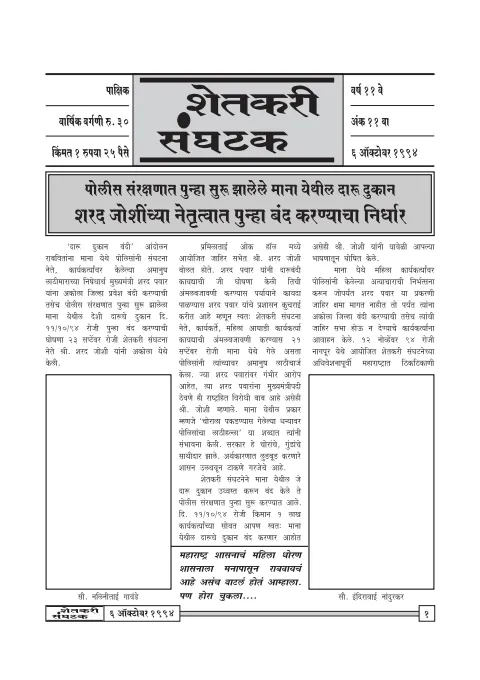
पोलीस संरक्षणात पुन्हा सुरू झालेले माना येथील दारू दुकान — शरद जोशींच्या नेतृत्वात पुन्हा बंद करण्याचा निर्धार
The lead report describes how the liquor shop at Mana, in Akola district, was reopened under police protection and how the Shetkari Sanghatana, under Sharad Joshi’s leadership, resolved to shut it down again. It recounts Joshi’s announcement (around 11 October) that the shop would be closed, the movement’s framing of the liquor trade as protected by the state at the cost of rural families and women, and the mobilisation of activists who would court arrest. Boxed lines voice women activists’ defiance — that freedom is never without pain, and that no whip of the state’s hirelings will bend them.
- Mana liquor shop reopened under police protection; movement resolves to close it again.
- Sharad Joshi leads the renewed ‘daru dukan bandi’ agitation.
- Liquor trade framed as state-protected predation on rural households and women.
- Women activists pledge to court arrest; defiance quotes boxed on the page.
स्वातंत्र्य वेदनारहित असत नाही / प्रकाश पोहरे यांचे उपोषण मागे (दारू दुकान बंदी आंदोलन वार्तापत्रे)
A cluster of dispatches from the liquor-shop-closure agitation (‘Freedom is never without pain’). It reports the police taking a contract/bribe (‘supari’) over the shop, activist Prakash Pohare withdrawing his hunger-strike, continuing arrests under the movement’s satyagraha, and a rasta-roko (road blockade) at Varkhed. The reportage stresses repression of Sanghatana workers, including women, and the movement’s insistence that the agitation will continue.
- Dispatches from the ongoing liquor-shop-closure satyagraha.
- Prakash Pohare withdraws his hunger-strike.
- Reports of arrests, a rasta-roko at Varkhed, and repression of activists.
- Frames the liquor shop as backed by a police ‘supari’ (contract/bribe).
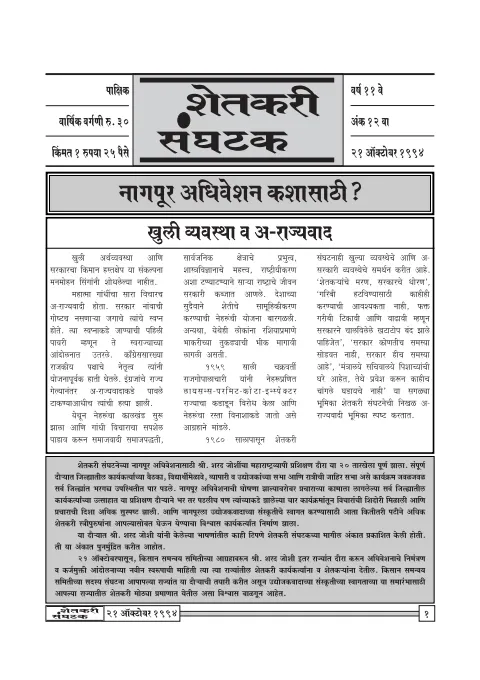
नागपूर अधिवेशन कशासाठी?
A long programmatic essay, ‘Why the Nagpur Convention?’, published as Sharad Joshi’s Maharashtra tour begins (from 20 September). It restates the Shetkari Sanghatana’s case for an open economic order and a ‘non-state’ (अ-राज्यवाद) order against the post-1947 Nehruvian socialist model, arguing that planning, bureaucracy, and political controls impoverished farmers and society. Organised under rhetorical headings — ‘How is the government?’, ‘How should the government be?’, and ‘The open order is not a stage but a path’ — it contends that an open, competitive order, not state protection, is what serves cultivators and the poor, and that experience and competition, not ideology, are the true teachers.
- Programmatic essay launching the Nagpur convention and Joshi’s Maharashtra tour.
- Defends an ‘open order’ (खुली व्यवस्था) and ‘non-statism’ (अ-राज्यवाद).
- Critiques the post-1947 Nehruvian socialist/planning model as impoverishing.
- Structured by ‘How is / how should the government be?’ headings.
- Argues the open order is a path, not a stage; experience and competition are the real teachers.
नागपूर अधिवेशन पूर्वतयारी समिती, जिल्हा औरंगाबाद
A boxed organisational notice listing the Nagpur Convention preparatory committee for Aurangabad district, naming the coordinating-committee head (Dr. Manavendra Kachole) and taluka-wise office-bearers (Khultabad, Aurangabad East/West, Gangapur, Paithan, Vaijapur, Sillod, Kannad, Aurangabad city).
- Lists the Aurangabad-district preparatory committee for the Nagpur Convention.
- Names Dr. Manavendra Kachole as coordinating-committee head.
- Gives taluka-wise office-bearers across Aurangabad district.
पदवीधरांना नव्हे, खऱ्याखुऱ्या तज्ञांना वाव
By श्री. वृधाजीराव मुळीक, स. न. वि. वि.
A signed opinion essay by Shri Vrudhajirao Mulik, ‘Scope for real experts, not degree-holders’, argues that policy and farm administration should draw on genuine practitioners and experienced cultivators rather than paper-qualified graduates. It contends that real agricultural and economic expertise lies with those who actually farm, and that the open order would reward such practical knowledge over credentialism.
- Argues real expertise, not degrees, should be given scope.
- Values practising farmers’ experiential knowledge over credentialism.
- Ties the argument to the Sanghatana’s open-order economics.
Generated by the v1.5 extraction pipeline. Awaiting editorial review.
Metadata and summary are AI-extracted from the source PDF and reviewed for editorial accuracy. The original work is available via the Read PDF tab above (where present); paragraph-level citation inside the PDF is deferred to a future engagement.