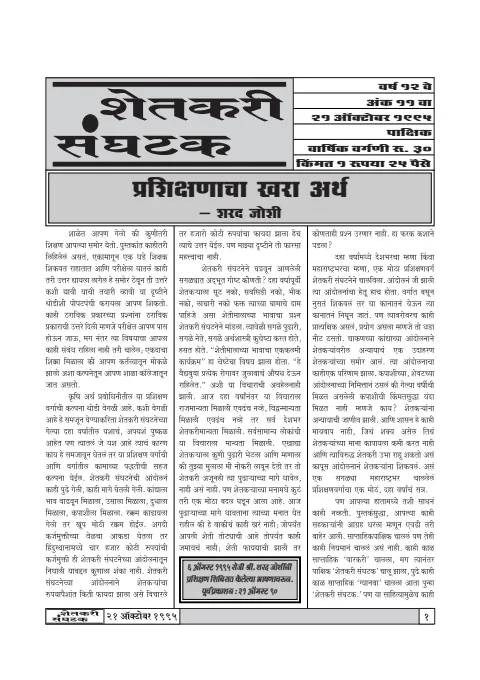
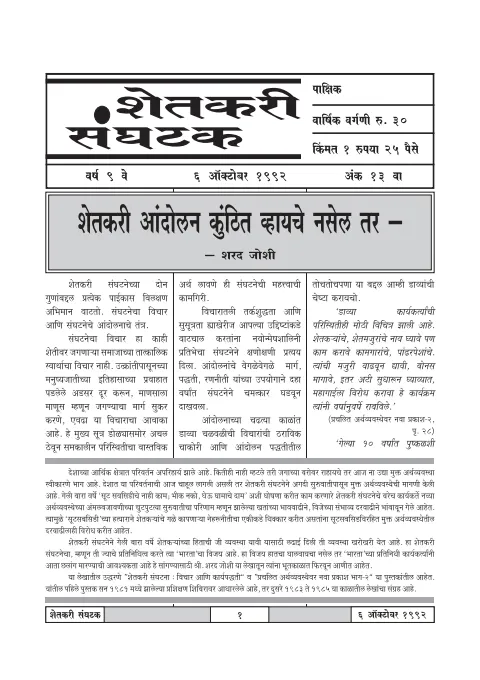
periodical issue
Shetkari Sanghatak
शेतकरी संघटक
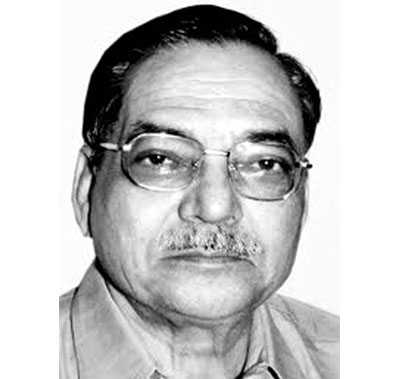
By sharad-joshi, बजरंग मलिक, sharad-joshi, स्वामी डी. डी., गोविंद जोशी, बाबूभाई जैन, sharad-joshi
पाक्षिक शेतकरी संघटक — मालक: मोहन विहारीलाल पारदेसी; संपादक, मुद्रक, प्रकाशक: सुरेशचंद्र म्हात्रे; प्रकाशन स्थळ व पत्रव्यवहाराचा पत्ता: अंगारमळा, मु.पो. आंबेठाण (४१० ५०१), ता. खेड, जि. पुणे; मुद्रण स्थळ: गणेश प्रिंटर्स, ६९३, बुधवार पेठ, पुणे - २ · Ambethan (Angarmala), Taluka Khed, District Pune · 1995
16 pages
Shetkari Sanghatak
Summary
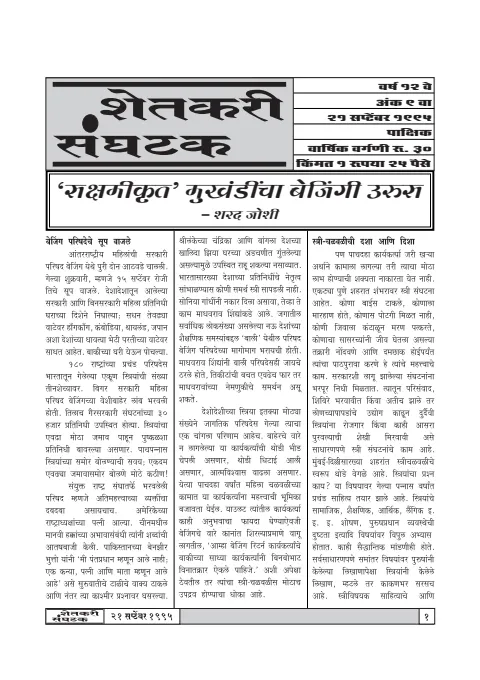
This is Year 12, Issue 9 of Shetkari Sanghatak (शेतकरी संघटक), a Marathi fortnightly newspaper of the Shetkari Sanghatana, dated 21 September 1995 and edited by Sharad Joshi. The issue is anchored by two Sharad Joshi editorials — a long polemical essay reading the just-concluded Beijing UN Women’s Conference as an elite NGO carnival that bypasses the working peasant woman, and a sharp attack on the Nehruvian land-ceiling regime as a fraud sold in the name of land reform. Around these sit a translated companion piece on Beijing by Vasudev Malik, a serialised Marathi translation of George Orwell’s Animal Farm (chapter ‘स्वराज्य अवतरले’) by Meghan Mudholkar, Govind Joshi’s field report on the breakdown of the Maharashtra cotton monopoly procurement scheme, an organisational notice listing the newly appointed district chiefs (jilhapramukhs) of the Sanghatana, advertisements for the Krishi Arth Prabodhini training camps, a long reportage on a bold woman sarpanch facing local goons and a passive administration, a poem ‘हिव’ by Swami D. D., and birthday thanks from Sharad Joshi himself. The issue’s argumentative centre is a classical-liberal/agrarian-reform critique of state planning, controlled markets and elite-led ‘empowerment’ discourse, with the recurring slogan in a boxed insert: ‘मुक्त अर्थव्यवस्था येत आहे, तिला कोणीही थांबवू शकणार नाही.‘
Key points
-
This Year 12, Issue 9 of the Marathi fortnightly Shetkari Sanghatak, dated 21 September 1995 and edited by Sharad Joshi, is anchored by two Joshi editorials on the Beijing Women’s Conference and the Nehruvian land-ceiling regime.
-
Joshi’s lead editorial reads the Fourth UN World Conference on Women, which concluded in Beijing on 15 September 1995 with some 140 government delegations and roughly 30,000 NGO representatives at the parallel Huairou meet, as an elite carnival bypassing the ordinary working woman.
-
He contrasts urban, reservation-bred women’s leadership with the organic emergence of the Shetkari Mahila Aghadi within the farmers’ movement, arguing that borrowed Western ‘empowerment’ vocabulary diverts attention from land, property and market reform.
-
In a second editorial Joshi attacks the Nehruvian land-ceiling regime as a fraud sold to the country in the name of land reform.
-
Vasudev Malik translates a companion piece from the Indian Express of 6 September 1995, written as a letter from rural Indian women to Beijing-bound delegates contrasting monsoon village life with the comfort of conference halls.
-
The issue serialises Meghan Mudholkar’s Marathi translation of George Orwell’s Animal Farm, running its second chapter in which the pigs systematise old Major’s ideas into Animalism and the animals spontaneously drive Mr Jones off the farm.
-
Govind Joshi files a field report on the breakdown of the Maharashtra cotton monopoly procurement scheme, and the issue also carries reportage on a woman sarpanch confronting local goons and a passive local administration.
-
A boxed insert repeats the recurring slogan that the free economy is coming and cannot be stopped, alongside a poem by Swami D. D. and Sharad Joshi’s own note of thanks for birthday greetings.
Essays
’सक्षमीकृत’ मुखंडींचा बेजिंगी उरूस
By शरद जोशी
Sharad Joshi’s lead editorial reads the Fourth UN World Conference on Women, just concluded in Beijing on 15 September 1995, as a fortnight-long ‘urus’ (carnival) of self-styled empowered ‘mukhandis’ (lady-leaders). He notes the staggering scale — 140 government delegations, about 30,000 NGO representatives at the parallel Huairou meet — and the elaborate diplomatic theatre around even letting the NGOs in, but argues that none of this reached the actual condition of the ordinary working woman, especially the peasant and Dalit woman in India. He contrasts the ‘socialist’ wave of urban educated and reservation-bred women’s leadership with the spontaneous emergence of the Shetkari Mahila Aghadi within the farmers’ movement, and warns that the borrowed western vocabulary of ‘empowerment’ (सक्षमीकरण) is being used to redirect the women’s question away from the genuine economic and ownership questions that the agrarian movement has placed at the centre. He insists that real progress for women requires opening up the economy, securing property in land for women, and freeing the family farm — not more conference resolutions or quota politics.
- Frames the Beijing conference as a fortnight ‘urus’ (festival) of self-described ‘empowered’ women leaders rather than a working-women’s forum.
- Cites 140 country delegations and roughly 30,000 NGO representatives at the parallel Huairou meet to underline its scale and the diplomatic theatre around access.
- Argues the conference rhetoric leaves the actual peasant, Dalit and ordinary working woman in India entirely untouched.
- Contrasts urban, reservation-bred socialist women’s leadership with the organic emergence of the Shetkari Mahila Aghadi within the farmers’ movement.
- Reads the imported vocabulary of ‘empowerment’ (सक्षमीकरण) as a device to deflect the women’s question away from property, land and market reform.
- Holds that genuine progress for women depends on opening the economy and securing land and ownership rights for women within the family farm.
तुम्ही बेजिंगला जाल तेव्हा…
By बजरंग मलिक यांच्या Indian Express दि. ६/९/१९९५ मधील लेखाचा अनुवाद
A short companion piece titled ‘तुम्ही बेजिंगला जाल तेव्हा…’ (‘When you go to Beijing…’), translated into Marathi by Vasudev Malik from an Indian Express article of 6 September 1995. The piece, written in the voice of rural Indian women addressing the well-heeled delegates leaving for Beijing, lists everything those delegates will miss about ordinary village life — monsoon rains, the kicks of a calf, the smell of fresh earth, the rasping calls of crickets — while they fly through jet-bridges, sit in air-conditioned halls and debate women’s rights in the abstract. It closes by reminding the delegates that the very water, air, soil and food that keep them alive come from the village women they claim to represent.
- Cast as a letter from rural Indian women to those leaving for the Beijing conference.
- Catalogues sensory detail of the monsoon village — rain, calves, fresh earth, crickets — that the delegates will miss.
- Contrasts that texture with the comfort of air travel, conditioned halls and conference-speak.
- Reminds delegates that their material existence depends on the village women they purport to speak for.
- Translated by Vasudev Malik from an Indian Express piece of 6 September 1995.
जनावरांचे शिवार — २. स्वराज्य अवतरले (जॉर्ज ऑरवेल यांच्या Animal Farm चे भाषांतर)
By श्री. रमेश मुधोळकर (१९८५)
Under the standing rubric ‘जनावरांचे शिवार’ (‘The Animals’ Field’), the issue carries Chapter 2, ‘स्वराज्य अवतरले’ (‘Self-rule arrives’), of a Marathi translation of George Orwell’s Animal Farm (1945) by Meghan Mudholkar. The chapter narrates the death of old Major three nights after his prophetic speech, the secret meetings through January and February in which the pigs — chiefly Napoleon, Snowball and Squealer — systematise his ideas into ‘Animalism’, and the sudden, unplanned revolution that breaks out when the drunk Mr Jones forgets to feed the animals. The animals drive Jones and his men off the farm, ceremonially destroy the harnesses, whips and slaughtering tools, rename Manor Farm as ‘Animal Farm’, and the seven commandments of Animalism are painted in white on the barn wall. The chapter ends with the cows being milked for the first time under the new regime and the milk mysteriously disappearing by evening.
- A serialised Marathi translation of George Orwell’s Animal Farm (1945) by Meghan Mudholkar; this instalment is Chapter 2.
- Old Major dies three nights after his speech; the pigs codify his teaching into ‘Animalism’ through secret winter meetings.
- Napoleon, Snowball and Squealer emerge as the intellectual leadership; Napoleon is described as fierce, Snowball as quick and inventive, Squealer as a persuasive talker.
- The revolution erupts spontaneously when Jones, drunk, neglects to feed the animals and they break into the store-shed.
- Jones and his men are driven off, instruments of cruelty are destroyed, the farm is renamed ‘Animal Farm’, and the Seven Commandments are painted on the barn.
- The chapter closes with the unexplained disappearance of the day’s milk — a quiet seed of the betrayal to come.
जमीन सुधारणेचे भाट
By शरद जोशी
In ‘जमीन सुधारणेचे भाट’ (‘The bards of land reform’), Sharad Joshi dissects the 71st Constitutional Amendment introduced in the Rajya Sabha on 21 August 1995, which adds yet more land-ceiling and tenancy laws to the Ninth Schedule and shields some 300 such statutes from judicial review. He argues that the entire body of post-1950 land legislation has been a Nehruvian socialist fraud: ceiling laws hollowed out the productive farmer without ever delivering a meaningful redistribution to the landless, ruined agriculture by capping farm size below viability, and entrenched a bureaucracy of land-record clerks and tehsildars who became the real masters of the village. He insists that the original socialist case for ceilings has collapsed in theory and in practice, that fifty percent of the laws now being protected post-date the 1991 liberalisation and were enacted purely to harass farmers, and that Nehru’s pet ‘दारिद्रय नारायण’ rhetoric created the very poverty it claimed to fight. The essay closes by demanding that all such laws be reviewed on first principles instead of being immunised from the courts.
- Targets the 71st Constitutional Amendment moved on 21 August 1995, which protects roughly 300 land-ceiling and tenancy laws from judicial review.
- Argues that ceiling laws never delivered serious redistribution to the landless and instead destroyed productive farming.
- Charges that the laws empowered the village clerk-and-tehsildar establishment rather than the cultivator.
- Claims half of the laws now being shielded post-date 1991 liberalisation and exist only to harass farmers.
- Reads Nehru’s ‘दारिद्रय नारायण’ (poverty-deity) rhetoric as the original engine of state-manufactured poverty.
- Demands that the legislation be re-examined from first principles rather than placed beyond the courts.
हिव (कविता)
By स्वामी डी. डी., उदगीर, जि. लातूर
A short Marathi poem ‘हिव’ (‘Frost’) by Swami D. D. of Udgir, Jila Latur, set in a boxed insert on page 10. In eight rhymed verses it sketches a peasant household waking at dawn to a hard frost: the cattle bellowing in the byre, the children sent off to school, the wife husking and grinding grain, the standing crops shrivelling in the cold, and the farmer himself standing in the field with thin clothes wrapped around him, watching his year’s labour freeze.
- Eight-verse Marathi poem on a frost-bound peasant morning.
- Domestic detail: cattle, the wife’s grain work, children leaving for school.
- Agrarian detail: shrivelled standing crop, ruined yield, hard cold on the farmer’s body.
- Signed by Swami D. D., Udgir, Jila Latur.
कापसाचा एकाधिकार मोडला, राज्यबंदी मोडली त्या गावात काय चाललंय?
By गोविंद जोशी, सेलू, जि. परभणी
Govind Joshi reports from Sevu, district Parbhani, on the consequences of breaking the Maharashtra cotton monopoly procurement scheme (एकाधिकार खरेदी योजना). For two years he tracks how the international price of cotton, which had fallen to Rs 4500 per quintal in 1994–95, recovered, but the Maharashtra scheme refused to pass on the rise; growers held out, sold across the state border into neighbouring procurement zones, and forced the price up. The article supplies a long, numbered field-list of fifty visible changes the price recovery produced in the cotton villages — specialist shops opening, new tractors and pumps, more children put through M.B.B.S., dispensaries seeing more elderly and women patients, ornaments and saris bought, even rising sales of cassettes, video and cigarettes — alongside an admission that traders too profited and that a parallel illegal cotton trade has now sprung up. The takeaway, framed in a boxed insert, is the slogan: ‘मुक्त अर्थव्यवस्था येत आहे, तिला कोणीही थांबवू शकणार नाही.’ — the free market is coming and no one can stop it.
- Datelined from Sevu, Jila Parbhani; tracks cotton prices over two years (1994–95 to 1995–96).
- Argues the state monopoly scheme tried to suppress the international price recovery but failed once farmers smuggled cotton out of state.
- Provides a numbered field-list of about fifty observed village-level changes from the price recovery.
- Welfare changes include new clinics, school admissions, dental and medical visits, household repairs, women’s purchases.
- Notes parallel rise of illegal trade and trader profiteering as honest features of a price-led, not scheme-led, recovery.
- Closes with the slogan that the free economy is coming and cannot be stopped.
दारिद्र्य निर्मूलनाच्या नावाखाली आणखी लुटीचे कारस्थान?
By बाबूभाई जैन, अकोलवेगा
A page-13 left-column piece reproduces Sharad Joshi’s statement (carried in Lokmat of 18 September 1995) attacking the Centre’s announcement of a fresh Rs 10,000-crore corpus, the ‘दारिद्रय निर्मूलन कार्यक्रम’, as the latest instalment of a Nehru–Indira tradition of using the rhetoric of poverty alleviation to set up further loot. The piece argues that the Congress’s own development model — what Joshi calls ‘दारिद्रय नारायण परिस्थितीची सुधारणेची देशाचा विकास अवळंबून आहे’ — has manufactured the very destitution it now promises to abolish, that the corpus will be funnelled through the same machinery that has failed for forty years, and that the Prime Minister’s framing is a deliberate diversion from the unfinished work of dismantling the controlled economy. Two pointed questions are posed: who will run this programme, and what will rural producers gain if the production-side discrimination against agriculture continues?
- Reproduces Joshi’s Lokmat statement of 18 September 1995 attacking a new Rs 10,000-crore poverty-alleviation corpus.
- Reads the announcement as continuous with the Nehru–Indira tradition of poverty rhetoric as cover for fresh patronage.
- Charges that the Congress ‘दारिद्रय नारायण’ model has manufactured the poverty it now promises to abolish.
- Demands clarity on who will administer the programme and whether discrimination against agricultural producers will end.
- Frames the announcement as a diversion from the unfinished agenda of dismantling the controlled economy.
शेतकरी संघटना जिल्हाप्रमुख (organisational announcement listing 23 district heads)
An organisational notice on the right column of page 13, signed by Bachhubhai Jain of Akiwahan, lists the 23 newly appointed one-year district chiefs (जिल्हाप्रमुख) of the Shetkari Sanghatana across Maharashtra, appointed under the joint direction of president Shri Shankar Dhondge and Shetkari Mahila Aghadi president Smt. Indrabai Patil. Districts named include Nanded, Latur, Beed, Usmanabad, Parbhani, Aurangabad, Jalna, Solapur, Sangli, Kolhapur, Ahmednagar, Nashik, Dhule, Jalgaon, Buldhana, Akola, Amravati, Wardha, Nagpur, Bhandara, Gadchiroli, Chandrapur and Yavatmal. The notice flags that an inaugural orientation camp for all 23 chiefs will be held jointly with the Krishi Arth Prabodhini training camp from 2–11 October 1995.
- Lists 23 newly appointed one-year district chiefs of the Shetkari Sanghatana.
- Appointments made jointly by Shankar Dhondge (president) and Indrabai Patil (Shetkari Mahila Aghadi president).
- Covers Marathwada, Khandesh, western Maharashtra, Vidarbha and the Konkan districts.
- Orientation camp scheduled with the Krishi Arth Prabodhini camp, 2–11 October 1995.
- Signed by Bachhubhai Jain of Akiwahan.
कृषि अर्थ प्रबोधिनी प्रशिक्षण शिबिरे (training-camp notice with enrolment form)
A page-14 announcement of the Krishi Arth Prabodhini training camps (कृषि अर्थ प्रबोधिनी प्रशिक्षण शिबिरे) to be held at the open-economy study centre (खुल्या अर्थव्यवस्थेला केंद्रवाणी) at Angarmal, Khed, Pune. The first camp from 2 October trains all district chiefs and select activists; a second runs 21–30 October and a third 6–15 / 21–30 November. The text explains that prior camps have drawn many enquiries but that the screening process is detailed: candidates must read foundational material, accept travel and stipend rules, and pay a camp fee of Rs 250. A full registration form (with fields for name, address, phone, Sanghatana position, education, occupation, family responsibility, language ability in Marathi/Hindi/English, and prior training) is reproduced on the right half of the page.
- Announces training camps at the Krishi Arth Prabodhini centre, Angarmal, Khed, Pune.
- First camp from 2 October 1995 for district chiefs and selected activists.
- Two further camps, 21–30 October and 6–15 / 21–30 November.
- Camp fee is Rs 250; participants must read prescribed material in advance.
- Page reproduces the full registration form (nav, patta, phone, position, education, occupation, language, prior training).
धीट महिला सरपंच, गुंड पुढारी, नाकर्ते प्रशासन आणि थंड जनता
A long reportage across pages 15–16 titled ‘धीट महिला सरपंच, गुंड पुढारी, नाकर्ते प्रशासन आणि थंड जनता’ (‘A bold woman sarpanch, goon-leader politicians, an incapable administration and an indifferent public’) follows the case of Smt. Vatsala-bai, the elected woman sarpanch of Tilsekhardurg in Ambheghai taluka, who is harassed by local Congress-aligned strongmen demanding she resign her seat. The article documents threats, an attempted forced submission of her resignation, a beating of women activists who came to support her, and the local police’s refusal to register cases against the named accused (Kedar, Sitabai, Bhure, Arjunrao Khar, Gadiwan and others). It records a panchayat meeting on 21 August 1995 at which 30 percent reservation for women was reaffirmed, the gram sabha’s resolution of support, and the failure of the district administration to act despite repeated representations. The piece reads the episode as a stress-test of the rural reservation experiment under the 73rd Amendment and a case study of how ‘goonda raj’ captures elected women’s seats.
- Centres on Smt. Vatsala-bai, woman sarpanch of Tilsekhardurg, Ambheghai taluka.
- Documents threats, a forced-resignation attempt and a beating of women activists who came in support.
- Names the local Congress-aligned faction (Kedar, Sitabai, Bhure, Arjunrao Khar) and the police’s refusal to act.
- Records the gram sabha’s resolution of support and the panchayat meeting of 21 August 1995 reaffirming women’s reservation.
- Reads the episode as a stress-test of the 73rd Amendment’s promise of women’s panchayat reservation.
- Frames the failure as a combination of goon politics, incapable administration and an indifferent public.
वाढदिवस शुभेच्छा — जाहीर आभार (open thank-you note for birthday wishes, dated १० सप्टेंबर १९९५)
By शरद जोशी
A short page-16 note, ‘वाढदिवस शुभेच्छा - जाहीर आभार’, in which Sharad Joshi publicly thanks the many farmer sympathisers, hitchintaks, well-wishers and other supporters across Maharashtra and beyond who sent him birthday greetings — by telegram, postcard, phone and letter — and who marked his birthday with messages of solidarity to the farmers’ movement. Joshi notes that he cannot reply individually to every greeting and offers a collective acknowledgement and pledge to remain in the service of the movement. Signed ‘आपला, शरद जोशी’ and dated 10 September 1995.
- Sharad Joshi’s public thank-you note for birthday greetings received from across Maharashtra and beyond.
- Acknowledges greetings by telegram, postcard, phone and letter.
- Frames the personal occasion as a moment of renewed pledge to the farmers’ movement.
- Signed and dated 10 September 1995.
Generated by the v1.5 extraction pipeline. Awaiting editorial review.
Metadata and summary are AI-extracted from the source PDF and reviewed for editorial accuracy. The original work is available via the Read PDF tab above (where present); paragraph-level citation inside the PDF is deferred to a future engagement.