speech
SOME CONTRADICTIONS IN THE PLAN
THE FORUM OF FREE ENTERPRISE, "Sohrab House", 235, Dr. Dadabhai Naoroji Road, BOMBAY 1. · Bombay · 1956
4 pages
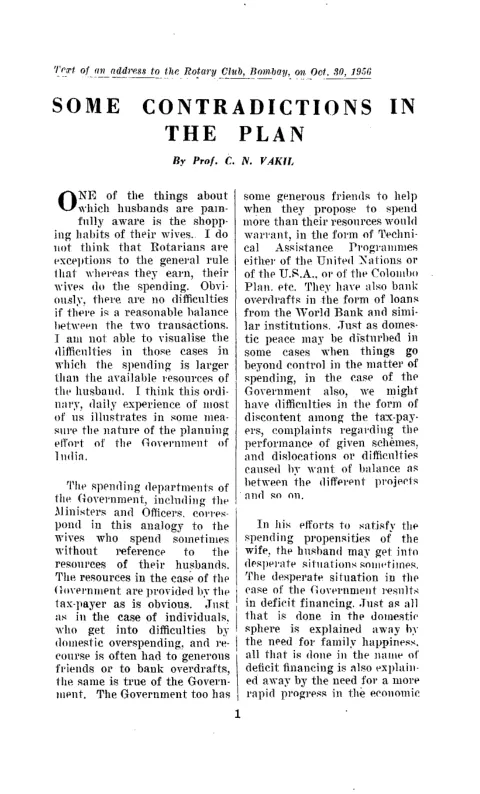
SOME CONTRADICTIONS IN THE PLAN
By Prof. C. N. VAKIL
Summary
Prof. C. N. Vakil’s October 30, 1956 address to the Rotary Club of Bombay diagnoses what he sees as a series of internal contradictions in the Government of India’s planning effort. He opens with an extended domestic analogy: just as a husband who outspends his income runs to generous friends or to bank overdrafts, the Government overspends its tax revenues and resorts to loans from the World Bank, Technical Assistance from the United Nations and the United States, and the Colombo Plan, while at home it papers over the shortfall with deficit financing. The visible symptoms — taxpayer discontent, complaints about the performance of schemes, dislocations between projects — flow, in his reading, from a basic want of balance.
The body of the talk identifies two specific contradictions inside the Plan itself. The first is the neglect of agriculture as the supplier of food and raw materials for the industrial worker in the towns. Unless the farmer can both feed himself and generate a surplus, industrial growth cannot be sustained; agriculture, Vakil insists, must be made not merely economically sound but prosperous if industry is to advance. The second is the simultaneous push for heavy industry and cottage industry: energy and resources diverted into artificially maintained cottage units — to fill, for example, the mill-cloth vacuum the Plan itself created — undercut the very abundance of consumer goods that the Plan claims as its goal, and produce only the appearance of employment gains.
Vakil closes on the question of price controls. Where the Plan tries to suspend the laws of demand and supply by physical controls without the social discipline such controls require, higher prices, internal difficulties and widespread discontent will upset the calculations of most of the Plan’s schemes. The taxpayer, he warns, will find himself squeezed to the bone — his position worse, in the speech’s parting line, than that of the husband who at least had the consolation of having pleased his wife.
Key points
-
Vakil frames the Government’s financial conduct through a domestic analogy: like an overspending husband, it leans on ‘generous friends’ — the World Bank, UN and US Technical Assistance Programmes, and the Colombo Plan — to bridge its shortfalls.
-
He identifies deficit financing as the ‘desperate situation’ equivalent of the household running into the red, and argues it lies behind the visible discontent among taxpayers and the dislocations between projects.
-
Industrial growth in India, in his view, cannot be achieved by neglecting agriculture; the farmer must produce both his own requirements and a marketable surplus for the towns, and agriculture must be made not merely sound but prosperous.
-
He flags the Plan’s simultaneous emphasis on heavy industries and on cottage industries as ‘an inherent contradiction’ — artificially propping up cottage units to fill vacuums (such as in mill-cloth) the Plan itself created cannot be economically justified.
-
Resource diversion to cottage industries, he warns, produces only the ‘supposed gains’ of employment, with the ultimate gain in income lower than the low wage employment afforded to those in the cottage sector.
-
He treats the Plan’s eight-million non-agricultural employment target as approximately the size of the additional workforce that population growth will create — leaving existing unemployment, partial employment and chronic disguised unemployment untouched.
-
The closing argument attacks physical price controls: governments do not like such controls, and unless India develops the social discipline they require, higher prices and widespread discontent will upset the Plan’s calculations.
-
Vakil’s parting image is that the taxpayer who pays for these contradictions will end up ‘squeezed to the bone’ — worse off than the spendthrift husband who at least pleased his wife.
Generated by the v1.5 extraction pipeline. Awaiting editorial review.
Metadata and summary are AI-extracted from the source PDF and reviewed for editorial accuracy. The original work is available via the Read PDF tab above (where present); paragraph-level citation inside the PDF is deferred to a future engagement.