occasional paper · statement of principles
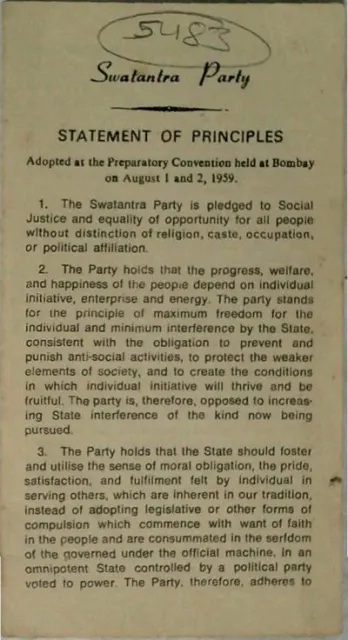
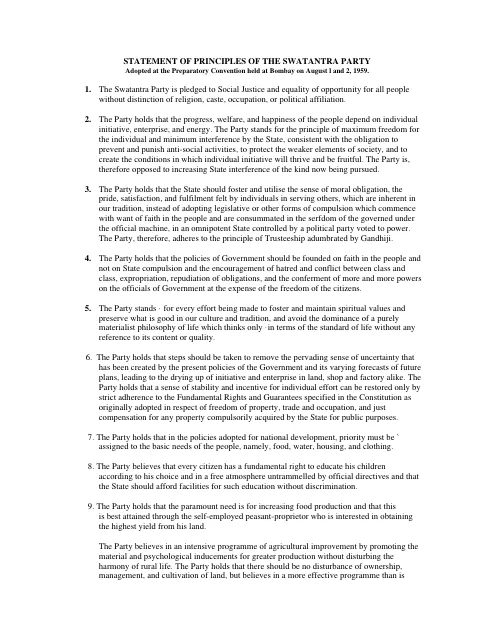
STATEMENT OF PRINCIPLES OF THE SWATANTRA PARTY
Adopted at the Preparatory Convention held at Bombay on August 1 and 2, 1959.
The Swatantra Party · Bombay · 1959
3 pages
Part of Swatantra Party
STATEMENT OF PRINCIPLES OF THE SWATANTRA PARTY
Summary
Adopted at the Swatantra Party’s Preparatory Convention in Bombay on August 1 and 2, 1959, this Statement of Principles sets out the twenty-one foundational planks of the new party in a numbered, declarative form. The opening clauses commit the party to social justice and equality of opportunity without distinction of religion, caste, occupation, or political affiliation, while staking out the party’s defining position: maximum freedom for the individual and minimum interference by the State, with state action confined to preventing anti-social activity, protecting the weaker sections, and creating conditions in which private initiative can be fruitful. The document explicitly opposes the trajectory of “increasing State interference of the kind now being pursued,” and frames its alternative around the Gandhian principle of Trusteeship rather than State compulsion.
The middle clauses translate this anti-statist frame into concrete economic positions. The party calls for restoring stability and incentive through strict adherence to the Fundamental Rights as originally adopted — including freedom of property, trade, and occupation, and just compensation for property compulsorily acquired. It prioritises food, water, housing, and clothing as the basic needs to be met, defends the self-employed peasant-proprietor against collectivisation and bureaucratic management of the rural economy, and demands remunerative and steady prices for agricultural produce. On industry, it endorses competitive enterprise with safeguards for labour, restricts state enterprise to heavy industries and services like Railways that supplement private effort, and opposes the State entering trade and disturbing free distribution. Clauses on taxation, deficit financing, foreign loans, inflation, and the cost of public administration warn against “crippling taxation,” “abnormal deficit financing,” and the expansion of the bureaucratic machine.
The closing clauses articulate the party’s civic and constitutional commitments: decentralised industrial distribution, full and lasting employment through balanced industrialisation, a fair deal for labour with the right to organise, and harmonisation of capital and labour. Principle 19 commits the party to “the rule of law, an independent judiciary, and for the full play of the powers of judicial review given to the Courts by the Constitution,” while opposing political pressure on officials. Principle 20 binds the party to “the cardinal teachings of Gandhiji,” and the concluding Principle 21 reserves to members “full liberty on all questions not falling within the scope of the Principles stated above,” framing internal pluralism as itself a democratic value.
Key points
-
The Statement was adopted at the Swatantra Party’s Preparatory Convention in Bombay on August 1 and 2, 1959, and is organised as twenty-one numbered principles.
-
Principle 2 sets the party’s core frame: maximum freedom for the individual and minimum interference by the State, with explicit opposition to “increasing State interference of the kind now being pursued.”
-
Principle 3 invokes Gandhiji’s Trusteeship doctrine as the alternative to the “omnipotent State controlled by a political party voted to power.”
-
Principles 6 and 9 defend property rights and the self-employed peasant-proprietor, opposing collectivisation and bureaucratic management of the rural economy and demanding just compensation for compulsorily acquired property.
-
Principles 10–11 confine state enterprise to heavy industries and services such as Railways that supplement private effort, and oppose state entry into trade and the resulting “controls and official management with all its wastefulness and inefficiency.”
-
Principles 12–15 warn against crippling taxation, abnormal deficit financing, foreign loans beyond capacity to repay, and inflation that erodes savings and fixed incomes, while calling for reduced cost of public administration.
-
Principle 19 commits the party to the rule of law, an independent judiciary, and the full play of judicial review under the Constitution, opposing political pressure on officials.
-
Principle 21 grants members full liberty on questions outside the Fundamental Principles, framing internal freedom of opinion as itself a democratic commitment.
Generated by the v1.5 extraction pipeline. Awaiting editorial review.
Metadata and summary are AI-extracted from the source PDF and reviewed for editorial accuracy. The original work is available via the Read PDF tab above (where present); paragraph-level citation inside the PDF is deferred to a future engagement.