edited volume · proceedings
The Bombay Plan & Other Essays
Second A. D. Shroff Memorial Lectures delivered under the auspices of Forum of Free Enterprise
Lalvani Publishing House, Bombay * Calcutta * New Delhi * Madras. Printed by S. R. Sawant at Ashok Printing Press, Khetwadi Main Road, Bombay 4, and published by S. P. Lalvani, Lalvani Publishing House, 210, Dr. D. N. Road, Bombay 1. · Bombay · 1968
50 pages
Part of A. D. Shroff Memorial Lecture
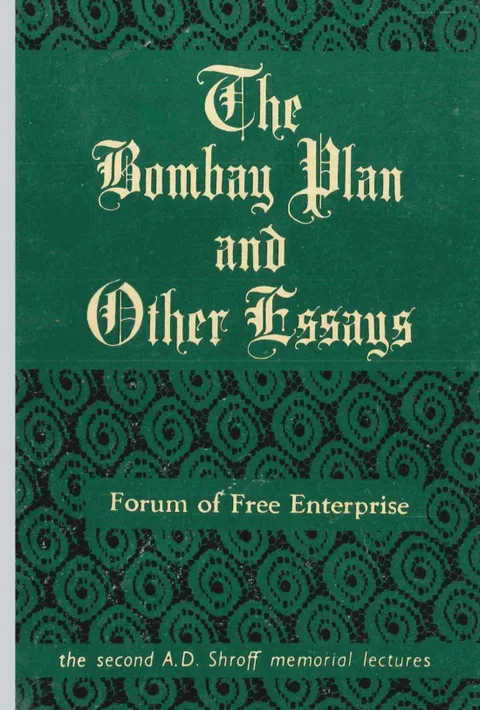
The Bombay Plan & Other Essays
Summary
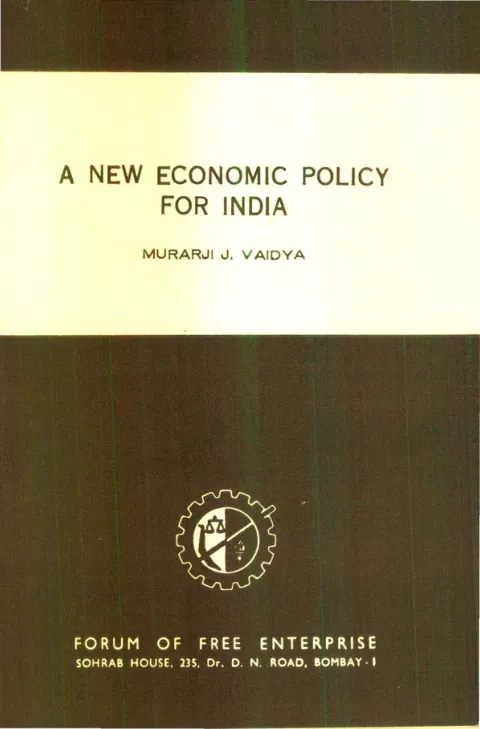
The Bombay Plan and Other Essays (Lalvani Publishing House, 1968) collects the Second A. D. Shroff Memorial Lectures, delivered on 27 October 1967 under the auspices of the Forum of Free Enterprise to honour the memory of A. D. Shroff, who had founded the Forum in 1956. Six contributors — H. V. R. Iengar (a former Governor of the Reserve Bank of India), V. B. Karnik (veteran trade unionist and associate of M. N. Roy), Dr. B. C. Ishwardas, Sudhanshu Kumar Basu, M. V. Arunachalam and A. K. Chanda — address controversies of the late 1960s: the Bombay Plan in retrospect, the wave of gheraos in Bengal, benevolence in business, Centre-State financial relations, a new concept of capitalism, and the public sector. An introduction signed by Murarji J. Vaidya, President of the Forum, situates the lectures as a continuation of Shroff’s effort to take economic argument to the ordinary citizen.
Key points
-
The volume collects the Second A. D. Shroff Memorial Lectures, delivered 27 October 1967 under the Forum of Free Enterprise to honour Shroff, who founded the Forum in 1956, with an introduction by Forum president Murarji J. Vaidya.
-
H. V. R. Iengar, a former Reserve Bank of India Governor, argues the 1944 Bombay Plan and the Planning Commission’s later plans share the same basic philosophy of a mixed economy with state-led heavy industry and foreign capital.
-
Iengar locates the real divergence in the space allowed to private enterprise against an expanding public sector, and in the rigour of controls over prices, profits, dividends and foreign exchange.
-
He attributes Shroff’s later disenchantment to the growth of a ‘monolithic’ Congress, intolerance of dissent, and the rhetorical turn toward a ‘Socialist Pattern of Society’ that foreclosed the entrepreneurial spirit the Bombay Plan had assumed.
-
He defends the Forum of Free Enterprise’s position that laissez-faire has no place in contemporary India but that a planned economy must still be powered by free enterprise voluntarily co-operating with the state.
-
V. B. Karnik, a veteran trade unionist and associate of M. N. Roy, treats the wave of gheraos that engulfed Bengal under the 1967 United Front ministry as fundamentally an economic problem, not merely a law-and-order issue.
-
Karnik documents gheraos spreading from factories into offices, schools and municipal boards, and shows the United Front’s Labour Minister instructed police not to intervene without ministerial sanction.
-
He cites the Calcutta High Court’s Full Bench judgment by Chief Justice D. N. Sinha, which defined a gherao as a physical blockade incapable of qualifying as legitimate trade-union activity.
-
Karnik argues gheraos are typically staged by small militant groups rather than the mass of workers, and that the concessions they extract are quickly repudiated, undermining established trade unions in the long run.
Essays
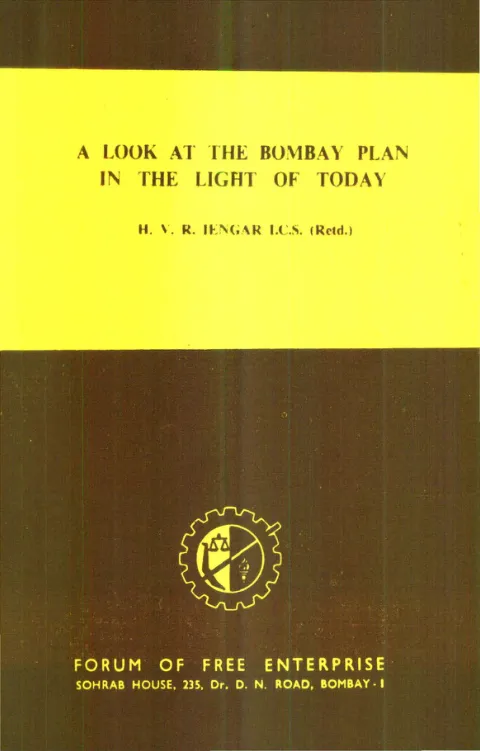
A Look at the Bombay Plan in the Light of Today
By H. V. R. Iengsr
H. V. R. Iengar, opening the Bombay lecture as a former Governor of the Reserve Bank, recalls that he broke the convention of central-bank silence to warn against the inflationary direction of fiscal policy, and explains that A. D. Shroff did the same on a wider front from outside Government. He then turns to the 1944 Bombay Plan, of which Shroff was a co-author, and asks how its assumptions look from 1967. His central claim is that the basic resemblance between the Bombay Plan and the work of the Planning Commission is strong — both rest on a mixed economy with heavy industry, a strong State role, foreign capital, and deficit financing — and that the truly decisive difference is one of degree: the scope conceded to private enterprise versus an expanding public sector, and the rigour with which controls are applied to prices, profits, dividends and foreign exchange.
Iengar reads Shroff’s later disenchantment as a response to the way Indian controls, the Congress’s drift toward a ‘monolithic’ party form, and the rhetorical ‘Socialist Pattern of Society’ progressively foreclosed the entrepreneurial spirit the Bombay Plan had assumed. He defends the Forum of Free Enterprise’s manifesto position that ‘laissez faire’ has no place in contemporary India but that a planned economy must still be powered by free enterprise, voluntarily co-operating with the State. He closes with a stark choice between forces that believe in property rights, the rule of law and evolutionary progress, and forces that believe in expropriation, lawlessness and revolution through chaos, registering himself as a guarded optimist about Indian democracy’s capacity to choose the first.
- Iengar frames the lecture by recalling his own break with the convention of Reserve Bank Governors avoiding public criticism of Government economic policy, a posture he ties to Shroff’s lifelong willingness to speak out.
- He argues the Bombay Plan (1944) and the Planning Commission’s plans share their underlying philosophy: mixed economy, state-led heavy industry, foreign capital and controlled deficit financing.
- The real divergence between Shroff’s later position and the Planning Commission, he says, lies in two things — the space given to private enterprise versus a vastly expanding public sector, and the rigour and reach of controls.
- He attributes Shroff’s later despair to the growth of a ‘monolithic’ Congress, intolerance of dissent, and the move toward a rhetorical ‘Socialist Pattern of Society’.
- He defends the Forum of Free Enterprise’s manifesto: ‘laissez faire’ is dead, but a planned Indian economy must be powered by free enterprise voluntarily co-operating with the State.
- He closes by contrasting forces of property rights, rule of law and evolution with forces of expropriation, lawlessness and revolutionary chaos, casting his lot — cautiously — with the first.
Gheraos
By V. B. Karnik
V. B. Karnik, a veteran trade unionist and close associate of M. N. Roy, devotes his lecture to the wave of gheraos that engulfed Bengal under the United Front ministry in 1967. He insists that the gherao, although a problem of law and order in form, is in substance an economic problem arising out of a particular phase of employer-employee relations. He narrates how the practice spread from individual factories to offices, schools, colleges and municipal boards, and how Ministers of the Left wing of the United Front (notably the Labour Minister) effectively instructed the police not to intervene without ministerial sanction.
Karnik draws heavily on contemporary press reports and on the Calcutta High Court’s Full Bench judgment, delivered by Chief Justice D. N. Sinha, which defined a gherao as the physical blockade of a target by encirclement or forcible occupation and held it incapable of being a legitimate trade-union activity. Karnik argues that gheraos are typically staged not by the mass of workers but by small militant groups posing as champions of workers’ interests, that the ‘concessions’ so secured are quickly repudiated, and that the long-run effect is to undermine established trade unions and the patient long-term work on which they depend.
- Karnik treats the gherao as fundamentally an economic problem within employer-employee relations, not merely an issue of public order.
- He documents the spread of gheraos in Bengal from March 1967 onward — including a phase when, by one account, five gheraos a day were taking place — and their movement from factories into offices, schools and municipal bodies.
- He shows that the United Front’s Labour Minister explicitly directed the police not to intervene in ‘legitimate’ trade-union action without prior ministerial reference, effectively shielding gheraos from criminal-law enforcement.
- He summarises the Calcutta High Court Full Bench judgment of Chief Justice D. N. Sinha, which defined a gherao as a physical blockade incompatible with the law of the land and outside the protection of the Trade Unions Act.
- He argues that gheraos undermine established trade unions because they are staged by small militant groups, displace patient long-term bargaining and erode workers’ confidence in their own organised strength.
Generated by the v1.5 extraction pipeline. Awaiting editorial review.
Metadata and summary are AI-extracted from the source PDF and reviewed for editorial accuracy. The original work is available via the Read PDF tab above (where present); paragraph-level citation inside the PDF is deferred to a future engagement.