edited volume · anthology
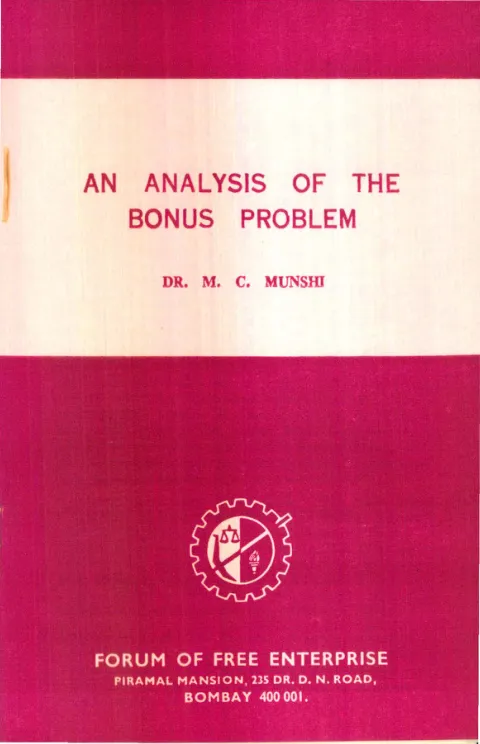
The Bonus Problem
FORUM OF FREE ENTERPRISE, SOHRAB HOUSE, 235 DR. D. N. ROAD, BOMBAY-1 · Bombay · 1972
23 pages
The Bonus Problem
Summary
The Bonus Problem is a Forum of Free Enterprise pamphlet collecting three talks delivered in Bombay and Bangalore in July 1972 by Y. D. Joshi (Chief Labour Adviser to a business house), S. R. Mohan Das (Director, Industrial Relations Institute of India), and Dr. M. C. Munshi (economist). The three authors converge on a single thesis: the Indian bonus system, which began in 1918 as an ex-gratia gesture from textile employers, has through fifty years of tribunals, commissions, the 1965 Bonus Act, the Khadilkar formula, and a freshly appointed Bonus Review Committee mutated into a juridicalised, ad hoc compensation regime that no party — employers, unions, the Bonus Commission, or the Supreme Court — has been able to define coherently. The pamphlet is framed by an epigraph from Eugene Black (“People must come to accept private enterprise not as a necessary evil, but as an affirmative good”) and treats the bonus question as a case study in how political interference and successive legislative tinkering corrupt industrial relations and corrode the foundations of free enterprise. The contributors urge settlement by negotiation across the table rather than by ministerial pressure or fresh statutory ceilings.
Key points
-
The pamphlet gathers three July 1972 talks delivered in Bombay and Bangalore by Y. D. Joshi, S. R. Mohan Das and Dr. M. C. Munshi, framed by an epigraph from Eugene Black on private enterprise as an affirmative good.
-
Y. D. Joshi traces bonus from its origin in 1918 as a textile employers’ gift, through Chief Justice M. C. Chagla’s 1944 General Motors ruling tying bonus to profits, to the tribunal formula the Supreme Court endorsed in 1959.
-
Joshi identifies the Central Labour Ministry’s Khadilkar formula, an additional 4 per cent advance payment, as the root cause of reopening a bonus question the 1965 Bonus Act had largely settled.
-
He rejects raising the Act’s 4 per cent minimum or 20 per cent maximum, warning that imposing 8 per cent on loss-making units would retard industrial growth, and urges settlement by negotiation.
-
S. R. Mohan Das calls bonus an anarchic compensation method that mutated from ex-gratia gift to profit-sharing to a vague gap-filler between subsistence, fair and living wages under INTUC pressure.
-
Mohan Das warns that ad hoc bonus expectations are spreading beyond industry into civil service, municipal and Zilla Parishad employment, corrupting wage structures across the public sector.
-
He argues the newly constituted Bonus Review Committee has already been pre-empted by the Labour Minister’s declared position that the minimum cannot fall below 8 per cent.
-
Dr. M. C. Munshi’s economic analysis traces bonus through six conceptual stages, concluding with the Supreme Court’s Greaves Cotton ruling that bonus is surplus-based rather than a deferred wage.
Essays
A Historical Perspective
By Y. D. JOSHI
Y. D. Joshi traces the legal and administrative history of bonus in India from 1918 to 1972. He explains how textile employers’ first “gift” payment was reinterpreted by Bombay trade unions as a deferred wage to guard against years of loss, how the Profit-Sharing Committee, the Industrial Court, the Labour Appellate Tribunal (abolished in 1957), and finally the Supreme Court in 1959 settled on a tribunal-derived formula that worked from 1950 to 1958, and how the 1961 Bonus Commission, the 1965 Bonus Act, and the recently constituted Bonus Review Committee successively unsettled it. Joshi argues that the issue was “not started by workers, but by the Central Labour Ministry,” that the Khadilkar formula of advancing an extra 4 per cent against possible recovery is “the root-cause of reopening the bonus issue,” and that further raising the 4 per cent minimum or 20 per cent maximum will not bring peace. He closes by insisting that negotiation across the table — not government pressure or fresh legislation — is the only durable settlement, and warns that imposing 8 per cent on losing units could retard the growth of industries.
- Bonus in India originated in 1918 as a textile employers’ gift; Bombay unions immediately reframed it as a deferred wage to cover loss years.
- Chief Justice M. C. Chagla’s 1944 General Motors decision tied bonus to industry profits, establishing the principle that no profit means no bonus.
- The Labour Appellate Tribunal formula (deduction of prior charges from gross profits to compute an “available surplus”) served 1950–1958 and was endorsed by the Supreme Court in 1959 in 15 consolidated cases.
- The 1965 Bonus Act set a 4 per cent minimum and 20 per cent maximum, with a four-year set-on/set-off carry, and was largely accepted until 1971.
- The Central Labour Ministry — not workers — reopened the question by promising an additional 4 per cent “advance” (the Khadilkar formula) and constituting a Bonus Review Committee.
- Joshi rejects further minima or maxima and advocates negotiation, warning that imposing 8 per cent on loss-making units would retard industrial growth.
An Anarchic Compensation Method
By S. R. MOHAN DAS
S. R. Mohan Das attacks bonus as an “anarchic compensation method” grafted onto an already chaotic wage and salary system. Modern industry, he argues, depends on structured, quantifiable wage systems that channel diverse pressures through a single framework; bonus, by contrast, began as an ex-gratia gesture, was rebranded “profit-sharing” to soothe democratic sensibilities, then mutated through INTUC’s semantic acrobatics into a vague gap-filler between subsistence, fair, and living wages. He treats the high-powered Bonus Commission, the Bonus Act, the case law, and the new Bonus Review Committee as exercises in fig-leafing a fundamentally illogical concept. Mohan Das warns that the “parasitism” of ad hoc bonus payments is now spreading to civil services, municipal offices and Zilla Parishads, and that the Bonus Review Committee — packed in a way that intimidates non-labour members — has been pre-empted from autonomous functioning, leaving “the whole country and its working people” continuously corrupted by ad hoc structures.
- Wage and salary systems work because they are structured, quantifiable and channel diverse pressures; bonus is an unstructured ad hoc parasite on that foundation.
- The conceptual journey from ex-gratia → profit-sharing → “gap” between subsistence/fair/living wage reflects political face-saving, not economic clarity.
- The LIC example shows the State capturing surplus regardless of premium income, leaving employees and policy-holders with secondary priorities.
- Bonus agitation is now infecting civil service, municipal and Zilla Parishad employees, who have been “continuously encouraged and whipped into parasitical expectations”.
- The recently constituted Bonus Review Committee has been pre-empted by the Labour Minister’s pre-announced position that the minimum cannot be less than 8 per cent.
An Economic Analysis
By DR. M. C. MUNSHI
Dr. M. C. Munshi offers an economist’s anatomy of the bonus concept across six analytical stages: from ex-gratia payment, to profit-sharing, to prosperity-sharing, to a vehicle for moving from need-based wage to living wage, to a putative deferred wage, and finally — following the Supreme Court (Greaves Cotton, 1954) and the National Commission on Labour — to a payment that is surplus-based rather than cost-based, and therefore not a deferred wage at all. Munshi notes that the late-19th-century Labour Theory of Value has long been an exploded doctrine, so the Court and the Commission have correctly refused to read bonus as deferred wages. In the rendered pages he then turns to two warnings the Supreme Court issued in the A.C.C. case (1959) — that elastic concepts like “a living wage” should not become juridical issues and that no privileged class should be created even within the working class — and observes that the organised-sector workforce of 6.7 million represents only 3.2 per cent of India’s 183.62 million workers. He begins to argue that the “available surplus” from which bonus is paid is largely adventitious gain from inflation and sheltered markets, and should be claimable by consumers (through lower prices) as much as by workers and entrepreneurs.
- Munshi maps six analytical stages through which the bonus concept has grown, from ex-gratia gift to surplus-based payment.
- The Supreme Court (Greaves Cotton, 1954) and the National Commission on Labour have ruled that bonus is surplus-based, not cost-based, and therefore not a deferred wage.
- The Textile Labour Association of Ahmedabad’s 1962 attempt to recharacterise bonus as deferred wage relied on the long-exploded Labour Theory of Value.
- Only 3.2 per cent of India’s working force (6.7 million of 183.62 million) belongs to the organised industrial sector that captures bonus payments.
- Munshi argues the “available surplus” is largely inflationary windfall from sheltered markets and should benefit consumers through lower prices as well as workers and entrepreneurs.
Generated by the v1.5 extraction pipeline. Awaiting editorial review.
Metadata and summary are AI-extracted from the source PDF and reviewed for editorial accuracy. The original work is available via the Read PDF tab above (where present); paragraph-level citation inside the PDF is deferred to a future engagement.