edited volume · anthology
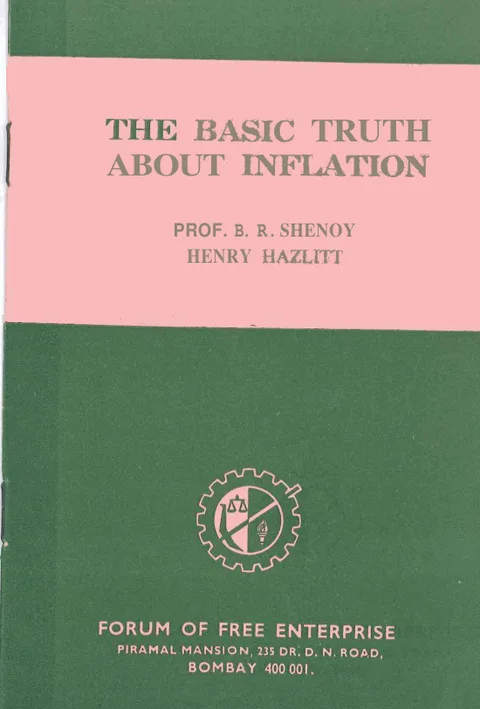
The Basic Truth About Inflation
By B. R. Shenoy
Forum of Free Enterprise, Piramal Mansion, 235 Dr. D. N. Road, Bombay 400 001. Published by M. R. PAI for the Forum of Free Enterprise, 'Piramal Mansion', 235 Dr. Dadabhai Naoroji Road, Bombay-1. and printed by B. D. Nadirshaw at Bombay Chronicle Press, Sayed Abdulla Brelvi Road. Fort. Bombay-1 · Bombay · 1977
11 pages
The Basic Truth About Inflation
Summary
This Forum of Free Enterprise pamphlet — published in Bombay on 14 April 1977 under the title ‘The Basic Truth About Inflation’ — pairs two essays to argue that inflation in any country is fundamentally a monetary phenomenon driven by government budget deficits, not an accidental price disturbance amenable to administrative controls. Part I, ‘Controlling Inflation in India’ by Prof. B. R. Shenoy, dismantles the Indira Gandhi government’s claim (echoed by the IMF, the World Bank, and J. R. D. Tata) that India had ‘reversed inflation’, tracing the post-1955 expansion of money supply and the temporary 1975–76 price decline to deficit-financed Reserve Bank credit and police-led hoarding raids rather than any genuine monetary discipline. Part II, ‘40-Year Inflation in U.S.A.’ by Henry Hazlitt (reproduced from The Freeman of October 1976), shows that American consumer prices have been driven by a 119 per cent increase in the M-2 money stock since 1967, with data tables stretching back to 1940 and 1933 — and warns that the cumulative monetary build-up is ‘a potential time bomb’. Read together, the two essays make a single classical-liberal case: governments cause inflation by spending beyond their revenues, and only honest fiscal and monetary discipline — not price controls, raids, or index-manipulation — can stop it.
Key points
-
The pamphlet pairs Prof. B. R. Shenoy’s Controlling Inflation in India with Henry Hazlitt’s 40-Year Inflation in U.S.A., reprinted from The Freeman of October 1976.
-
Shenoy rejects the Indira Gandhi government’s claim, endorsed by IMF chief Witteveen, World Bank president McNamara and J. R. D. Tata, that India had reversed inflation.
-
Shenoy shows India’s money supply grew 6.5 times between 1954-55 and 1975-76 while the General Prices Index rose 3.86 times, collapsing real wages to 40 paise of their earlier value by 1970-71.
-
Shenoy argues the 1974-76 price decline began in September 1974, before the Emergency, and was produced by police raids on stockists, credit restrictions and the unloading of 7.38 million tonnes of imported foodgrains.
-
Shenoy coins the term the Raisman trick to describe using an administratively engineered price dip to misrepresent underlying fiscal indiscipline as genuine monetary success.
-
Hazlitt argues American inflation is not a recent phenomenon but an unbroken decades-long trend, with the dollar’s purchasing power falling to about 24 cents of its 1940 value by 1976.
-
Hazlitt reports the M-2 money stock rose 119 per cent since 1967 while consumer prices rose 74 per cent, attributing the gap to M-2’s composition, productivity gains and lagging public expectations.
-
Hazlitt warns that subjective public expectations about inflation could shift suddenly, letting prices race ahead of the underlying money stock at any moment.
Essays
Controlling Inflation in India
By B. R. Shenoy
Shenoy opens by defining inflation as an expansion of money that drives up the General Prices Index, then attacks the Indian Union Ministry of Information’s January 1976 pamphlet ‘India’s war against Inflation’ and the Congress Party’s February 1977 election manifesto, both of which claimed that India had uniquely ‘reversed’ inflation. He traces the post-Independence pattern: budget deficits financed by Reserve Bank credit caused the money supply to multiply 6.5 times between 1954-55 and 1975-76, while the General Prices Index rose 3.86 times. Real wages collapsed — every rupee of 1954-55 wages was worth only 40 paise by the ‘garibi-hatao’ election year of 1970-71.
The heart of the essay reinterprets the 1974-76 price decline. Shenoy shows that prices had already turned downward in September 1974, nine months before the Emergency was declared, and that the subsequent fall was an ‘artificially produced phenomenon’ caused by police raids on stockists, MISA and DIR detentions of smugglers and tax-dodgers, drastic credit restrictions, and the unloading of 7.38 million tonnes of imported foodgrains. He argues the result was merely a temporary redistribution of stocks from private to government godowns, leaving the underlying monetary cause untouched — and indeed the upturn had resumed by January 1977. The essay closes by accusing the World Bank, the IMF, and the Indian Legislative Assembly of being ‘misled by the index numbers’ in what he calls ‘the Raisman trick’: mistaking an administratively engineered dip for genuine monetary control.
- Inflation is defined strictly as a monetary phenomenon — an expansion of money supply driving up the General Prices Index.
- Indira Gandhi’s government, the IMF chief Witteveen, World Bank president McNamara, and J. R. D. Tata had all endorsed India’s claim to have ‘reversed inflation’; Shenoy rejects this.
- Money supply grew 6.5 times from Rs. 1,955 crores (1954-55) to Rs. 12,632 crores (1975-76); prices multiplied 3.86 times since 1950.
- Real wages collapsed — a 1954-55 rupee was worth only 40 paise by 1970-71, the ‘garibi-hatao’ election year.
- The 1974-76 price fall began in September 1974, before the Emergency, and was caused by police raids, credit squeezes, and food imports — not by monetary discipline.
- Selective credit controls and stockist raids merely shifted stocks from private godowns to government ones, leaving underlying inflation intact.
- Shenoy coins ‘the Raisman trick’ to describe the political use of manipulated index numbers to misrepresent fiscal indiscipline as success.
40-Year Inflation in U.S.A.
By Henry Hazlitt
Hazlitt’s essay, reproduced from The Freeman of October 1976, opens by puncturing the popular American belief that inflation is a recent two- or three-year phenomenon. The price decline from 1933 to 1940 obscured what is in fact an unbroken upward march of consumer prices ever since: by 1976 the dollar’s purchasing power had fallen to roughly 24 cents of its 1940 level, and to 57.5 cents of its 1967 level. Hazlitt notes that since 1967 the M-2 money stock has risen 119 per cent while consumer prices have risen 74 per cent — a gap he attributes to three factors: M-2’s inclusion of less-liquid time deposits, productivity-raising capital investment that has expanded the supply of goods, and a subjective lag in which the public still treats inflation as accidental rather than continuous.
The warning at the close is blunt: subjective expectations can shift suddenly and dramatically, at which point prices will overtake the money supply. The essay ends with a polemical call against complacency, accompanied by Table A (M-2, CPI and dollar purchasing power, 1967-1976) and Table B (the same series, 1940-1976), the latter compiled by the American Institute for Economic Research at Great Barrington at Hazlitt’s request.
- American inflation is not a recent crisis but at least a nine-to-ten-year, arguably a 35-to-40-year, monetary trend.
- Since 1967, M-2 has risen 119 per cent while consumer prices have risen 74 per cent.
- The gap between money growth and price growth has three causes: M-2’s broader composition, productivity-driven supply increases, and subjective lag in public expectations.
- Table A and Table B (compiled by the American Institute for Economic Research) document the dollar’s purchasing-power collapse from 1940 (=100) to 24.1 by mid-1976.
- The decisive risk is that subjective opinion can shift suddenly, causing prices to race ahead of the money stock.
- The cumulative 35-to-40-year increase in the American money stock is ‘a potential time bomb’.
Generated by the v1.5 extraction pipeline. Awaiting editorial review.
Metadata and summary are AI-extracted from the source PDF and reviewed for editorial accuracy. The original work is available via the Read PDF tab above (where present); paragraph-level citation inside the PDF is deferred to a future engagement.