speech · memorial lecture
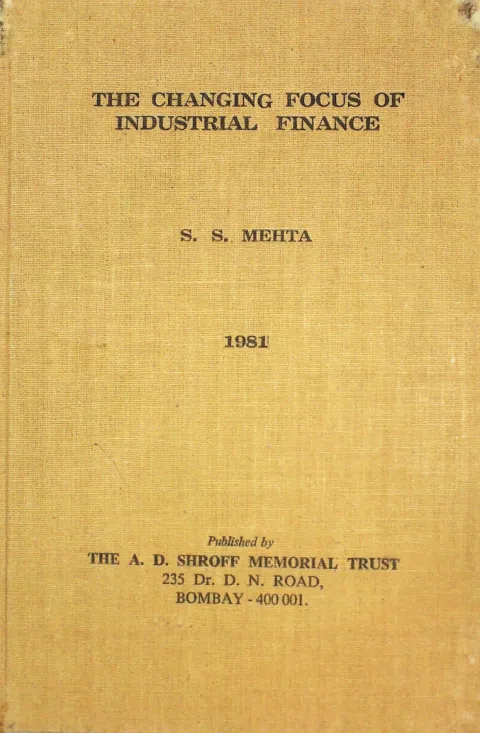
The Changing Focus of Industrial Finance
By S. P. Mehta
Published by THE A. D. SHROFF MEMORIAL TRUST, 235 Dr. D. N. Road, Bombay - 400 001. Published by M. R. Pai on behalf of The A. D. Shroff Memorial Trust, 235, Dr. Dadabhai Naoroji Road, Bombay 400 001, and Printed by B. D. Nadirshaw at The Bombay Chronicle Press, Horniman Circle, Bombay 400 001. · Bombay · 1981
33 pages
Part of A. D. Shroff Memorial Lecture
The Changing Focus of Industrial Finance
By S. S. MEHTA
Summary
Delivered as the A. D. Shroff Memorial Lecture in Bombay on 11 February 1981, Siddharth S. Mehta — then Chairman and Managing Director of ICICI — uses the occasion to chart how Indian industrial finance was reshaped between Independence and the early 1980s, and to question whether the institutional and regulatory architecture built up since 1951 still serves industry well. He traces the rise of all-India term-financing institutions (IFCI, ICICI, IDBI, UTI, LIC, GIC) together with State Finance Corporations, joint-sector Industrial Development Corporations and Technical Consultancy Organisations, arguing that the institutional framework has grown well beyond what was envisaged in the 1950s and now offers a near-complete package of financial services to industry.
The second half of the rendered pages turns to the strain showing through this edifice. Mehta notes that bank-branch expansion after nationalisation has slowed and that the scope for raising the domestic saving ratio is limited, even as foreign-exchange pressures from rising oil prices, dwindling official development assistance and growing protectionism point to a future in which resources must work harder. He insists that the principal economic challenge is to dovetail additional resource mobilisation with a marked improvement in the efficiency of utilisation.
From there, Mehta opens an explicitly reformist register. He criticises the way credit policy has been used as an allocative instrument, the way large industrial borrowers face hardships from credit screening, and the way ideological framings of public-sector enterprise have obscured questions of operational efficiency and financial return on investment. He argues that planning has been stretched too far, narrowing institutional and individual initiative, and that a regulatory bias has crept into instruments ostensibly designed to promote industrial growth — producing fragmentation, sickness and rising capital costs.
The final rendered pages take up the role of financial institutions themselves. Mehta observes that bank nationalisation in 1969 effectively institutionalised all sources of industrial finance, leaving users without meaningful alternatives, and laments that profitability has acquired “a derogatory status” even though it is the natural index of efficient resource use. He calls for a reappraisal of the framework so that financial institutions can balance their primary responsibility — efficient provision of industrial finance — with their growing social obligations.
Key points
-
Frames the lecture as a tribute to A. D. Shroff, the late founder of the Forum of Free Enterprise and a founding director of ICICI, whose economic philosophy centred on individual enterprise.
-
Charts the building of India’s term-financing architecture from 1948 onwards — IFCI (1948), State Finance Corporations (early 1950s), ICICI (1955), LIC (1956), UTI (1963), IDBI (1964) and GIC (1972) — and notes their combined annual sanctions rose at a compound 25% over 1970-71 to 1979-80.
-
Quantifies the post-nationalisation expansion of commercial banking: branches grew from 8,262 in June 1969 (5,154 rural/semi-urban) to 32,419 in June 1980 (23,179 rural/semi-urban), and deposits from Rs. 4,646 crores to Rs. 33,283 crores.
-
Warns that the easy gains from branch-led resource mobilisation are over and that foreign-exchange reserves, ODA inflows and the saving ratio all face medium-term pressure as oil prices rise and protectionism grows.
-
Identifies the central policy challenge as dovetailing additional resource mobilisation with sharply improved efficiency of utilisation across both physical/social infrastructure and industry.
-
Argues that planning, fiscal policy and credit policy have over-emphasised socio-political objectives and become unduly comprehensive and detailed, narrowing the scope for institutional and individual initiative.
-
Critiques the regulatory bias in industrial policy — reservations, licensing-induced fragmentation, restrictions and price/distribution controls — for producing industrial sickness, underutilised capacity and impaired recycling of institutional funds.
-
Argues that 1969 bank nationalisation institutionalised virtually all sources of industrial finance, leaving the corporate sector overdependent on a closed, government-controlled system in which profitability — the proper index of efficient resource use — has acquired a derogatory status.
Generated by the v1.5 extraction pipeline. Awaiting editorial review.
Metadata and summary are AI-extracted from the source PDF and reviewed for editorial accuracy. The original work is available via the Read PDF tab above (where present); paragraph-level citation inside the PDF is deferred to a future engagement.