speech
CHANGING SCENARIO OF INDUSTRIAL FINANCE & CAPITAL MARKET IN THE NEW MILLENNIUM
Published by M. R. Pai on behalf of The A. D. Shroff Memorial Trust, 235, Dr. Dadabhai Naoroji Road, Mumbai 400 001, and printed by India Printing Works, 42, G. D. Ambekar Marg, Wadala, Mumbai 400 031. · Mumbai · 2001
43 pages
Part of A. D. Shroff Memorial Lecture
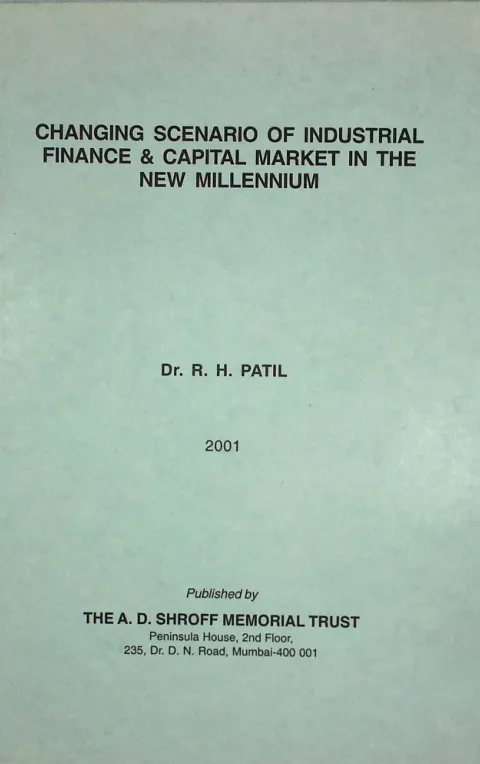
CHANGING SCENARIO OF INDUSTRIAL FINANCE & CAPITAL MARKET IN THE NEW MILLENNIUM
By Dr. R. H. PATIL
Summary
Delivered on 10 October 2000 as the A. D. Shroff Annual Public Lecture and published in 2001 by the A. D. Shroff Memorial Trust, Dr. R. H. Patil’s lecture traces how the liberalisation reforms launched in 1991 have transformed — and in many ways undone — the post-Independence apparatus of development financial institutions (DFIs) such as IDBI and ICICI. Patil, the founding Managing Director of the National Stock Exchange, presents the lecture as a tribute to Shroff’s faith in market mechanisms, arguing that the licensing-era policy frame ‘strangulated market forces’ and that the spectacular success of the NSE has reinforced his conviction that markets, not administered finance, are the most effective instrument for allocating capital efficiently.
The argumentative core is a defence of the capital market against what Patil calls a ‘discriminatory’ policy frame that systemically privileges banks and DFIs over equity and bond markets. He surveys the post-1991 squeeze on DFIs — loss of concessional resources, rising NPAs, the Khan Working Group’s recommendation to convert DFIs into universal banks — and questions whether converting them into ‘pure and simple vanilla versions of commercial banks’ is the right strategy. Drawing on US and East Asian comparisons, he argues that capital markets, by transferring risk directly to investors who choose to bear it, perform a more honest and more disciplining role than banks, which periodically transfer their bad loans to taxpayers through public-sector recapitalisations.
In the rendered pages Patil develops a sustained critique of public-sector banks, the ‘too big to fail’ syndrome, and the deposit-insurance regime that lets depositors ignore the risks taken by banks holding their money. He calls for risk-based deposit-insurance pricing, mandatory disclosure of portfolio quality, credit-rated marketable debt instead of cash-credit lending, and a vigorous secondary market in government bonds so retail investors — not just LIC and the provident funds — can hold sovereign paper. The chunk breaks off mid-discussion of a recently appointed committee on retail markets for government securities; the remaining 23 pages of the booklet (which the rendered set does not cover) presumably extend this prescription into further institutional recommendations.
Key points
-
The lecture is the 2000 A. D. Shroff Annual Lecture (delivered 10 October 2000, published 2001 by the A. D. Shroff Memorial Trust, sponsored by Bank of Baroda) and opens with Patil’s personal tribute to Shroff’s early advocacy of market economics.
-
Patil credits the National Stock Exchange — which he founded and built within six years — as proof that the market mechanism can act as ‘a powerful policy instrument to cleanse economic system and make it functionally more efficient.’
-
Post-1991 liberalisation has eroded the protected concessional funding base of DFIs (IDBI, ICICI, etc.), saddled them with high NPAs from past directed lending, and forced the Khan Working Group to recommend their conversion into universal banks; Patil questions whether becoming ‘vanilla versions of commercial banks’ is the right exit.
-
Diversification by ICICI into B2B, B2C, IT, venture capital, housing and car finance is held up as a model of capital-market-oriented reinvention rather than retreat into traditional commercial banking.
-
The capital market, Patil argues, places ultimate risk on the investor who chose to bear it, whereas banks systematically transfer their bad lending decisions to taxpayers via periodic public-sector recapitalisations — the ‘too big to fail’ problem is not unique to India.
-
Government and RBI are charged with sustaining a ‘discriminatory’ preferential treatment of banks over the capital market through implicit guarantees, blanket deposit insurance, captive SLR demand, and tax-disadvantaged government bonds for retail investors.
-
Policy prescriptions surveyed in these pages: risk-rated deposit-insurance premiums and disclosure, mandatory third-party portfolio rating for banks, a shift from cash-credit to credit-rated marketable debt, market-making in DFI bonds, and an active retail secondary market in government securities.
-
The booklet positions itself within the A. D. Shroff Memorial Trust’s mission of educating the public on banking, insurance and industrial finance — explicitly continuing a Forum-of-Free-Enterprise lineage of market-economics advocacy.
Generated by the v1.5 extraction pipeline. Awaiting editorial review.
Metadata and summary are AI-extracted from the source PDF and reviewed for editorial accuracy. The original work is available via the Read PDF tab above (where present); paragraph-level citation inside the PDF is deferred to a future engagement.