speech
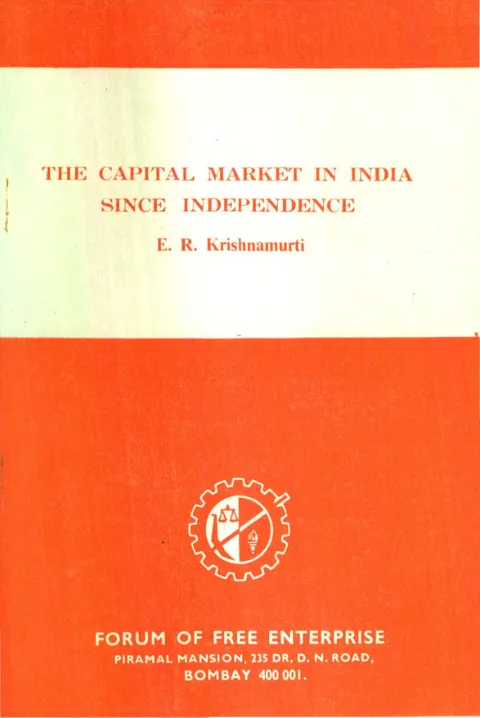
The Capital Market in India Since Independence
FORUM OF FREE ENTERPRISE, PIRAMAL MANSION, 235 DR. D. N. ROAD, BOMBAY 400 001. · Bombay · 1978
24 pages
The Capital Market in India Since Independence
By E. R. Krishnamurti
Summary
E. R. Krishnamurti, then Executive Director of the Madras Stock Exchange, delivers the 1978 A. D. Shroff Memorial Lecture as a stock-taking of India’s first three decades of planned development and a diagnosis of what has gone wrong with the capital market. He concedes that the Five Year Plans set a pattern of development and that, by the late 1970s, India had built genuine technical capability in industry and agriculture, modernised cultivation, and restored a comfortable external position. But he reads the same record as a story of planners who refused to take stock periodically, of plan targets that slipped because of poor implementation rather than overambition, and of an industrial policy that drifted from rational liberal foundations in the 1950s toward ideological hostility to the private sector from the late 1960s onward.
The core polemical argument is that price controls, the MRTP Act, the nationalisation of insurance and commercial banks, and a punitive tax regime have together starved private industry of credit, profitability and confidence, while diverting nearly 90 per cent of organised savings under government tutelage. Krishnamurti welcomes the Janata Government’s more liberal re-orientation, the Jha and Choksi committee proposals to rationalise indirect and direct taxation, and the proposal to allow a 12 per cent post-tax return on net worth in price fixation, but warns that the Finance Minister’s insistence on alternative revenue to match any tax cut is bewildering and counter to expert advice.
Turning to the capital market itself, he traces the post-Independence institutional architecture — IFCI (1948), the State Financial Corporations, ICICI (1955), IDBI and UTI (1964) — and concedes the development banks have channelled large sums to industry. But he argues that this institutionalisation, combined with nationalisation of LIC and the banks and persistent credit squeezes against joint-stock companies, has sapped the equity market, blunted the retail investor and made every worthwhile issue dependent on underwriting. He calls for at least 60 per cent of public-sector capital to be offered to Indian investors, urges a radical taxation overhaul to release household savings (over 70 per cent of total domestic savings) into productive investment, and projects that to support 10–12 per cent industrial growth the capital market must mobilise Rs. 300–500 crores of fresh capital annually in the 1980s.
Key points
-
Frames the lecture as a 31-year review of planned development since Independence, crediting the plans with setting a pattern of growth but faulting their implementation, ideological drift and ad-hoc revisions (‘A five year plan took eight years to complete’).
-
Argues that from the late 1960s the State turned weighted against the private sector through nationalisation of insurance (1955), banks (1969) and general insurance (1971), the MRTP Act, statutory price controls and punitive direct and indirect taxes.
-
Quantifies the fiscal burden: direct taxes up 13x and indirect taxes 28x between 1948-49 and 1977-78, with roughly Rs. 30,000 crores of cumulative additional taxation since Independence, blunting the growth rate.
-
Welcomes the Janata Government’s liberal re-orientation, the Jha Committee on indirect tax and the Choksi Committee on direct tax (recommending a 50 per cent ceiling on marginal income tax) as a ‘happy departure’ from past ad hoc policy.
-
Traces the post-Independence institutional architecture of finance — IFCI (1948), State Financial Corporations, ICICI (1955), IDBI and UTI (1964) — and notes that nearly 90 per cent of organised investment savings now sits under government tutelage.
-
Diagnoses the capital market itself as sapped: equity has become unattractive, fresh capital raised by joint-stock companies has fallen to about Rs. 100 crores annually, and every worthwhile issue ‘had to be fully underwritten to ensure the success of the issue’.
-
Recommends that the government offer 60 per cent of public-sector capital — equity and other securities — to the Indian investing public, similar to the foreign-company FERA dilution model, to revive retail participation.
-
Projects that to attain 10–12 per cent industrial growth in the 1980s, the capital market must mobilise Rs. 300 to Rs. 500 crores of fresh investment annually, conditional on a radical change in the government’s tax and regulatory outlook.
Generated by the v1.5 extraction pipeline. Awaiting editorial review.
Metadata and summary are AI-extracted from the source PDF and reviewed for editorial accuracy. The original work is available via the Read PDF tab above (where present); paragraph-level citation inside the PDF is deferred to a future engagement.