essay
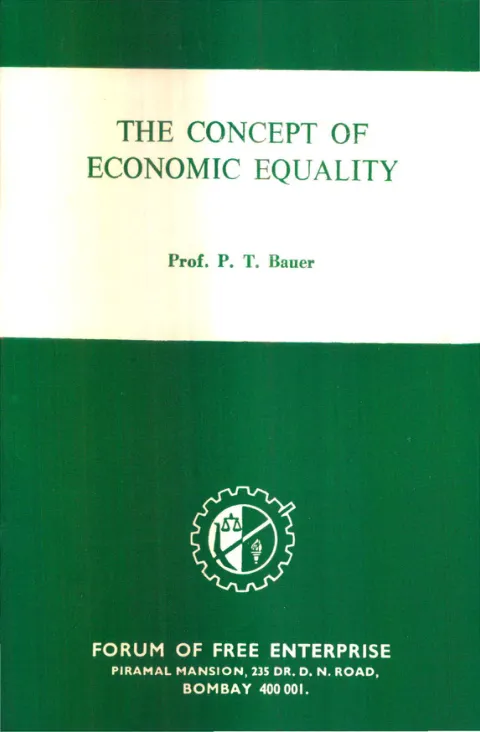
The Concept of Economic Equality
Published by M. R. PAI for the Forum of Free Enterprise, 235 Dr. Dadabhai Naoroji Road, Bombay-400 001, and Printed by S. V. Limaye at India Printing Works, 9 Nagindas Master Road Ext. 1, Fort, Bombay 400 023. · Bombay · 1981
20 pages
The Concept of Economic Equality
By Prof. P. T. Bauer
Summary
P. T. Bauer’s booklet, published by the Forum of Free Enterprise in Bombay in September 1981 as excerpts from his paper “The Grail of Equality”, mounts a sustained classical-liberal critique of the egalitarian project. Bauer argues that the economic differences observed in open societies arise primarily from differences in aptitude, motivation, foresight, and the readiness to seize opportunities — not from exploitation or appropriation. Because such differences are produced rather than confiscated, the language of “inequality” prejudges the moral question; “difference” is the more accurate and neutral term. Any political programme that sets out to remove these differences must rely on extensive coercion, and so trades the promise of greater equality of income for a far more pronounced inequality of power between rulers and subjects.
Bauer then turns the standard rhetoric of redistribution against itself. The supposed beneficiaries of the welfare state are not, in his account, primarily the poor: substantial direct and indirect taxes fall on workers in Britain and elsewhere, while the major beneficiaries are the politicians, civil servants, and administrators who run the apparatus and entrench it. State spending on welfare promotes the inflation that erodes the small saver’s ability to provide for himself, which in turn breeds further demand for state provision. He marshals international evidence — Soviet income differentials, the spread of social services in Communist countries — to argue that mass coercion has not produced economic equality even where it has been pursued for half a century.
A distinct middle section, headed “Equality of Opportunity”, attacks the Fabian assumption (associated with Tawney) that equal opportunity will naturally yield equal results. Bauer insists that aptitudes and motivations differ, that loving parents and cultivated backgrounds advantage some children, and that policies aimed at equalising results require ever-greater control of social and personal life. Politicising economic life raises the stakes of who holds power, intensifies ethnic and group conflict in multiracial societies, and — in the Third World — makes the conduct of the rulers “a matter of life and death for millions”.
The booklet closes by separating two ideas often elided in public debate: relief of poverty and reduction of inequality. Egalitarian policies, by focusing on relative position, divert attention from the causes of real hardship. “To make the rich poorer”, Bauer writes, “does not make the poor richer.” The pursuit of economic equality is, on his account, more likely to harm than help the very poor — by politicising life, restricting capital accumulation, obstructing social and economic mobility, and inhibiting enterprise in every direction.
Key points
-
Economic differences in open societies arise from differing aptitudes, motivations, foresight, and readiness to perceive opportunities — not from exploitation of others.
-
“Difference” is the neutral and more accurate term for variation in income; “inequality” smuggles in a moral verdict by treating any divergence as injustice.
-
Pursuing economic equality requires coercion that produces a far greater inequality of power between rulers and subjects than the income differences it claims to remove.
-
Major beneficiaries of redistribution are not the poor but the politicians, civil servants, advocates, and administrators who run the system and perpetuate it.
-
Welfare-state taxation falls heavily on the poor themselves; the welfare state redistributes responsibility between state and citizen as much as it redistributes income between rich and poor.
-
Soviet-bloc evidence after half a century of mass coercion shows income differences as wide as in market-oriented societies, undermining the empirical case for the egalitarian project.
-
Equality of opportunity does not yield equality of result, because loving parents, cultivated backgrounds, good looks and aptitude produce unequal opportunities even before any policy is applied.
-
Reduction of poverty and reduction of inequality are distinct, often conflicting goals: “to make the rich poorer does not make the poor richer”.
Generated by the v1.5 extraction pipeline. Awaiting editorial review.
Metadata and summary are AI-extracted from the source PDF and reviewed for editorial accuracy. The original work is available via the Read PDF tab above (where present); paragraph-level citation inside the PDF is deferred to a future engagement.