pamphlet
THE CURRENT PRICE SITUATION
By Abhay Pethe
FORUM OF FREE ENTERPRISE, PIRAMAL MANSION, 235, DR. D.N. ROAD, MUMBAI 400 001. · Mumbai · 1998
28 pages
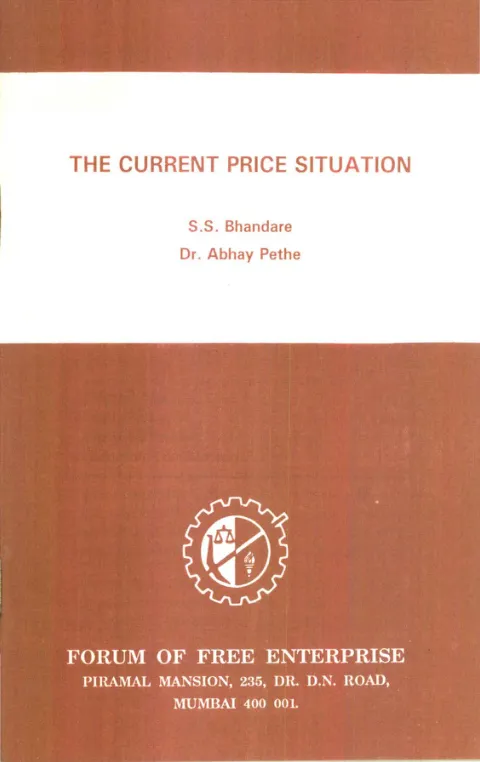
THE CURRENT PRICE SITUATION
By S.S. Bhandare, Dr. Abhay Pethe
Summary
This Forum of Free Enterprise pamphlet collects two talks delivered at a Mumbai public meeting on 18 August 1998, in the immediate aftermath of an inflationary scare that saw the Wholesale Price Index touch 8.78% year-on-year. The first essay, by Tata Services economic advisor S.S. Bhandare, reads the spike as a primarily supply-side phenomenon — poor monsoon, traders exploiting shortages of potatoes, onions and oilseeds — compounded by a persistent fiscal deficit and an accelerating procurement-price ratchet, and prescribes a fresh wave of green revolution, fiscal consolidation that protects capital spending, and better governance. The second essay, by Mumbai University economist Dr. Abhay Pethe, steps back from current-events diagnosis to ask what a price structure actually is — comparing it to blood pressure in the body — and to argue that the dynamics of expectations (vividly on display in the contagion of the Asian currency crisis) are central to understanding inflation.
Key points
-
The pamphlet collects two talks delivered at a Mumbai public meeting on 18 August 1998, shortly after the Wholesale Price Index touched 8.78 per cent year-on-year, the highest reading since November 1995.
-
Tata Services economic advisor S. S. Bhandare traces the spike chiefly to a supply-side shock, with potato prices up 378.6 per cent and onion prices up 82.4 per cent after a 3.7 per cent fall in 1997-98 agricultural output.
-
Bhandare also points to a widening inflationary gap, with M3 money-supply growth of 17.6 per cent far outpacing real GDP growth of 5.1 per cent and a fiscal deficit reaching 6.1 per cent of GDP against a 4.5 per cent target.
-
He identifies a ‘ratchet effect’ in which minimum support prices for paddy, wheat, sugarcane, cotton and jute rose 10-12 per cent annually through the 1990s, against 5-7 per cent in the 1980s.
-
Bhandare recommends a fresh green revolution to raise crop productivity 30-50 per cent within five to seven years, alongside fiscal consolidation that protects capital expenditure.
-
Mumbai University economist Dr. Abhay Pethe instead asks what a price structure is, comparing it to blood pressure in the body — necessary, but alarming once fluctuations cross a threshold.
-
Pethe argues that a relative price structure operating under unhindered market forces produces ‘optimal or efficient’ resource allocation, making ‘getting the prices right’ central to reform.
-
He stresses that agents act on what they believe to be true rather than on truth itself, attributing much of the Asian currency crisis’s contagion to such mistaken expectations.
-
Pethe notes that measuring inflation is inherently arbitrary, since the choice of index — CPI, WPI or GDP deflator — and of base year depends on the purpose for which it is built.
Essays
Resurgence of Inflation
By S.S. Bhandare
Bhandare opens by noting the paradox of an Indian economy ‘beseiged with rising inflation in the midst of industrial slowdown or sectoral recession.’ He traces the resurgence to four channels: a 3.7% decline in 1997-98 agricultural production combined with traders exploiting shortages of fruits, vegetables and oilseeds; a widening inflationary gap as M3 growth (17.6%) outstrips real GDP growth (5.1%); persistent fiscal slippage with the fiscal-deficit-to-GDP ratio reaching 6.1% against a 4.5% target and financed largely by net bank credit to the government; and the ‘ratchet effect’ of accelerating minimum-support-price fixation, which crossed annual increases of 10-12% in the 1990s versus 5-7% in the 1980s for paddy, wheat, sugarcane, cotton and jute.
He argues India ‘cannot and should not emulate global standards of inflation’ à la the Maastricht Treaty, that tightening monetary and credit policy at this juncture would engender ‘stagflation’, and that an average long-term inflation rate of 7-8% is an ‘inevitable occurrence’ given the country’s growth imperatives and the unfinished agenda of phasing out administered pricing, procurement and cross-subsidisation. His prescriptions urge a fresh wave of green revolution to raise crop productivity by 30-50% over five to seven years, fiscal consolidation that the new Finance Commission should drive in dialogue with Centre and States without sacrificing capital expenditure, raising the domestic savings ratio above 25-26% of GDP to finance lumpy infrastructure needs, and improving the ‘quality and effectiveness of political governance and administration.’
- WPI inflation touched 8.78% y-o-y by late August 1998 — the highest since November 1995 — with CPI for industrial workers crossing the 12.4% double-digit mark over the year ended June 1998.
- The principal driver is a supply-side shock in primary articles (potatoes up 378.6%, onions 82.4%, oranges 72.8%) following a 3.7% decline in 1997-98 agricultural production, aggravated by trader and speculator exploitation of shortages.
- A persistent inflationary gap is widening: M3 growth of 17.6% against real GDP growth of 5.1%, with the fiscal-deficit-to-GDP ratio at 6.1% versus the 4.5% target and net bank credit to government exceeding the entire incremental M3.
- Minimum support prices for paddy, wheat, sugarcane, cotton and jute rose 10-12% annually in the 1990s (versus 5-7% in the 1980s), creating a ‘ratchet effect’ that sets new benchmarks for open-market prices.
- Policy prescriptions: a fresh green revolution lifting crop productivity 30-50% within 5-7 years; fiscal consolidation centred on phasing out revenue deficits in 3-5 years without cutting capital expenditure; raising the domestic savings ratio above 25-26% of GDP; better political governance.
Understanding the phenomenon and its implications
By Dr. Abhay Pethe
In the rendered opening of his talk, Pethe steps back from current-events analysis to ask what a price structure actually is and what functions it performs. He defines the price structure as the configuration of all prevailing prices of consumables and assets, comparing its role in the economy to that of blood pressure in the body — necessary in a positive way, alarming only when fluctuations cross a threshold. He distinguishes two analytic dimensions: the relative structure of prices, which under unhindered market operation produces ‘optimal or efficient’ resource allocation and which administered intervention distorts (making ‘getting the prices right’ the heart of reform), and the nature and rapidity of change, which is shaped by elasticities and by agents’ past experience.
This second dimension leads him to a central methodological point: expectations are ‘tremendously important in the decision making process of the agents,’ since agents ‘take decisions on the basis not of truth but on the basis of what they believe to be true,’ and a large share of the contagion of the ongoing Asian currency crisis can be attributed to ‘wrong’ expectations. He notes that economists have only recently woken up to the importance of endogenising expectations (citing Adaptive, Rational and Culture-constrained variants) and that modelling them remains an open problem. The rendered chunk ends as Pethe pivots to the technical question of how inflation is measured — observing that the choice of index (CPI, WPI, GDP deflator) and of base year is ‘a tricky process and inherently a bit arbitrary,’ contingent on the purpose for which the index is being constructed.
- Price structure is the configuration of all prevailing prices and functions like blood pressure — essential, but symptomatic of deeper malady when it fluctuates beyond a point.
- The relative price structure guides resource allocation; if market forces operate unhindered the result is ‘optimal or efficient’, whereas administered intervention introduces distortion — hence the reformist priority of ‘getting the prices right’.
- The dynamic dimension — rapidity of price change, agents’ past experience, underlying elasticities — is at least as important as the static relative structure.
- Expectations are central to inflation; agents act on what they believe to be true, and ‘wrong’ expectations underwrote much of the contagion of the Asian currency crisis.
- Inflation measurement is inherently arbitrary in its choices of basket, weightage, base year and index (CPI, WPI, GDP deflator), and those choices depend on the purpose of the index.
Generated by the v1.5 extraction pipeline. Awaiting editorial review.
Metadata and summary are AI-extracted from the source PDF and reviewed for editorial accuracy. The original work is available via the Read PDF tab above (where present); paragraph-level citation inside the PDF is deferred to a future engagement.