speech
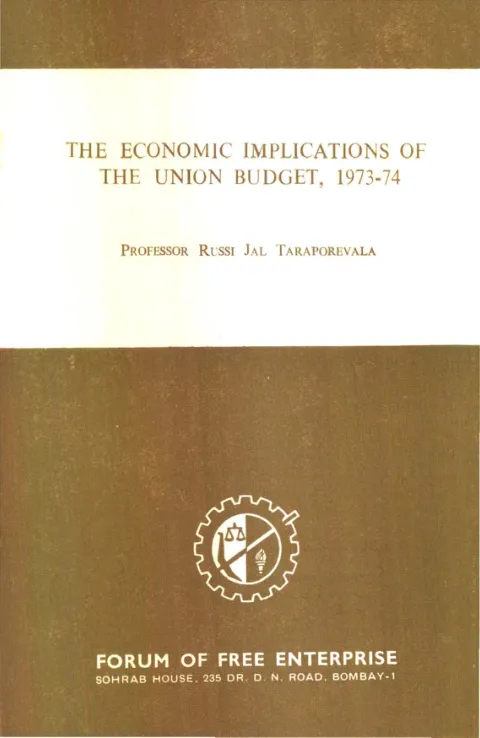
The Economic Implications of the Union Budget, 1973-74
FORUM OF FREE ENTERPRISE, SOHRAB HOUSE, 235 DR. D. N. ROAD, BOMBAY-1 · Bombay · 1973
24 pages
The Economic Implications of the Union Budget, 1973-74
By Professor Russi Jal Taraporevala
Summary
Professor Russi Jal Taraporevala’s lecture, delivered under the auspices of the Forum of Free Enterprise in Bombay on 2nd March 1973, dissects the Union Budget for 1973-74 against the backdrop of a year of severe stress in the Indian economy. He opens by surveying the macroeconomic landscape — unprecedented kharif-season drought in 1972, a national-income growth rate that had collapsed from 7.3% in 1969-70 to barely 1.5-2% in 1971-72 and 1972-73, stagnant pulse production, slumping oilseeds, and the Economic Survey’s own admission that growth had been ‘unsatisfactory.’ Industrial production, though it rebounded to roughly 7.3% in early 1972, was clouded by power cuts, retarded by the Monopolies and Restrictive Trade Practices Act, and squeezed by a banking system — now state-owned — that was diverting credit from the private sector to the Government.
The central preoccupation of the lecture is what Taraporevala calls ‘galloping inflation.’ He marshals price-index data — a 13.7% jump in the wholesale price index in the twelve months to December 1972, food articles up 19.5%, edible oils 26.3%, sugar 38.5% — to argue that supply-side shortages, not demand alone, are the engine of the price spiral, and that Government price, distribution and credit controls have manifestly failed to arrest it. Unemployment, he stresses, has assumed ‘draconian proportions’: educated unemployed registrants alone rose from 20.53 lakhs to 26.12 lakhs in twelve months.
Against this diagnosis, Taraporevala measures the Finance Minister’s budgetary response and finds it wanting. He notes that the headline deficit of Rs. 85 crores is ‘deceptively small’ once the Third Pay Commission and likely expenditure overruns are accounted for, projecting a true gap of Rs. 300-500 crores. He observes that the Rs. 292 crores of new taxes lean overwhelmingly on indirect levies — auxiliary import duties, higher excise on tobacco, motor spirit, rayon, iron and steel — confirming, in his view, that ‘the limits for direct taxation, even in our socialistic economy, appears to have been reached.’ On direct taxation he flags the partial integration of agricultural income, the partial plugging of the Hindu Undivided Family loophole on the Wanchoo Committee’s recommendation, and — most critically — the extension of the long-term capital-gains holding period from 24 to 60 months, which he argues will throttle stock-market liquidity, sharpen price volatility, and ‘reduce dramatically the liquidity of assessees in respect of their investments.’
In the rendered pages he concludes the corporate-tax section by welcoming the proposed backward-area incentives — a 20% profit deduction for ten years plus a 15% Central subsidy — but warns that ‘nothing major has been attempted in the Finance Bill’ on corporate taxes and that the budget’s stated goal of curbing inflationary pressures ‘will not be achieved.‘
Key points
-
The 1972 monsoon failure caused an estimated 8-million-ton loss in kharif food-grain output and pulled national income growth down to 1.5-2% in 1971-72 and 1972-73.
-
Inflation is the dominant concern: the wholesale price index jumped 13.7% in the year to December 1972, with food articles up 19.5%, edible oils up 26.3%, and sugar up 38.5%.
-
The Monopolies and Restrictive Trade Practices Act and the exclusion of large industrial groups and foreign companies from licensing liberalisation are flagged as retardants on industrial growth.
-
Money supply rose 12.3% in 1972-73 against falling real output, and net bank credit to Government rose by Rs. 747-980 crores while private-sector credit was squeezed.
-
Unemployment registrations rose from 44.95 to 56.88 lakhs in twelve months; educated unemployed from 20.53 to 26.12 lakhs.
-
The headline 1973-74 deficit of Rs. 85 crores is judged ‘deceptively small’; the true deficit is projected at Rs. 300-500 crores once the Third Pay Commission and overruns are counted.
-
New taxation of Rs. 292 crores is overwhelmingly indirect — auxiliary import duties on most goods, higher excise on tobacco, motor spirit, iron and steel — signalling that direct-tax limits have been reached.
-
Extending the long-term capital-gains holding period from 24 to 60 months is criticised as a step in the wrong direction that will damage stock-market liquidity and amplify price volatility.
-
The partial integration of agricultural income with non-agricultural income for rate-fixing purposes, and the partial plugging of the Hindu Undivided Family loophole, are welcomed as ‘a step in the right direction’.
-
Backward-area concessions (20% profit deduction over ten years plus 15% Central subsidy) are ‘heartily welcomed’, though their implementation is left for later finalisation.
Generated by the v1.5 extraction pipeline. Awaiting editorial review.
Metadata and summary are AI-extracted from the source PDF and reviewed for editorial accuracy. The original work is available via the Read PDF tab above (where present); paragraph-level citation inside the PDF is deferred to a future engagement.