speech
THE ECONOMIC IMPLICATIONS OF UNION BUDGET 1978-79
FORUM OF FREE ENTERPRISE, PIRAMAL MANSION, 235 DR. D. N. ROAD, BOMBAY 400 001. · Bombay · 1978
22 pages
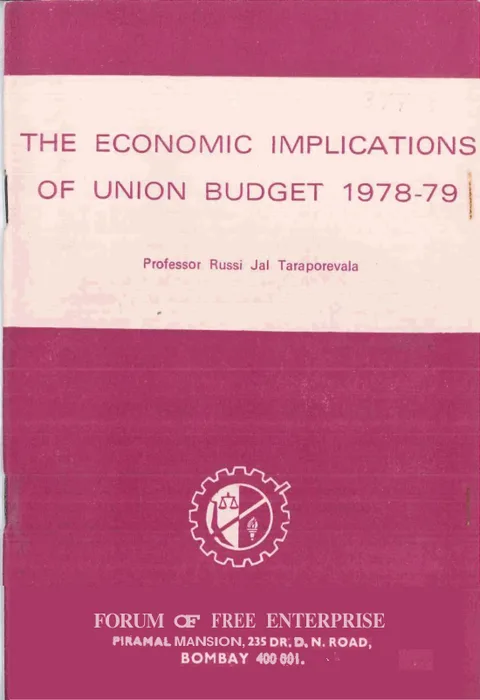
THE ECONOMIC IMPLICATIONS OF UNION BUDGET 1978-79
By Professor Russi Jal Taraporevala
Summary
Professor Russi Jal Taraporevala’s lecture, delivered under the auspices of the Forum of Free Enterprise in Bombay on 3rd March 1978 and published soon after, offers a sustained, sector-by-sector reading of the first Union Budget presented by the Janata Government — Finance Minister H. M. Patel’s Budget for 1978-79. Taraporevala situates the Budget against an unusually favourable macroeconomic backdrop: gross national product had resumed real growth of about 5 per cent, the 1977-78 kharif had pushed foodgrain stocks to record buffer levels, and foreign-exchange reserves had reached roughly Rs. 5,000 crores — the highest in three decades. Against that setting he asks whether the Budget seizes the once-in-a-generation opportunity to convert easy money, ample food and ample forex into a new pattern of growth and development.
His verdict is mixed. He commends the price stability achieved in 1977-78 as a real administrative success, welcomes the Plan tilt toward agriculture, irrigation, rural development and decentralisation, and praises specific moves — the abolition of the interest tax, the proposed sale of Government gold stocks, the new Rupee-finance facility through term-lending institutions for the import of approved projects, and the cut in customs duty on polyester filament yarn. He repeatedly returns, however, to two underlying anxieties: the administrative machinery’s failure to absorb foreign exchange reserves for productive investment, and the Finance Minister’s continued reliance on indirect taxation (Rs. 499 of Rs. 549.5 crores of new mobilisation comes from excise and customs) which spreads the burden across nearly every conceivable item even after small-scale and agricultural concessions.
The pamphlet then works through the direct-tax proposals in detail. Taraporevala flags the sharp rise in compulsory deposit rates (lifting the marginal personal rate plus deposit to 84 per cent), the curtailment of the Section 54E long-term capital-gains exemption, and especially the draconian and arbitrary disallowance of advertising, publicity and sales-promotion expenditure as measures he believes will choke employment in the advertising and publishing sectors and produce endless litigation. He likewise warns that the withdrawal of the export-market development weighted deduction, while symbolically aligned with drawing down forex reserves, risks discouraging exports in the long run. The lecture closes by arguing that the Budget is genuinely innovative in spirit — the Finance Minister has the unusual luxury of buffer stocks, comfortable reserves and pragmatic instincts — but that the key to Indian growth lies in actually deploying foreign-exchange reserves and in liberating, not further constraining, private enterprise.
Key points
-
Frames the 1978-79 Budget as H. M. Patel’s first full Janata Government Budget, delivered at an unusually favourable macro moment: 5 per cent GNP growth, record foodgrain stocks and forex reserves near Rs. 5,000 crores.
-
Reads the Economic Survey alongside the Budget: agriculture and price stability are the bright spots; industry (2.3 per cent growth) and employment (over 10.78 million on the live register) are the dismal features.
-
Argues that the true policy question is how to deploy historically large foreign-exchange reserves for productive investment — and that the ‘administrative machinery’ has so far failed to do so.
-
Welcomes Plan re-prioritisation toward agriculture, irrigation, rural electrification, dairy (Operation Flood II) and decentralisation, but says outlays on power, family planning and infrastructure remain inadequate.
-
Records new resource mobilisation of Rs. 549.5 crores — Rs. 499 crores from excise/customs, only Rs. 25.5 crores from direct tax changes and Rs. 25 crores from the Compulsory Deposit Scheme — and treats this dependence on indirect taxation as ‘truly a gigantic impost’ spread across almost all excisable items.
-
Praises concrete liberal measures: abolition of the 7 per cent interest tax on bank lending, sale of Government gold stocks as an anti-inflationary instrument, the new Rupee-finance facility for import of approved projects, and customs reduction on polyester filament yarn.
-
Sharply criticises the disallowance of advertising, publicity and sales-promotion expenditure above small slabs as ‘draconian and completely arbitrary’, warning of mass unemployment in advertising and small newspapers.
-
Concludes that the Budget is ‘innovative’ in approach but that its success ultimately depends on whether the Finance Minister can mobilise foreign-exchange reserves and break free of inherited administrative attitudes.
Generated by the v1.5 extraction pipeline. Awaiting editorial review.
Metadata and summary are AI-extracted from the source PDF and reviewed for editorial accuracy. The original work is available via the Read PDF tab above (where present); paragraph-level citation inside the PDF is deferred to a future engagement.