speech
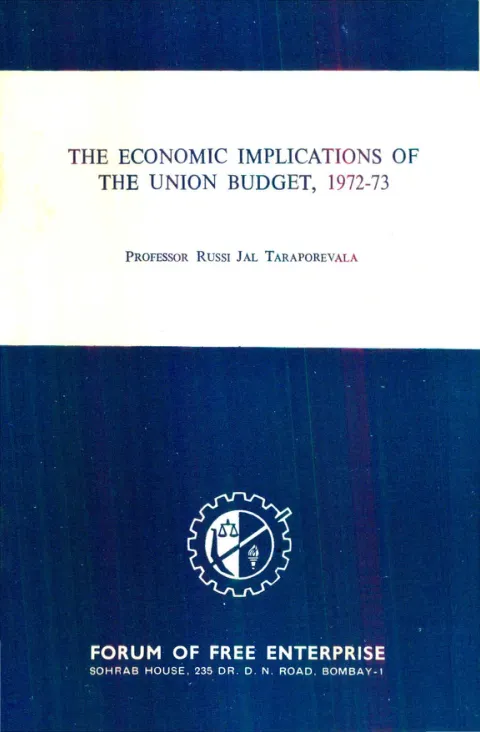
THE ECONOMIC IMPLICATIONS OF THE UNION BUDGET, 1972-73
Published by M. R. PAI for the Forum of Free Enterprise, "Sohrab House", 235 Dr. Dadabhai Naoroji Road, Bombay-1, and printed by P. H. Raman at Associated Advertisers & Printers, Bombay-34. 15/May/1972. · Bombay · 1972
18 pages
THE ECONOMIC IMPLICATIONS OF THE UNION BUDGET, 1972-73
By Professor Russi Jal Taraporevala
Summary
Professor Russi Jal Taraporevala’s pamphlet, drawn from a public lecture delivered under the auspices of the Forum of Free Enterprise in Bombay on 24th March 1972, dissects the Union Budget for 1972-73 against the unusually punishing backdrop of the preceding year. He opens by cataloguing the abnormal shocks of 1971-72: an unprecedented influx of more than ten million refugees from the territory then becoming Bangla Desh, drought in Maharashtra and Andhra Pradesh, cyclone in Orissa and floods in Uttar Pradesh, Bihar and West Bengal, the Indo-Pakistan war that put the economy on a war footing, and the sudden suspension of U.S. aid. That the Indian economy still made roughly 4 per cent growth, he argues, testifies to the underlying soundness of its structure.
The heart of the booklet is a sector-by-sector audit. Agriculture is the bright spot, with foodgrain output reaching 107 million tons in 1970-71. Industry, by contrast, is stagnant — growth has fallen from around 9 per cent in 1961-65 to an estimated 3 to 3.5 per cent — and Taraporevala, citing the Economic Survey, locates the cause in a “general dearth of savings” and an all-time low in corporate savings rather than in licensing or procedure. He tracks the squeeze on private credit (bank credit to the commercial sector actually contracted by Rs. 215 crores in 1971-72 while credit to Government surged by Rs. 764 crores), the comfortable foreign exchange reserves, the moderate 3.9 per cent price rise in calendar 1971, and the grim employment picture in which both public and private sector job growth had stalled.
Turning to the budget itself, Taraporevala notes that three budgets in 1971 had already loaded the economy with about Rs. 500 crores of new taxes, so the current budget’s additional Rs. 183 crores is presented as a moderate tax effort coupled with a strategy of growth through a 27 per cent jump in central plan outlays to Rs. 2,307 crores. He works through the indirect taxes — customs revisions, excise hikes on tobacco, art silk, synthetic fibre yarn, steel, kerosene, fertilisers and power-driven pumps, plus an excise “rationalisation” yielding Rs. 10.70 crores — and the minor direct tax tinkering with lotteries, capital gains on jewellery, charity trusts and the Unit Trust Scheme. He flags the withdrawal of the 5 per cent tax concession on priority industries as a wrong-headed move.
The conclusion is sharply critical: while the budget’s growth-through-plan-outlay strategy could start a new development cycle, the Finance Minister’s hint at clubbing husband-wife-minor-children incomes, harsher Hindu Undivided Family taxation and rejection of the Wanchoo Committee’s recommended rate cuts portends a “death blow” to that very growth strategy. Taraporevala’s running motif is that taxation is eroding private savings by transferring them into the public exchequer, and that without restoring savings industrial revival will remain out of reach.
Key points
-
Frames 1971-72 as a year of abnormal shocks — Bangla Desh refugee influx of over ten million, multi-state natural calamities, the Indo-Pakistan war, and the suspension of U.S. aid — yet credits the economy with roughly 4 per cent growth.
-
Argues agriculture was the most promising sector (foodgrain output of 107 million tons in 1970-71) while industrial production growth collapsed to an estimated 3 to 3.5 per cent.
-
Identifies the central problem of industrial stagnation, citing the Government’s own Economic Survey, as a ‘general dearth of savings’ rather than procedural or policy obstacles, with corporate savings at an all-time low.
-
Documents a sharp monetary squeeze on the private sector: net bank credit to commercial sector contracted by Rs. 215 crores in 1971-72 while credit to Government rose by Rs. 764 crores.
-
Reads the 1972-73 budget as ‘modest’ on tax effort (Rs. 183 crores additional taxation) but ambitious on plan outlays — a 27 per cent jump in central plan outlays to Rs. 2,307 crores intended to spur growth.
-
Walks through the indirect tax package — customs hikes (Rs. 8.60 crores), excise on tobacco, art silk, synthetic fibre yarn, steel, kerosene, fertilisers and power-driven pumps, plus a ‘rationalisation’ regrouping of excise slabs.
-
Criticises the abolition of the 5 per cent corporate tax concession on the priority industries list, urging instead that the Finance Minister frame a new priority list including small-scale and infant industries.
-
Warns that proposed end-of-year measures — clubbing of husband, wife and minor children’s incomes, harsher Hindu Undivided Family taxation, and rejection of the Wanchoo Committee’s rate-cut recommendations — would deal a ‘death blow’ to the growth strategy of the budget.
Generated by the v1.5 extraction pipeline. Awaiting editorial review.
Metadata and summary are AI-extracted from the source PDF and reviewed for editorial accuracy. The original work is available via the Read PDF tab above (where present); paragraph-level citation inside the PDF is deferred to a future engagement.